

Lucid Air Named Best Car Design for 2020 in the Good Design Awards
The Lucid Air has been named Best Car Design for 2020 in the Good Design Awards. One of the world’s most prestigeous design prizes, The Good Design Awards have been an annual fixture since 1950, and are hosted by The Chicago Athenaeum Museum of Architecture and Design.
The Lucid Air was awarded a Good Design Award for 2020 by The Chicago Athenaeum.
Images: Lucid Motors
The Lucid Air has been named Best Car Design for 2020 in the Good Design Awards. One of the world’s most prestigeous design prizes, The Good Design Awards have been an annual fixture since 1950, and are hosted by The Chicago Athenaeum Museum of Architecture and Design.
Christian Narkiewicz-Laine, architecture critic and chief curator of The Chicago Athenaeum’s Good Design® awards said: “In a word: Bold. The new battery-electric Lucid Air is an aesthetic shotgun approach to vehicle design that will clearly transform, if not revolutionize the transportation industry in the future,”
“Designed for Lucid Motors by former Audi-Volkswagen designer Derick Jenkins, the new luxury sedan is sleek and elegant, sculpted like a streamlined aircraft, while its futuristic details exit in a very clean and orderly approach, something more relatable, clearly future-focused, but still enduringly smart and sophisticated.”
“What’s more, the new electric car, unofficially dubbed ‘Tesla killer,’ is also giving Tesla a run for the money in terms of pricing, technology, and performance.”
“The California-based startup Lucid Motors is a game-changing electric vehicle in the near future, standing out from the fold with proven performance and a new vision developed by industry veterans, skilled designers and, crucially, all the financing in the world,” Narkiewicz-Laine continues.
“Jenkin’s amazing muscular design for Lucid Air is a stunning break-through vehicle from the otherwise dull, monotonous American car industry as we know it.”
While there is no doubt the Lucid Air nails its design brief, I would rather wait until the vehicle has had a successful market introduction and is in the hands of journalists and customers before dubbing it a ‘Tesla killer’ or ‘game-changer’. Many manufacturers, from established automakers like Nissan and Mercedes-Benz, to fresh startups such as Fisker and Rivan have exciting EV concepts in development.
Their financial success and ability to compete with Tesla depends on how quickly — and profitably — they can scale their EV manufacturing. A task that has taken Tesla many years to perfect.
You can read more about the Lucid Air’s Good Design Award below:
Source: The Chicago Athenaeum Museum of Architecture and Design

NIO's First Autonomous Driving Sedan to be Unveiled on NIO Day
Chinese automaker NIO is set to unveil the company’s first autonomous driving sedan at an event on January 9, 2021. NIO claims the vehicle will premiere the latest autonomous driving technologies and a 150 kWh battery pack, which would be the largest fitted to a production passenger vehicle. We can expect NIO has Tesla’s Long Range Model S in its sights with this battery, and will be aiming to exceed the 647km (402 mi) range of the Model S.

Chinese automaker NIO (NASDAQ: NIO) is set to unveil the company’s first autonomous driving sedan at an event on January 9, 2021. NIO claims the vehicle will premiere the latest autonomous driving technologies and a 150 kWh battery pack, which would be the largest fitted to a production passenger vehicle. We can expect NIO has Tesla’s Long Range Model S in its sights with this battery, and will be aiming to exceed the 647km (402 mi) range of the Model S.
From the teaser released by NIO, the new sedan appears similar — in silhouette at least — to the company's ET Preview Concept released at the 2019 Shanghai Auto Show, with the fastback roofline, pronounced hip flare running from the front fender to the rear, and the short, squat front end.
According to NIO, “the event will feature a range of exciting activities, including performances by the famous music composer Shi Lei Chang, NIO BAND, whose NIO Day 2020 theme song "The Future is Ahead," and leading Chinese musician Wang Feng.”
NIO ET Preview Concept. Images: NIO


Top 5 Battery Electric Vehicles to Look Forward to in 2021
For fans of the premium German automotive establishment, it would be hard to go past a svelte 4-door EV from Ingolstadt. Audi plays it safe with a traditional long hood, wide grille and aggressive vent design — one doesn’t want too many people to know one is driving an electric vehicle — but I’ll forgive these design features that serve very little practical function on an EV because of the wide hips, high-door line/low roof line and beautifully shaped rear.
It was difficult to narrow this list down to five vehicles; we would have liked to include many other makes in this list but have restricted it to our favourite vehicles that have a high probability of hitting the market in 2021. It’s going to be an exciting year for Electric Vehicles, with Tesla looking to move into the Indian Market, Volkswagen ramping up its ID.3 and ID.4 production, NIO entering the year with good cashflow and healthy sales, worldwide release of luxury models from Chinese automakers BYD and Xpeng, and more.
Here's the top 5 battery electric vehicles to look forward to in 2021:
5. Tesla Model Y

Tesla’s Model Y is a common sight on US roads, but its international launch in 2021 is expected to drive big profits for Tesla.
Image: Tesla Motors
Tesla’s styling isn’t exactly scintilating, but it does age well, and is more a victim of its popularity than anything else. The Model Y has been on sale in the US since March 2020, and has proven popular with US consumers. It just hit the market in China as production began at Gigafactory Shanghai in December, and Tesla stores across the country have seen long lines to experience the vehicle.
The Model Y takes the Model 3’s formula, and elevates it — quite literally — to a new level. Consumer preferences have shifted toward SUVs, and globally sales of the jacked up vehicles make up over 50 per cent of the passenger car market.
It’s easy to see why the Model Y has been such a sales success; it’s $45,000 USD base price gives you a car with 483km (300mi) range, Tesla’s brilliant autopilot system, regular over the air updates, all the tech and gadgets consumers love from the brand, and the best fast charging network in the world.
The Model Y is sure to continue its sales success, as Europe, Australia and India await its introduction in 2021.
4. Audi E-Tron GT, E-Tron GT RS

Audi’s E-Tron GT is one svelte looking low-slung EV.
Image: Audi AG
For fans of the premium German automotive establishment, it would be hard to go past a svelte 4-door EV from Ingolstadt. Audi plays it safe with a traditional long hood, wide grille and aggressive vent design — one doesn’t want too many people to know one is driving an electric vehicle — but I’ll forgive these design features that serve very little practical function on an EV because of the wide hips, high-door line/low roof line and beautifully shaped rear.
The E-Tron and E-Tron RS are based on Porsche’s Taycan, but it’s expected that Audi will heavily re-engineer the platform for its own models, and that the Renn Sport version will have even more power than Porsche’s Taycan Turbo S. Audi’s press department promises up to 434 kW (590 hp) and a 0-100kmh (0-62mph) of 3.5 seconds, and an interior familiar to Audi owners, but dressed in sustainable materials and vegan ‘leather’.
The Volkswagen Audi Group is now quite experienced at producing EVs, with a number of popular models on sale. I am confident that the development of the E-Tron will be smooth for Audi, and that it will enter the market in late 2021, pending any (futher) catastrophic global events for the company or the world.
3. Rivian R1T, R1S

Rivian’s R1T promises a no-compromise adventure-focused EV.
Image: Andy Hedrick
Surely Rivian is just another automaker startup with big dreams and impossible odds? Many back Rivian as the next Tesla in the marketplace for good reason; Chief Executive RJ Scaringe is an engineer who completed his training at MIT’s prestigious Sloan Automotive Lab, and plans for Rivian to design and build everything in house.
Rivian has received close to $3 billion in funding from the likes of Saudi-backed JIMCO, Cox Automotive, Ford and Amazon, and It’s R1T Pickup and R1S SUV plan to beat Tesla to the line of the popular — and profitable — global SUV and pickup truck market.
With in-house designed battery, platform, thermal system, drivetrain and software, Rivian will likely hold a similar competitive advantage to Tesla against manufacturers who simply outsource component design to third parties. Rivian is planning a range of battery sizes from 105kWh to a massive 180kWh, and up to 680km (400mi) range, but has yet to provide any range figures for a vehicle towing a large load. When you get to your remote campsite in a national park, how do you charge up? The company plans a high-speed charging network at popular camping, hiking and kayaking sites in parks around the US.
The R1T and R1S are handsome vehicles, and are sure to attract the EV buyer who finds Tesla’s Cybertruck a little ostentatious. The Launch Editions of the R1T and R1S start at $75,000 and $77,500 USD respectively, and include a 300mi range, quad-motor setup, a 5 ton (11,000lbs) towing capacity, the offroad package, 4x 110V and 3x12V outlets, and options that including a full camp kitchen that slides out of the side of the vehicle.
2. Lucid Air
The Lucid Air in its top specification produces 1,080 hp from a 113kWh battery.
Image: Lucid Motors
Sure, the Audi E-Tron GT, Tesla Model S or Porsche Taycan will appeal to those who appreciate a tech-focused performance EV from an established name, but none can compete with the futuristic beauty of the Lucid Air. Designed by Derek Jenkins, formerly of Mazda, Volkswagen USA and Audi USA, the design language of the Air isn’t restrained by a family heritage or recognisable face that must be continued; it is fresh, premium and futuristic.
Lucid claims the most aerodynamic sedan on the market, with a drag coefficient of 0.22cd. The Air features a 34 inch 5k display cluster, up to 895kW (1,080hp) of.power in the Dream Edition, and Lucid DreamDrive, the company's autonomous driving system that utilises LiDAR, radar, ultrasonic sensors and multiple cameras.
Lucid signed a battery deal with Samsung in 2016, and in 2018 received $1 billion in funding for its new Californian factory from a Saudi Arabian investment fund, and is expected to begin deliveries of its Air Dream Edition mid-2021.
Rivian/Amazon Delivery Van

Amazon’s custom delivery van, developed and built by Rivian.
Image: Rivian
The only commercial vehicle on this list, and it takes top spot? Let us explain. The COVID-19 pandemic has changed the way we live and work, and its likely the majority of workers in the service sector/office environments will at least have the option to work from home even with the rollout of COVID-19 vaccines. With massive demand on postal and delivery services as consumers favour online shopping, It will be critical to minimise diesel particulates and emissions in our communities, and for transport companies to reduce fuel and maintenance costs. Amazon has already ordered 100,000 vans, in a bid to significantly reduce their carbon footprint by 2030.
Although specification details are limited at this stage, it’s expected that production of the bespoke delivery van will begin in late-2021 at Rivian’s Normal, Illinois factory. Reports in the press suggest the van may be based on a version of the ‘skateboard’ electric platform from the R1S/R1T, with a stretched wheelbase. Amazon has reported that the vehicle will feature Alexa voice control to assist drivers, as well AI controlled delivery routes to optimise efficiency and speed. While there are other exciting commercial EVs coming to market from companies like Arrival, Morris Commercial, Volvo and Daimler Trucks, Rivian’s promise is seen in the vote of confidence from Amazon, and the seed funding the company has received.

Tesla Closes 2020 with a Record Q4 and 500,000 Vehicles Delivered
Tesla delivered 499,500 vehicles for the 2020 calendar year, and produced 509,737 vehicles. That’s almost 10x the production output from 2015. Many Wall Street analysts dismissed Tesla’s 500,000 unit goal for the year, as the onset of COVID-19 impacted the automaker’s production facilities around the globe…
Freemont Outbound Delivery Lot - Image: Tesla
Tesla delivered 499,500 vehicles for the 2020 calendar year, and produced 509,737 vehicles. That’s almost 10x the production output from 2015. Many Wall Street analysts dismissed Tesla’s 500,000 unit goal for the year, as the onset of COVID-19 impacted the automaker’s production facilities around the globe, and negatively affected sales across the broader passenger car market.

Image: Tesla
Five years ago, the company’s CEO Elon Musk emphasised a plan to reach a delivery target of 500,000 vehicles per year by 2020. At the time, this number seemed overly ambitious, as production difficulties, cashflow troubles and quality concerns seemed to be the most interesting stories to the media.
After a string of profitable quarters, successful launch of the Model Y and massive capital expansion, 2020 culminated in Tesla’s listing on the S&P 500 index, and a massive push to increase production by year end.
Tesla produced 179,757 vehicles and delivered 180,570 vehicles in Q4, up 42 per cent and 36 per cent respectively on Q4 2019 numbers. In Q3 2020, Tesla produced 145,036 vehicles and delivered 139,300 vehicles.
Elon Musk took to Twitter to mention the thousands of employees who contribute to Tesla’s continued success:
Investors and the majority of analysts have been very bullish on Tesla at the end of 2020, and the stock has surged past $705 US per share as at market close on December 31. Despite this, The New York Times, amongst other media outlets still falls into the trap of labelling Tesla as an “upstart automaker [that] will probably face stiffer competition in 2021.”
While its true Tesla has ongoing customer service and quality issues to address, and a huge amount of work ahead to continue to scale to meet future production and delivery targets, it’s dangerous to not see Tesla for what it now is; an energy company with the best automotive software on the market, and likely the best electric vehicles available today.
We can expect the full Q4 and calendar year 2020 earnings to be reported in late January or early February.
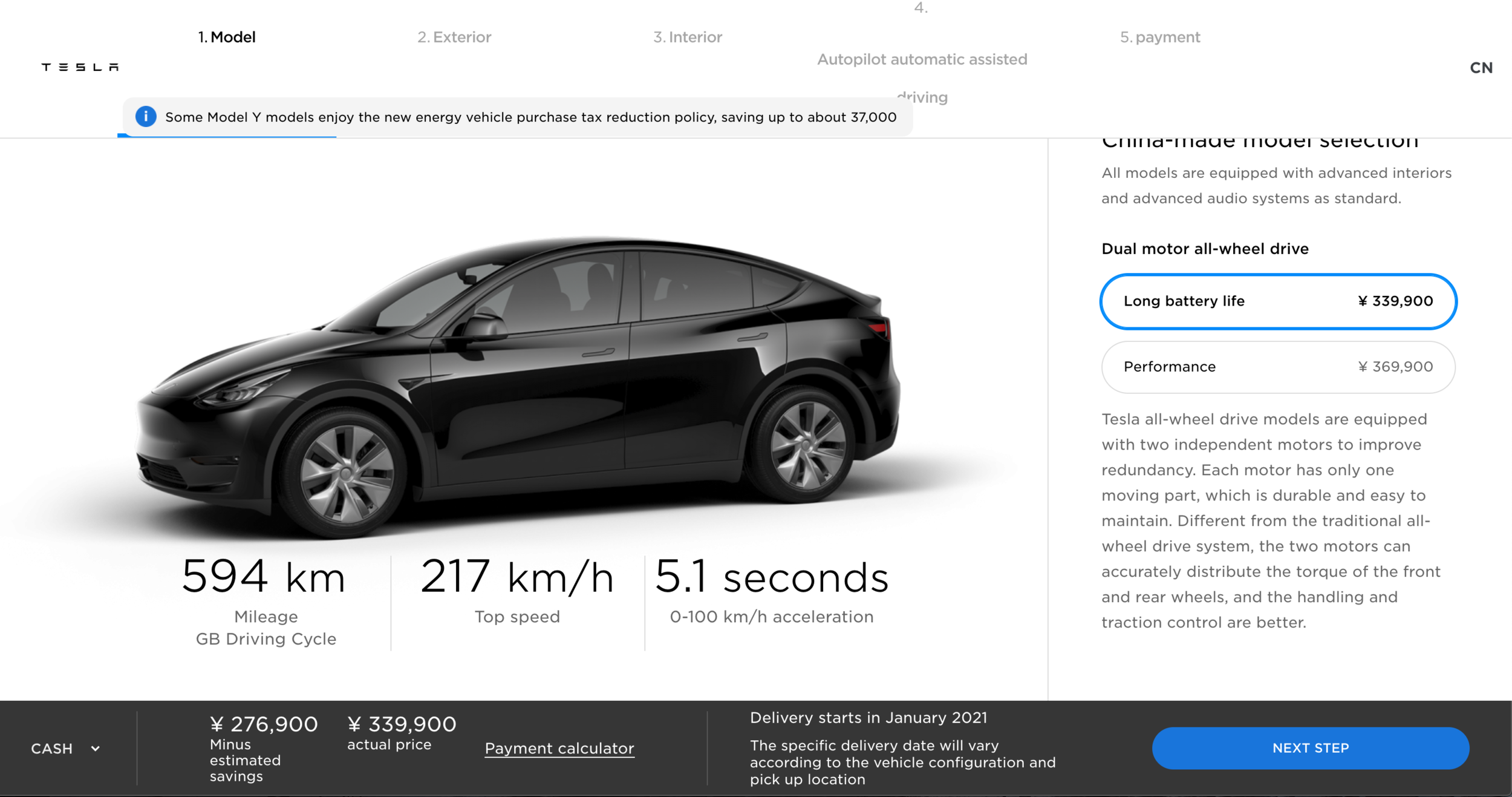
Tesla Launches Model Y in China with MY2021 Upgrades and Sharp Pricing
Tesla Model Y orders are now open in the Tesla China Design Studio, priced from 488,000 yuan ($68,500 USD) for the Model Y Long Range, and 535,000 yuan ($75,200 USD) for the Model Y Performance.
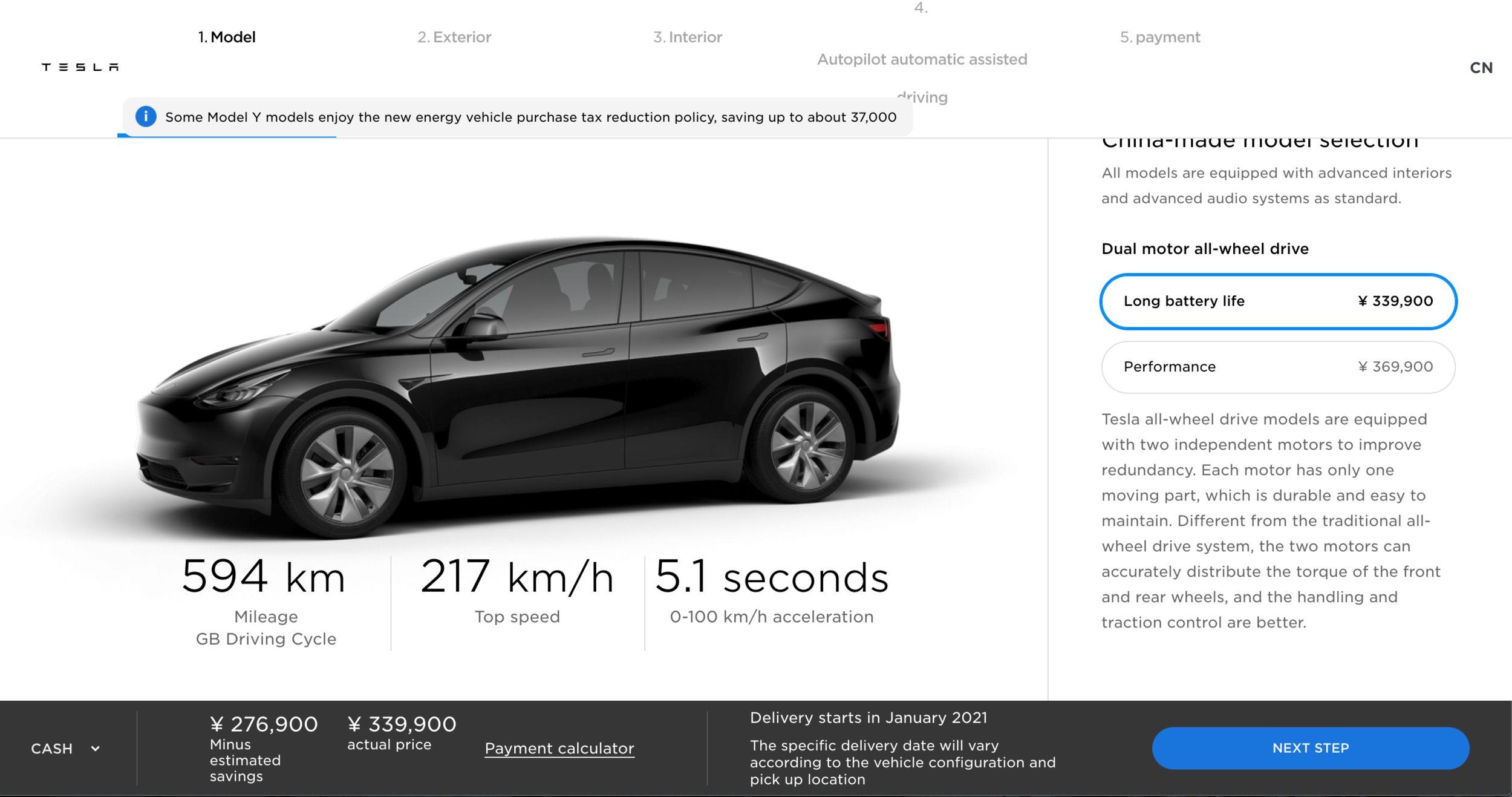
Tesla Model Y orders are now open in the Tesla China Design Studio, priced from 488,000 yuan ($68,500 USD) for the Model Y Long Range, and 535,000 yuan ($75,200 USD) for the Model Y Performance.
According to Tesmanian, sources within Tesla China indicate over 100,000 orders were received upon release of the pricing information, and the company had to post an update on an update on Weibo stating the following:
"CURRENTLY, THERE ARE TOO MANY ORDERS ON THE OFFICIAL WEBSITE AND MAY NOT BE REFRESHED. PLEASE BE PATIENT."
While cheaper than expected, The Model Y’s main competitor is expected to be the NIO ES6, which starts from 358,000 yuan in China. The Model Y has also received some updates for the 2021 model year, including the revised centre console also seen on US-made Model 3s, new wood trim on the doors and an integrated wireless phone charger.
There’s currently no update regarding Australian pricing or delivery information for the Model Y, but as the China rollout — and the Model 3 Australian rollout — has demonstrated, Tesla often waits until the last minute to open the online design studio for the newest vehicles.

British Columbia Leading Canada's Green Transition, COVID-19 Brings Economic Opportunity
B.C. also set new 2025 emissions targets earlier this month. George Heyman, Minister of Environment and Climate Change Strategy said in a press conference “Across the province, people are working every day to tackle climate change and make our economy cleaner and stronger.
Clean Energy Canada brings us a story that demonstrates the importance of climate action to British Columbians. According to a poll in July by Clean Energy Canada, 79 percent of British Columbians agree that COVID-19 has brought about economic change that presents opportunities to mitigate climate change.
B.C. also set new 2025 emissions targets earlier this month. George Heyman, Minister of Environment and Climate Change Strategy said in a press conference “Across the province, people are working every day to tackle climate change and make our economy cleaner and stronger. It’s clear we still have much more to do in order to meet our CleanBC targets – and I won’t be satisfied until we see a significant and steady decline in emissions. To make sure we stay on track to build a cleaner and stronger future, we’re putting in place a new near-term emission target that is both ambitious and achievable. This is another key step on the path to reaching our climate targets for 2030 and beyond.’
The new emission target requires greenhouse gases in B.C. to be 16% below 2007 levels by 2025. and also provides a benchmark on the road to B.C.’s legislated emission targets for 2030, 2040 and 2050 of 40%, 60% and 80% below 2007 levels, respectively. The Province will also set sectoral targets, which are yet to be established, but shoud be finalised before March 31, 2021, and will develop legislation to help B.C. reach net zero by 2050 targets.
Source: B.C. 2020 Climate Change Accountability Report
The 2020 Climate Change Accountability Report provides new estimates for provincial emissions for the next four reporting years (2019-22) and modelling of the estimated impacts of CleanBC actions by 2030, as well as data on progress made through CleanBC in sectors like transportation, industry, buildings and communities and the public service.
Merran Smith, executive director at Clean Energy Canada, made the following statement in response to the above report:
“B.C. has emerged as not only a Canadian leader but a world leader when it comes to climate action. It was the first government in North American to price pollution, the first to legislate a ban on the sale of gas-powered vehicles, and it was among the first to make its emissions targets legally binding.
“B.C.’s climate leadership hinges on a new, rigorous system of climate reporting and accountability, which means celebrating our successes while also acknowledging—and acting—when more needs to be done. Climate policies are only as successful as the results they accomplish.
“While the B.C. government’s new goal of reducing emissions by 16% below 2007 levels by 2025 is a commendable start, it’s also a reminder of how far the province has to go to reach its 2030 goal of 40%. Emissions have been heading in the wrong direction, and we certainly hope we don’t have to say that again next year. We look forward to seeing the province’s updated plan, due next year, for how it will reach these targets.
“Polling shows that the vast majority of British Columbians want to see B.C. put fighting climate change at the centre of COVID recovery plans. And with a Biden presidency kicking off the new year and game-changing clean stimulus plans from countries like Germany, the U.K., and South Korea, it’s clear that B.C. must compete on climate if it’s to compete economically into the future. The province’s climate plan, CleanBC, provides an excellent platform on which to do so. Now is the time to increase its ambition—and there is no time to waste.”
Electric Vehicles
B.C. has had a Zero-Emission Vehicles Act since 2019, which sets phased-in annual targets and other compliance requirements, ensuring automakers increase the number of EVs that they sell in B.C. to meet consumer demand. Automakers will be required to achieve 10% provincial ZEV sales by 2025, 30% by 2030, and 100% by 2040 (for light-duty vehicles).
Source: B.C. Climate Change Accountability Report
From the above report:
The province is backing Battery Electric Vehicles with clear and simple goals including:
making electric cars more affordable
shifting to renewable fuels
investing in charging and hydrogen refuelling stations, active transportation and public transit”
B.C., together with a range of partners, has made good progress in setting a path for lower emissions, particularly for passenger vehicles. ¡ In 2019, electric light-duty vehicle sales more than doubled compared to the previous year to over 17,000, making up nearly 9% of all light-duty vehicles sold in B.C. This brings us close to our 2025 target of 10% ZEV sales for new vehicles five years early.
To help expand availability of ZEVs, B.C. also completed regulations that mandate 100% of new lightduty vehicles sold to be ZEVs by 2040. ZEV compliance requirements start for the model year 2020.
Supported by the CleanBC Public Charger and Hydrogen Fuelling Programs, there are currently more than 2,000 public Level 2 charging stations, 190 public fast charging sites,6 and three public hydrogen fuelling stations. Since 2018, the number of fast charging sites across B.C. has increased by 55%. Another 1,900 charging stations were installed in homes and workplaces with the Go Electric Charger Rebates. Work is underway to continue expanding these networks.
To help reduce emissions from heavier vehicles, B.C. launched a Go Electric Commercial Vehicle Pilot Program. The government increased funding for its Go Electric Specialty-Use Vehicle Incentive in Budget 2020, which is available for eligible medium- and heavy-duty transport trucks, delivery vans, electric cargo bicycles, passenger buses, and low-speed utility trucks.
Together with the BC Trucking Association, the Heavy-Duty Vehicle Efficiency Program completed its first year, exceeded training goals and providing over $1 million for equipment.

Hyundai's Ioniq 5 EV Leaked; Possible 2021 Australian Debut
Hyundai’s popular Kona and Ioniq Electric models will soon have a new stablemate in the form of the Ioniq 5. The EV crossover will debut the new stand-alone Ioniq sub brand (similar to Genesis, but electric only), and is expected to be an important vehicle for the Korean automaker.
Images: Hyundai Europe
Hyundai’s popular Kona Electric and Ioniq Electric models will soon have a new stablemate in the form of the Ioniq 5. The EV crossover will herald the launch of the new stand-alone Ioniq sub-brand (similar to Genesis, but electric only). The Ioniq 5 is expected to be an important vehicle for the Korean automaker, competing in the compact crossover market and will share design cues with the above Hyundai 45 concept.
Hyundai Australia played an important role in the development of the Ioniq 5 according to an interview with Hyundai Motor Company Australia (HMCA) general manager product planning Andrew Tuitahi published in Go Auto.
Tuitahi stated “We’ve participated in design reviews for Ioniq 5, (and) we just got our first prototype at the office recently. We’ve been involved in the Ioniq program in terms of the planning process since it first came up as a concept.”
He went on to state about the production car “it’s so very close [to the concept] (the Hyundai 45 EV concept), they changed almost nothing. I think the wheel size dropped from 22s to 20s but other than that…The first prototypes where you’d really start focusing on fine-tuning are only just coming to the different R&D centres now. So we’ll have a look at the car we’ve got, chat with our colleagues in Korea and we’ll work out a plan.”
Hyundai recently teased details about the Ioniq 5 on YouTube, using the phrase “Extra Power for Life” to hint at the vehicle’s bi-directional charging capabilities.
Thanks to the Korean Car Blog we have some specification details about the Ioniq 5:
The Ioniq 5 First Edition:
Dual motor 233kW
58 kWh battery, 450km combined range (WLTP) (73 kWh with 550km range to come later)
0-100km/h time of 5.2 seconds
4.64 metres long, 3 metre wheelbase, 1.89 metres wide, 1.6 metres high
Solar roof
800V charging system
According to Go Auto, the colour range will be revealed on the Hyundai website on February 16, and deliveries are scheduled to begin mid-2021.

Tesla End of Year Wrap Up
The electric vehicle market is booming, despite COVID-19 putting the brakes on the auto industry generally. Of course Tesla has become a darling of investors, with the company seeing a 50% share price increase since the announcement in early November that the automaker was entering the S&P 500.
The electric vehicle market is booming, despite COVID-19 putting the brakes on the auto industry generally. Of course Tesla has become a darling of investors, with the company seeing a 50% share price increase since the announcement in early November that the automaker was entering the S&P 500. Not since Yahoo and the dot com boom in the late nineties have we seen such confidence in the future of a company.
Tesla isn’t one to slow down for the holiday season, and with a final production and deliveries push expected, Gigafactories across the world under construction, charging infrastructure and vehicle updates, we look at the news this week, and what we can expect to see in the new year.
Sales & Deliveries
North American and European sales of Model 3 and Y remain strong, and the company has apparently met (admittedly low) Model S and X targets for the year, and has halted production for these vehicles.
Tesla sales are strong in China, and this is the market that will help push Tesla to its 500,000 unit goal in 2020. Indeed, many analysts and commentators believe Tesla will surpass this target. With over 20,000 ‘made in China’ Model 3s sold in November, that demand looks set to continue through December, just as the Model 3 was recently awarded Number 1 electric vehicle in China by owners in a recent Net Promoter Score (NPS) index survey. Any concerns around battery availability have subsided, as Tesla’s Chinese production recently moved to lithium iron phosphate (LFP) batteries from supplier CATL.
In Q4 2019, Tesla delivered 112,000 vehicles. Tesla has been ramping production in Q3 and Q4, and Rob Maurer of Tesla Daily has projected just over 24,000 units of Model 3 in production from Giga Shanghai in December. His other projections include:
53,000 Model Y units produced in Q4;
58,000 Model 3 units produced in Q4;
19,000 Model S and X units produced in Q4;
530,000 total units produced in 2020
Tesla needs 181,000 deliveries worldwide to achieve the 500,000 unit annual target. Watch Tesla Daily’s Q4 prediction video below:
Factories
As was expected, construction of Giga Texas is powering forward, with the skeleton and roof of the facility already under construction, and the first phase of the project due for completion in 2021.
Over in China, Tesla completed the Model 3 and Model Y production lines in record time, and new single-piece body castings have been spotted at the factory, suggesting Tesla’s new ‘Gigapress’ casting machines are now online.
Tesla certainly isn’t resting though, and it appears the company is continuing to expand the production facility east of the current footprint:
Meanwhile, over in Germany, Giga Berlin is also charging full steam ahead, with ‘Gigapress’ casting machines arriving at the factory, and external walls being erected, despite a number of hold ups due to permits, environmental concerns and missed payments. Again, Tesla is expected to commence operations on time if not earlier, with production tests due for July 2021, some 13 months after construction on the site began.
FSD pricing and updates
Tesla’s autonomous Full Self Driving package is set to become a cash cow for the company, with the billions in R&D dollars spent set to be recouped over the next few years. Previously available as a stand-alone option before or after delivery for a cost of $10,000, Tesla announced 2021 will bring a subscription pricing model for owners who wish to pay for the option in instalments.
Tesla has also just released its holiday 2020 update, as part of Firmware 2020.48.25. There are some notable changes mentioned in the release notes including:
“The driving visualization has been refreshed and now offers a larger visualization to allow drivers to view more details of the road surroundings. The next turn will now appear above the visualization if the navigation turn list is covered by another app.”
“Schedule departure can now precondition your battery and cabin even when your car is unplugged. To account for different utility rate plans, you can now set the time when your off-peak rates end to save on charging costs. To access, tap SCHEDULE from the climate control or charging panel when parked.”
“Supercharger pins on your touchscreen will now display the number of available stalls at charging sites. Quickly search for nearby amenities by tapping an amenity icon on the Supercharger popup display.”
Teslarati has a full rundown of software changes listed here
Superchargers
Can electric vehicles from brands other than Tesla now charge at Tesla Superchargers? Not quite. Marques Brownlee asked Elon Musk on Twitter “Why don't more electric car makers take up Tesla on their offer to use the Supercharging network? Incompatible tech? Hidden fees? Pride? There's gotta be a good reason.” to which Elon Musk replied: “They are, although it’s kind (sic) low-key. Tesla Superchargers are being made accessible to other electric cars.”
Naturally, the internet went crazy, though you won’t see Porsche Taycan owners at a Supercharger any time soon. Tesla is focused on rolling out Superchargers for its customers, installing the high-speed Tesla-only chargers in more locations, and updating more Supercharger sites from 150kW version 2 models to 250kW version 3 models. Construction of Tesla's Supercharger factory in China appears to be ramping up too, and has a 10,000 unit per year production goal.
S&P 500 Inclusion
The big news this week is the inclusion of Tesla into the S&P 500 club; a move that many have signalled since Tesla achieved four straight profitable quarters in July this year. According to the Wall Street Journal, shares have surged some 70% since the announcement of the company’s addition in November.
Tesla’s listing on the stock market benchmark represents the biggest company ever to join the S&P 500, and its USD$650 billion market capitalisation figure means Tesla is the sixth largest publicly listed company in the United States.
1990 to 2020: Largest Companies Added to the S&P 500

Elon Musk appeared extremely grateful on Twitter, Tweeting on December 22 “Thanks to everyone who worked so hard to make Tesla successful. My heart goes out to you.”
Tesla is now the world’s most valuable automaker, with huge growth potential and some serious competitive advantages in the market place (more on that below).
The Street has just named Tesla as its ‘number one stock of the year’, with 12 of 16 panellists agreeing Tesla stood above Zoom Video, Moderna, Amazon and Netflix (numbers two to five respectively)
Image: The Street
What about Tesla Energy?
The growth of Tesla Energy is part of the reason many investors see so much future potential in the company; while solar and household battery growth has been slow over the last few years, Q3 and Q4 2020 were good quarters for the business, and Tesla energy looks to have generated around $1.85 billion in revenue for the 2020 calendar year.
According to The Motley Fool, During Q3 2020, Tesla shipped 759 megawatt-hours (MWh) worth of batteries, an 81% increase from Q2's 419MWh. That’s a higher rate of growth than Tesla’s automotive business, which saw shipments for Q3 at 139,593 units, a sequential increase of 54% over Q2's 90,650 units.
We can expect to see more grid-scale battery projects boosting the energy business in 2021; recently a number of large projects utilising Tesla Powerpack and Megapack technology have been completed, including Yorktown New York’s 490 MW Tesla battery, and an upgrade of an additional 50 MW added to the Hornsdale battery in South Australia. Construction commenced in October on the 182 MW (730MWh) Moss Landing battery in California, which consists of 256 Megapacks, and will be able to power every home in San Francisco for up to six hours according to Tesla.
Tesla Solar has been bubbling away for a few years now, and the company’s energy products have become on average 30% cheaper than the US average primarily due to their online business model. By reducing ‘soft costs’ or non-component costs of each system, customers are able to purchase customised packages that suit their homes, and can even pay off the installed system through a subscription program.
Many in the industry believe that Tesla Energy can generate revenue equal to that of the automotive side of the business, and that it’s just a question of scaling up production, and expanding subscription-based solar and battery systems outside the United States.
What else could possibly happen in 2020?
Well now that you mention it, according to Reuters, there’s a little something called ‘Project Titan’ that the Cupertino tech giant Apple is working on. It’s an electric vehicle that has been in the works since 2014, and part of the secret vehicle’s competitive advantage will apparently be a new battery design that could “radically” reduce the cost of batteries while maximising range.
Gene Munster from Loup Ventures doesn’t see Apple’s entry into personal mobility as a threat to Tesla’s market share; Munster stated that the firm believes traditional automakers are Apple’s target.
Loup Ventures predicts that electric vehicles will account for close to 30% of all auto sales by 2025, with one third of that market to be dominated by Tesla.
Elon Musk dropped quite the Tweet today, stating that during the company’s Model 3 design and engineering phase, he approached Apple to see if Tim Cook was interested in acquiring Tesla: “During the darkest days of the Model 3 program, I reached out to Tim Cook to discuss the possibility of Apple acquiring Tesla (for 1/10 of our current value). He refused to take the meeting.”
How different the automotive and energy landscape could have been…
What’s in store for 2021
So what will next year bring? Like many investors (myself included), Tesla experts see exceptional growth for the company, based on strong demand for electric vehicles generally, and increasing market share in key markets such as China. Wedbush analyst Daniel Ives believes China’s demand dynamic in the EV market will disproportionally benefit Tesla, and that the Chinese market could account for over 40% of Tesla’s sales within eighteen months.
Gali from Hyperchange demonstrates that Tesla has already figured out how to build electric vehicles profitably, with a gross margin figure of 23 percent. He sees a lot more growth potential on a profit per car basis, as the company focuses on software, and begins to recoup costs associated with the research and development of the Full Self Driving software. Gali is projecting a gross profit amount of $2.5 billion for Q4 2020, $2.7 billion in cashflow, and he expects capital expenditure to increase to $4-$6 billion per year from 2021 as Tesla pours more money into factories.
Model Y sales and deliveries are expected to get off the ground early in 2021, and with the Cybertruck Gigafactory due for completion mid-year, 2021 could be the year that Tesla brings the first mass-market electric pickup truck to consumers.
Tesla also unveiled its new 4680 battery cells in September, and the new tabless cells are expected to offer exceptional thermal and electrical efficiency. These cells are expected to be at the core of Cybertruck and Semi performance and efficiency, and while Tesla has these cells currently deployed in prototypes, the company lacks a facility to manufacture them at scale.
One of Tesla’s main goals is terrawatt-hour (TWh), or one trillion watt hour scale battery production, and the company has a manufacturing goal of 3TWh by the year 2030. Elon Musk has also used Twitter to suggest Tesla may be able to manufacture 20 million vehicles a year by this date:
Clean Technica has an excellent article on Tesla’s future that delves deeper into the above, however any future light commercial vehicles from the company are notably absent. With Rivian, Arrival and other manufacturers seeing this segment as a growth market for EVs, I wouldn’t be surprised to find Tesla leveraging their expertise to manufacture delivery vehicles.
2020 has been a difficult year for the automotive industry, but I am cautiously optimistic that Tesla’s battery and vehicle roadmap will play out in their favour, and that we will continue to see the company scale and grow at a rapid rate. Say what you like about Elon Musk; Tesla is now much bigger than one man, and the company has driven the global automotive market rapidly towards electrification and zero emissions transportation.
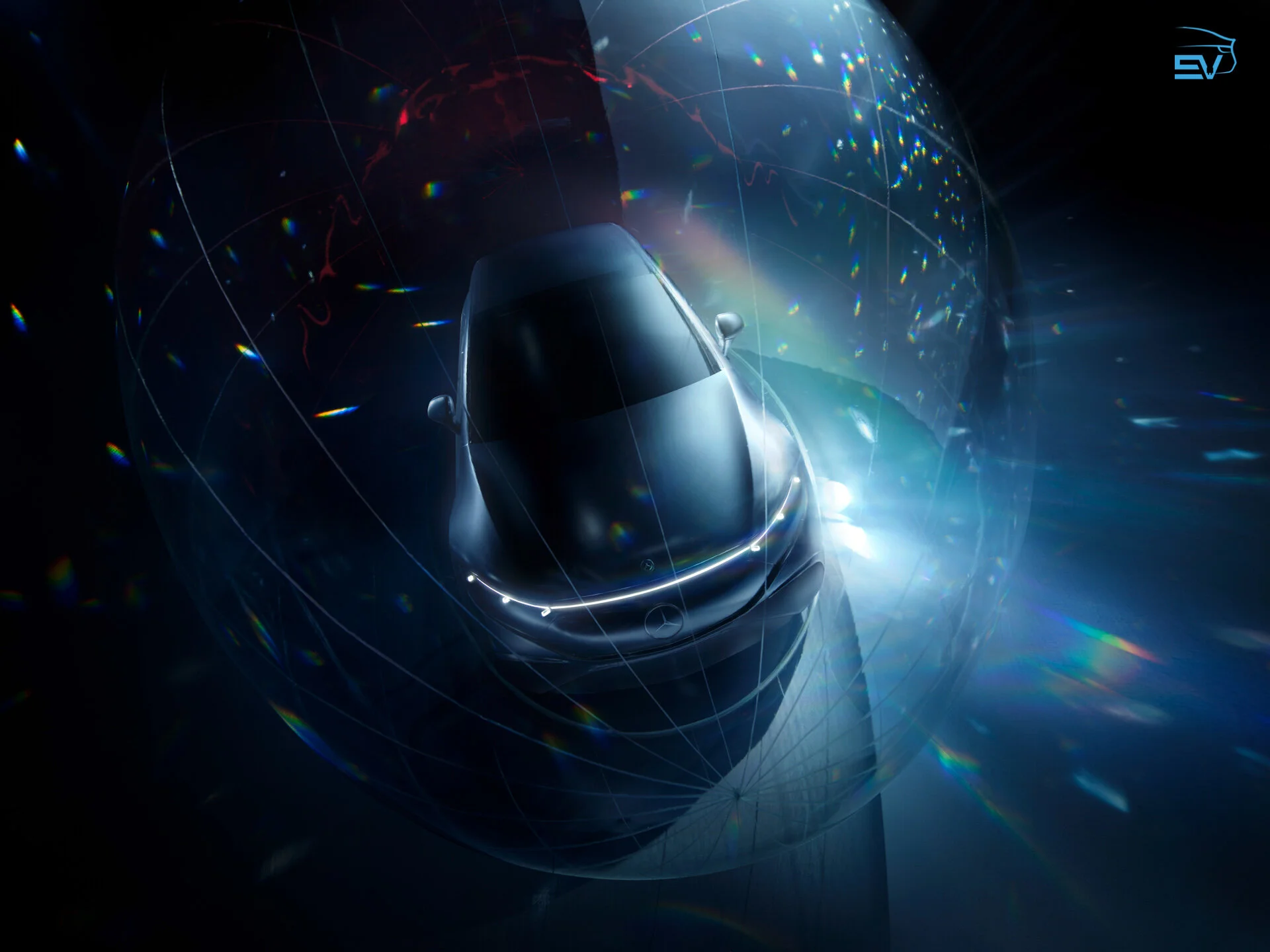
Mercedes-Benz Accelerates EV Rollout; 8 BEVs In Production by 2022
Mercedes-Benz has today announced announced its ambition to fully electrify the entire product portfolio by 2039 as part of a plan to achieve CO₂ neutrality, and this includes the rollout of eight all-electric Mercedes-EQ models from 2022 built on dedicated electric architecture. The first mass-market Battery Electric Vehicle (BEV) from Stuttgart, the Mercedes-Benz EQC has been available around the world since 2019, and is based on the pre-existing GLC SUV platform.
Images: Mercedes-Benz AU
Update: Mercedes-Benz has released an additional rendering, which you can find below. This vehicle looks to be pretty close to final production design, and will be Mercedes’ first D-segment vehicle without a traditional grille.
Mercedes-Benz has today announced announced its ambition to fully electrify the entire product portfolio by 2039 as part of a plan to achieve CO₂ neutrality, and this includes the rollout of eight all-electric Mercedes-EQ models from 2022 built on dedicated electric architecture. The first mass-market Battery Electric Vehicle (BEV) from Stuttgart, the Mercedes-Benz EQC has been available around the world since 2019, and is based on the pre-existing GLC SUV platform.
The Mercedes-Benz EQS, as shown above and below will be the first to commence production in early 2021, and is essentially the luxurious S-Class reimagined for a zero emissions future. From the camouflagued vehicle, we can see an imposing physical presence -something the S-Class has always been known for- and a low, wide nose, possibly with a faux grille a-la Jaguar i-Pace or an indentation around the badge. The bonnet (hood for you North Americans!) rises steeply into a huge windscreen, which appears to continue above the driver’s head, as is the trend nowadays.
The high bootline and almost fastback look is unusual for the S-Class segment, however the large tail lights with some presumably funky graphics and lightbar spanning the width of the rear should provide a visual family reference to the EQC, while defining the EQS’ unique character.
The side profile looks a little slab-sided under camouflague, with the C-pillar, doors and rear fender covering a large area relative to the glasshouse, however it looks like there may be some interesting surfacing hiding under that blue wrap. The Goodyears on the test car look to be hugging at least 21-inch or 22-inch wheels, as is the trend these days. That’s aesthetics over efficiency for you.
The EQS will be produced in Sindelfingen from early 2021, while the less expensive EQA and EQB models will be produced at the Rastatt and Kecskemét (Hungary) plants respectively. We can expect the world premiere of the EQA on January 20, 2021 according to Mercedes-Benz.
Fast forward to the second half of 2021, and Mercedes-Benz states that the EQE ‘business sedan’ will begin production at the Bremen plant, as well as in Beijing for the Chinese domestic market only. Continuing the the Germans’ fondness for manufacturing SUVs in the United States, the EQE and EQS SUV variants will be manufactured at the brand’s Tuscaloosa Alabama plant.
According to Mercedes, a total of eight Mercedes-EQ electric vehicles will be produced at seven locations on three continents by 2022.
Daimler’s Battery Plans
Battery development, manufacture and supply will obviously be a critical part of this increase in BEVs, and Mercedes-Benz plans to increase investment in the energy side of manufacturing, alongside battery specialists.
Mercedes-Benz and BAIC have jointly set up a battery production plant at the existing location in the Yizhuang Industrial Park in Beijing (China) for vehicles sold in the domestic market.
In addition to two battery plants in Kamenz (Germany) already producing battery systems for Mercedes-Benz, the company plans a future battery plant at the Sindelfingen site, increasing capacity already available from the nearby Untertürkheim plants in preparation for locally built electric models.
Furthermore, Mercedes-Benz is upgrading the Jawor (Poland) battery plant, currently manufacturing battery packs for plug-in hybrid variants of the C,E and S-Classes, to include battery systems for upcoming EQ models, as well as planning a battery plant in the vicinity of the Tuscaloosa Alabama factory.
You can read the full press release below, alongside an interview with Jörg Burzer, Member of the Board of Management of Mercedes-Benz AG, Production and Supply Chain.


Mercedes-Benz Sindelfingen plant (Germany): Launch of electric luxury sedan EQS in Factory 56 in first half of 2021
Mercedes-Benz Rastatt plant (Germany): Production of first all-electric compact SUV EQA started - also at Beijing plant (China) in 2021
Mercedes-Benz plant in Kecskemét (Hungary): Decision to locate second all-electric compact SUV EQB. Production launch in 2021 - also at Beijing plant (China)
Mercedes-Benz Bremen plant: Production launch of electric EQE business sedan in 2021 - at Beijing plant soon thereafter (China)
Mercedes-Benz Tuscaloosa plant (USA): SUV variants EQS und EQE begin in 2022
Mercedes-Benz battery production network: Production start of battery systems for EQS and EQE in Untertürkheim/Hedelfingen (Germany) imminent. Production of compact SUV battery systems in Kamenz (Germany), Jawor (Poland) and Beijing (China) plants. Tuscaloosa battery plant will produce batteries for SUV variants of EQS and EQE beginning 2022
15 December 2020, Stuttgart. Mercedes-Benz is targeting leadership in electric drives and vehicle software. The consistent electrification of the entire product portfolio is a key element of the strategic focus "Ambition 2039" and a prerequisite on the way to CO₂ neutrality. In 2022 the portfolio includes eight all-electric Mercedes-EQ models. The global Mercedes-Benz production network is ready for the company’s electric product offensive and is integrating its Mercedes-EQ models into series production in its existing plants.
Markus Schäfer, Member of the Board of Management of Daimler AG and Mercedes-Benz AG; responsible for Daimler Group Research and COO Mercedes-Benz Cars: “With its ‘Electric First’ strategy, Mercedes-Benz is consistently on the path to CO₂ neutrality and is investing heavily in transformation. Our vehicle portfolio becomes electric and thus also our global production network with vehicle and battery factories. We intend to lead in the field of e-mobility and focus in particular on battery technology. We are taking a comprehensive approach, ranging from research and development to production, and also including strategic cooperation.”
The EQS, the first electric luxury sedan from Mercedes-Benz, will start in the first half of 2021 in Factory 56 at the Sindelfingen site (Germany). With the production launch of the electric compact SUV EQA at the Rastatt plant (Germany) and the current decision to locate EQB production in the Hungarian plant in Kecskemét, the company is taking further important steps toward making its product portfolio CO₂ neutral. The course has also been set toward “Electric First” in the global powertrain production network as well. High-efficiency battery systems will also be manufactured and assembled within the production network.
Jörg Burzer, Member of the Board of Management of Mercedes-Benz AG, Production and Supply Chain: “The Mercedes-Benz production network is global, digital and flexible, and ready for the upcoming electric offensive – thanks, of course, to our highly qualified and motivated employees worldwide. We are now beginning a real Mercedes-EQ fireworks display. Six electric product launches by 2022 underscore the strength and competence of our Mercedes-Benz production sites worldwide. The production network will have a total of six Mercedes-EQ car locations. Local production of highly efficient battery systems plays a central role in the Mercedes-Benz strategy - coupled with a comprehensive sustainability concept that spans the entire life cycle of the battery all the way to recycling.”
Mercedes-Benz vehicle plants consistently implement electric offensive
In May 2019 production of the EQC (combined power consumption: 21.5 kWh/100 km; combined CO₂ emissions: 0 g/km) at the Mercedes-Benz plant in Bremen (Germany) was integrated into ongoing series production. Just a few months later the German-Chinese production joint venture, Beijing Benz Automotive Co. Ltd. (BBAC), launched EQC production for the local market in China. In 2020 production of the EQV premium electric MPV (combined power consumption: 26.4 kWh/100 km; combined CO₂ emissions: 0 g/km)1 started in Vitoria, northern Spain.
Compact car class customers can look forward to two fully electric compact SUVs in the EQA and EQB in 2021. EQA will celebrate its world premiere on January, 20 2021 as the first fully electric derivative of this compact car. The EQA production launch at the Mercedes-Benz Rastatt plant went smoothly. As with the EQC from Bremen and Beijing and the EQV from Vitoria, which are already on the market, the fully electric models at the Rastatt plant run on the same production line as compact vehicles with conventional and hybrid drives. That means all five vehicles produced in Rastatt are electrified: In addition to the fully electric EQA, the AClass, A-Class sedan, B-Class and the compact SUV GLA are also produced at the Mercedes-Benz plant in Rastatt - with classic combustion engines as well as plug-in hybrid drive. With that the Mercedes-Benz Rastatt plant is making an important contribution on the road to a CO₂ neutral vehicle fleet and to the Mercedes-Benz AG electric offensive. EQA production will also follow next year (2021) at BBAC in Beijing for the Chinese market.
EQB production will launch in 2021 at two locations in the global Mercedes-Benz Cars production network: in the Hungarian Mercedes-Benz plant in Kecskemét for the world market and in the German-Chinese joint venture BBAC in Beijing for the local market. Plant preparation, including employee training and renovation work, is already underway. The compact SUV EQB will be the first purely electrically powered production vehicle from Hungary and will complement the plug-in hybrid portfolio consisting of the CLA and CLA Shooting Brake. The A-Class will also be produced in Kecskemét with a plug-in hybrid drive, in addition to production in the German Mercedes-Benz plant in Rastatt.
Furthermore, in the first half of 2021 production of the EQS electric luxury sedan will begin in Factory 56 at the Mercedes-Benz plant in Sindelfingen (Germany). EQS is the independent, fully electric member in the new S-Class program and is the first to use the new electric architecture for luxury and upper-class electric vehicles at Mercedes-Benz. In Factory 56 the S-Class and, in the future, the Mercedes-Maybach S-Class, and the EQS will be produced in a fully flexible manner on the same line. Factory 56 embodies the future of production at Mercedes-Benz and sets new standards for automobile construction. In Factory 56 efficiency gains of around 25 percent are achieved compared to the previous S-Class assembly. This is made possible by optimizing the entire value chain and full digitalization with MO360, the digital Mercedes-Benz production ecosystem. For further information on this: https://media.daimler.com/marsMediaSite/ko/en/47014243
Furthermore, the Mercedes-Benz plant in Bremen will begin production of the EQE business sedan in the second half of 2021, followed shortly thereafter at the Beijing plant. The EQE thus complements the allelectric portfolio of the two plants. The Beijing plant will then produce a total of four Mercedes-EQ models for the local market.
The Mercedes-Benz plant in Tuscaloosa (USA) is also preparing for production of the EQE SUV and EQS SUV in 2022, which will be produced in the future on the same line with SUVs with conventional and plug-in hybrid drives.
In 2022 a total of eight Mercedes-EQ electric vehicles will be produced at seven locations on three continents. This is possible because the company made early investments worldwide in flexibility and technical equipment with future-oriented Industry 4.0 solutions. In the Mercedes-Benz AG plants, vehicles with different drive types can be produced in parallel thanks to highly flexible structures. With a view to the strategic goal of generating more than half of sales with so-called xEVs, i.e. plug-in hybrids and electric vehicles, from 2030 on and gradually increasing the purely electric share, the high degree of flexibility is a decisive advantage. It enables production to be adjusted at short notice depending on market demand.
smart rounds off the electric Mercedes-Benz Cars portfolio with three additional models. The smart EQ fortwo (combined power consumption: 16.5 kWh/100 km, combined CO₂ emissions: 0 g/km)1 and smart EQ fortwo Cabrio (combined power consumption: 16.8 kWh/100 km, CO₂ emissions combined: 0 g/km)1 are produced in Hambach, France, and the smart EQ forfour (combined power consumption: 17.3 kWh/100 km; combined CO₂ emissions: 0 g/km)1 in Novo Mesto, Slovenia. The next generation of smart electric vehicles will be produced by the joint venture smart Automobile Co., Ltd. in China. This is a joint venture of MercedesBenz AG and the Zhejiang Geely Group (Geely Holding).
Plug-in hybrid drive is important as a key technology and intermediate step toward a purely electric product portfolio. More than 20 plug-in hybrid model variants are already an integral part of the Mercedes-Benz product portfolio. The portfolio will be expanded to include more than 25 model variants by 2025. Their production therefore also plays an important role in the global production network. Plug-in hybrid vehicles are already rolling off Mercedes-Benz Cars assembly lines in almost all car plants.
Global battery production network: a key success factor in the Mercedes-Benz electric offensive
The batteries for the Mercedes-EQ electric vehicles are supplied by a global battery production network with plants on three continents. Local battery production is a key success factor for the Mercedes-Benz electric offensive.
Two plants in Kamenz (Germany), have been producing battery systems for hybrids, plug-in hybrids and electric vehicles since 2012. The second battery factory at the site began operations in 2018 and has been producing the EQC's battery systems since 2019. It was designed from the start as a CO₂ neutral plant and combines, among other things, solar energy, geothermal energy and a combined heat and power plant. The battery systems for the EQA have also recently rolled off the production line at the site. Since the start of production at Accumotive, more than a million batteries based on lithium-ion technology for electric, plug-in hybrid vehicles and 48-volt systems have been produced at the Kamenz site.
Mercedes-Benz and BAIC have jointly set up local battery production at the existing location in the Yizhuang Industrial Park in Beijing (China). This supplies the nearby vehicle plant, which has also added all-electric Mercedes-EQ models to its portfolio with the EQC. Production of battery systems for the EQC started there in 2019. With the start of production of the EQA, EQB and EQE, the plant will manufacture battery systems for a total of four Mercedes-Benz EQ models beginning in 2021.
This year the battery plant in Jawor (Poland) started producing plug-in hybrid batteries for the C, E and SClasses. In the coming year the location will expand its portfolio to include battery systems for the compact Mercedes-EQ models, the EQA and the EQB. Much like the battery plant in Kamenz, the plant was designed from the outset for CO₂ neutral production.
In the future at the Untertürkheim (Germany) site two plants will produce battery systems. Final preparations for the production of the battery systems for the EQS, which will roll off the production line in nearby Sindelfingen in the first half of 2021, are currently underway at the Hedelfingen plant. The battery system for the EQE will also be produced in Hedelfingen. Another battery plant is currently being built in the Brühl facility, which will manufacture battery systems for Mercedes-Benz plug-in hybrids starting 2022. The work on the building has already been completed. The battery plant in Brühl will be fitted with the corresponding equipment in the coming months.
Production of the EQS and EQE SUV models will start in 2022 at the Mercedes-Benz plant in Tuscaloosa (USA). A battery plant is currently being built in the immediate vicinity and will supply highly efficient battery systems for both models. Work on the building has already been completed. The ultra-modern systems will be installed in the coming months.
In addition, the Mercedes-Benz production strategy currently provides for another battery plant at the Sindelfingen site.
Together with local partner Thonburi Automotive Assembly Plant (TAAP), Mercedes-Benz Cars set up a battery production facility in Bangkok (Thailand) and began operations in 2019. Battery systems for the current C, E and S-Class plug-in hybrids are manufactured at the site. Preparations are also being made there to manufacture drive batteries for all-electric Mercedes-EQ brand vehicles.
Electric First und Ambition2039: CO₂ neutral mobility und production
Under “Electric First,” Mercedes-Benz is pursuing the consistent electrification of all model variants and vehicle types as a clear objective. The decisive factor here over the next few years is the gradual increase in the purely electric share of the vehicle portfolio. So-called xEVs, plug-in hybrids and fully electric vehicles, should account for more than half of sales by 2030 - and the trend is rising. Electrically powered vehicles from Mercedes-Benz are enjoying increasing popularity. The company delivered a total of 45,000 electric vehicles and plug-in hybrids (xEVs) worldwide in the third quarter of 2020.
With “Ambition2039,” Mercedes-Benz introduced its path to CO₂ neutrality over a year ago. Vehicle production plays a crucial role in this regard. As early as 2022 the company’s Mercedes-Benz car and van plants will produce CO₂ neutrally around the world. This includes more than 30 car and van plants, as well as battery plants.
Brief interview
“We’re producing the Mercedes-EQ models the Mercedes way: Completely digital and flexible, highly efficient and maximally sustainable.”
Questions for Jörg Burzer, Member of the Board of Management of Mercedes-Benz AG, Production and
Supply Chain
Mr. Burzer, are you equipped for the production of electric vehicles in your production network?
The Mercedes-EQ production network is ready for our electric offensive. We started this transformation several years ago and set up our plants with maximum flexibility. The Mercedes-EQ electric models are gradually being integrated into our existing vehicle plants worldwide. They come off the same lines as vehicles with combustion engines or plug-in hybrid drives. The same applies to all of our Mercedes-Benz car plants - a total of six on three continents. This concept is particularly advantageous because demand for electric and electrified vehicles is developing very differently by region and we can adjust our production planning accordingly on short notice. In this way we can manufacture exactly what our customers want.
What specifically does your production planning for the upcoming model offensive look like?
One thing is certain: the proportion of all-electric vehicles in our portfolio will increase sharply in the coming years. By 2030 more than fifty percent of our vehicles will roll off the assembly line as so-called xEVs. Plug-in hybrids and hybrids will therefore continue to play an important role in our production planning over the next few years. However, our target is clearly designed for 100 percent Mercedes-EQ and we are directing our capacity precisely in this direction. We are preparing our production, as well as our employees, step by step for this change. Our sustainability concept is also a central focus: from 2022 on we will produce CO₂ neutral in our Mercedes-Benz plants worldwide.
What, specifically, were the challenges?
Every vehicle launch during ongoing production comes with challenges. That, of course, also applies to electric vehicles. However, thanks to the know-how in our plants and cross-location system planning, we could quickly develop and implement flexible solutions. The consistent digitalization of our processes through our digital production ecosystem MO360 also made a significant contribution. An important factor here, of course, is attaining targeted qualifications for our colleagues in our plants, which we consistently promote.
How will powertrain production continue in the future?
For the global Mercedes-Benz powertrain production network, the shift toward e-mobility poses a special challenge. However, we are determined to continue aligning our drive division to this change and make it sustainable for the future. We have already built up extensive know-how in our powertrain plants in recent years. It starts with the expansion of our battery production network and includes, among other things, manufacturing and assembling parts of the electric drivetrain ourselves. Still, it’s also clear that the drivetrains of the future will differ significantly from those of today.
You will manufacture the batteries for the Mercedes-EQ models in house?
The local production of batteries is an essential success factor in our electric offensive. With a view to steadily increasing demand and, in accordance with our production planning, we are setting up our global battery production network to be flexible worldwide. Today we already produce batteries in Kamenz, Bangkok and Beijing. The ramp-up of our battery plants in Hedelfingen and Jawor is imminent and our colleagues in Brühl and Tuscaloosa are already preparing to start production in 2022. Our production network is very well positioned for the Mercedes-EQ model offensive.
Which new electric model are you personally most looking forward to?
Basically, I look forward to every new Mercedes-Benz. A very special milestone is certainly the upcoming EQS production launch. It will roll off the assembly line, together with the S-Class, in our new Factory 56 at the Mercedes-Benz plant in Sindelfingen. Here we’re setting the course for our entire production network: With the most modern production technologies Factory 56 is a blueprint for our global network. At the same time, it bolsters our claim - the Mercedes way - to the production of the Mercedes-EQ models: completely digital and flexible, highly efficient and maximally sustainable.

Mazda MX-30 e-Skyactiv Electric, Mild-Hybrid Set for Australian Release in 2021
Like the every other carmaker on the planet, the Japanese automaker has been cashing in for years from sales of internal combustion engine SUVs, and this trend looks set to continue as manufacturers race to develop electric and hybrid variants of high-riding platforms. The MX-30 electric is a good looking thing, but has received a fair amount of criticism overseas for its small 35.5kW battery, 200km WLTP range (real world range is closer to 175km) and maximum DC charging speed of 50kW.
Mazda MX-30 e-Skyactiv:
Battery: 35.5kW prismatic cell lithium-ion
Charging: Up to 50kW DC (CCS), 6.6kW AC
Range: 200km (WLTP)
Engine: AC synchronous motor - 107kW, 271Nm
Like the every other carmaker on the planet, the Japanese automaker has been cashing in for years from sales of internal combustion engine SUVs, and this trend looks set to continue as manufacturers race to develop electric and hybrid variants of high-riding platforms. The MX-30 electric is a good looking thing, but has received a fair amount of criticism overseas for its small 35.5kW battery, 200km WLTP range (real world range is closer to 170 km) and maximum DC charging speed of 50kW.
Mazda claims the MX-30 has been designed with a ‘right sized battery’, based on the fact that the average European commute is 48km per day -well within the capabilities of the MX-30- and that a smaller battery offers a reduced environmental footprint in manufacturing, less vehicle weight and greater energy efficiency. Without debating these points, consumers still feel at ease with a greater range, and one can’t help think that either Mazda is not able to compete with offerings from Hyundai, Kia and Volkswagen, or is deliberately handicapping its EV offerings so as not to poach sales from petrol and diesel product lines.
The fully electric MX-30 e-Skyactiv will go on sale in Australia from mid-2021. Read the full press release below:
11th December 2020: Mazda Australia is excited to confirm the local arrival of its first ever Mazda MX-30 crossover in 2021.
The first ever Mazda MX-30 combines truly individualised styling cues with a choice of green powertrain solutions: e-Skyactiv G with mild hybrid technology, or the fully electric e- Skyactiv system.
“MX-30 is the bold next step of Mazda’s Sustainable Zoom-Zoom 2030 strategy,” said Mazda Australia Managing Director, Vinesh Bhindi.
“Combining modern design and sustainable, tactile interior materials, the MX-30 has been created to stimulate the senses and connect with the driver and its occupants.
“While furthering our ‘well to wheel’ emissions reduction strategy, the MX-30 remains a Mazda at heart: it is poised, agile and fun to drive with exceptional handling.
We are looking forward to seeing MX-30 in Mazda dealerships next year,” he said.
The MX-30 M Hybrid will arrive in the first half 2021, with the MX-30 Electric going on-sale in the middle of the year.
MX-30 pushes Kodo design further than ever
Mazda’s first-ever MX-30 has pushed the boundaries of Kodo design further than ever before.
The MX-30’s design team focused on emerging new values and lifestyles among its target audience. Young, metro and forward-thinking, these people live for experiences, are continuously connected, and adore modern design: the resulting MX-30 shape is the result.
Its exterior is designed to emphasise the vehicle’s solid mass, creating an impression of strength and beauty by minimising clutter.
As first impressions last, particular emphasis was placed on the MX-30’s unique front-end styling. Here, the central Mazda logo is the focus point, with surrounding surfaces designed to reflect onto the logo, conveying vitality and reliability.
This solid mass impression extends along the vehicle’s side profile, with its upright A-pillars, sweeping D-pillars and curved side panels conveying strength.
With the Soul Red Crystal, Polymetal Grey and Ceramic Metallic exterior finishes, a blacked- out roof section and metallic upper body sections are available, offering a stunning three- tone contrast.
Single colour bodies in Machine Grey, Polymetal Grey, Ceramic Metallic, Jet Black and Arctic White will also be available.
An airy, relaxing interior space with premium, sustainable materials
Referencing the legendary Mazda RX-8 sports car, opening the MX-30’s Freestyle doors introduces a forward-thinking cabin that combines a sense of light and space with a wide range of sustainable materials.
Following Mazda’s characteristic driver-centric cockpit design, the MX-30’s interior makes use of floating elements and spaces that are designed to declutter. Touchscreen air- conditioning controls add simplicity, while the floating centre console, upper instrument panel and dash displays convey lightness.
Rear-seat occupants are treated to a couch-like experience, with the Freestyle outer-hinged door system offering a true sense of occasion upon entry.
During the MX-30’s design phase, interior materials that blended high sustainability with passenger comfort were deemed essential.
Heritage cork – a tribute to Mazda’s 1920 founding as the Toyo Cork Kogyo company – exemplifies this. The MX-30’s cork interior surfaces are made from sustainable raw materials, derived from tree bark without cutting the tree down. Mazda applies a unique coating to ensure durability and installs the finished product into the door grips and console trays.
Premium Vintage Leatherette upholstery is created from non-animal materials and manufactured with water rather than solvents, showcasing a tactile quality and premium appearance while being kind to the environment.
Upper door trims are finished in a breathable fabric that is created from recycled PET bottles and the fabric seat trim elements use up to 20 per cent recycled thread.
Five-star rated safety
The five-star Euro NCAP rated MX-30 evolves the Mazda Proactive Safety philosophy with a comprehensive suite of active and passive safety measures.
The MX-30’s i-Activsense system introduces a Turn-Across Traffic functionality to the Smart Brake Support System, which helps prevent collisions when turning ‘across traffic’, for example at an intersection.
Road Keep Assist, which maintains the right track even without lane markings, and Emergency Lane Keeping with Blind Spot Assist, are also included.
A rigid body, optimal driving position and structures that efficiently absorb impact energy provide additional peace-of-mind.
For the EV, the high voltage electric power flow is shut down the instant a collision occurs, and the battery module is covered with high-strength steel and a rigid surrounding frame for solid impact protection.
Ten airbags are included as standard: front, curtain, front-side, rear-side, front far-side (driver) and a driver’s knee airbag.
Human Machine Interface shapes in-car technology
From the interior layout and packaging through to infotainment and connectivity options, the Mazda MX-30 is designed to integrate with its owner’s connected, tech-savvy lifestyle.
A new, 7.0-inch touchscreen display sits on the central console and adapts its graphical display to suit the temperature and time of day. Once started, the interior climate control system (including air-conditioning and seat heating) is controlled via this screen.
An 8.8-inch widescreen central display, as seen in the Mazda CX-30 acts as an information centre, while a 7.0-inch TFT LCD meter panel sits in the instrument panel.
The latest-generation Mazda Connect system functionality ensures rapid and reliable interaction with the MX-30’s on-board systems and extended applications.
New-generation Jinba-ittai
Since 1989’s original Mazda MX-5, a Mazda bearing the MX nameplate has stood for
innovation and unparalleled driver engagement. The first ever Mazda MX-30 is no exception.
Based off the innovative Skyactiv-Vehicle Architecture that debuted in 2019, the Mazda MX- 30 range uses new-generation structural technologies to enhance Mazda’s Jinba-ittai – oneness between car and driver – philosophy.
Improved body rigidity provides the suspension a more responsive platform with which to work, enhancing roadholding and driver feedback as well as safety.
The Electric model incorporates a specific Electronic G-Vectoring Control Plus (e-GVC Plus) system that specifically leverages the electric motor’s torque to enhance chassis response by actively altering the front axle torque split.
For the M Hybrid model GVC Plus uses the braking system to manage traction and aid directional stability.
The result is a vehicle that is a pleasure to drive, with a sense of engagement, agility and handling balance that one expects from a Mazda vehicle.
The Mazda MX-30 M Hybrid System
The Mazda MX-30 M Hybrid is powered by a 2.0-litre, four-cylinder direct-injection ‘Skyactiv- G’ petrol engine, paired with Mazda’s own ‘M Hybrid’ mild hybrid system. Combined outputs are 114kW and 200Nm, while consuming 6.4L/100km on the combined cycle (NEDC).
Combining the virtues of Skyactiv-G with the M Hybrid system provides improved fuel efficiency, a smoother transition from idling stops and a more refined driving feel.
M Hybrid can recover energy generated from vehicle deceleration, improving efficiency and braking ability. The system can shut the internal combustion engine down before the MX-30 comes to a complete stop, thanks to a new belt-driven integrated starter motor (ISG). Not only does the ISG smooth the transition to an idling stop, it also aids re-start by assisting to spin the engine’s crankshaft. The result is a reduction in noise and vibration.
The M Hybrid battery majors on safety, durability and cold weather performance, and works with the regenerative braking system to store energy levels. The redeployment of this energy is intelligently controlled, and can be used to assist engine torque, enhance braking power or prolong idle stop time – all while improving fuel efficiency.
A six-speed automatic Skyactiv-Drive transmission is equipped with a torque converter and drives the front wheels.
Mazda MX-30 e-Skyactiv: A Mazda first
Mazda’s new e-Skyactiv powertrain provides the MX-30 Electric with purely electric power. Our engineers envisioned a way to apply Mazda’s human-centric development philosophy to the EV space, combining a 35.5kWh lithium-ion battery pack and a 107kW/271Nm electric motor into a vehicle that prioritises driver connection – an enduring Mazda value.
The electric motor, inverter, DC-DC converter and junction box are integrated into a single high-voltage unit that is mounted towards the front of the vehicle.
Sizing for the high-voltage battery was carefully considered to fit the inner-urban lifestyle of the target market, while minimising CO2 emissions throughout its life cycle, from resource extraction through to battery disposal.
Mounted low underneath the floor for maximum driving engagement, the result is a system that can supply 224km of vehicle range (combined, NEDC) while being light, compact, safe and easy to charge.
Using the average Australian daily commute of 32km ‘round-trip’, the MX-30’s range ensures fuss-free, silent driving over the course of a five-day working week – without the need to charge.
When it is time to plug in, both regular AC and rapid charge DC ports are packaged as a set, accessed on the right rear side of the vehicle.
Here next year
The first ever Mazda MX-30 will arrive in Australian showrooms in 2021. Full lineup, pricing and specifications will be confirmed closer to market launch.

Ford's Mustang Mach-E: An In-Depth Look with the Designers
Cars are so good these days that we often fail to understand the planning, design and engineering that goes into our personal transport. This great video from Ford dives in-depth with the company’s designers, looking at the exterior design, Ford SYNC and connectivity, the interior design and performance and charging.
Cars are so good these days that we often fail to understand the planning, design and engineering that goes into our personal transport. This great video from Ford dives in-depth with the company’s designers, looking at the exterior design, Ford SYNC and connectivity, the interior design and performance and charging.
Also worth watch is Jay Leno’s introduction to the Mach-E and the 7-motor (!) 1400hp Mach-E below.
The Mach-E is expected to go on sale in the US in the first quarter of 2021; sadly Ford has no plans to bring the Mach-E to Australia.

Hyundai's New 'E-GMP' Platform to Underpin Future BEVs
Designed exclusively for electric vehicles, the E-GMP platform architecture marks an engineering step change from Hyundai. With the company’s current range of EVs based on platforms designed for internal combustion engines, The E-GMP platform provides increased development flexibility, powerful driving performance, increased driving range, strengthened safety features, and more interior space for occupants and luggage according to Hyundai.
Designed exclusively for electric vehicles, the E-GMP platform architecture marks an engineering step change from Hyundai. With the company’s current range of EVs based on platforms designed for internal combustion engines, The E-GMP platform provides increased development flexibility, powerful driving performance, increased driving range, strengthened safety features, and more interior space for occupants and luggage according to Hyundai.
During an online digital discovery event, Albert Biermann, President and Head of R&D Division for Hyundai Motor Group. stated “Today our front-wheel driven Hyundai and Kia BEVs are already among the most efficient ones in their segments. With our rear-wheel driven based E-GMP, we are extending our technological leadership into segments where customers demand excellent driving dynamics and outstanding efficiency.”
According to Hyundai, E-GMP reduces complexity through modularisation and standardisation, allowing rapid and flexible development of products which can be used across most vehicle segments, such as sedans, SUVs and CUVs.

Hyundai claims that future vehicles based on E-GMP architecture can provide range over 500km on a full charge (WLTP) and be charged up to 80% within 18 minutes through high-speed DC charging.
E-GMP will be based on an 800V system architecture, while also allowing 400V charging. The company claims a world first for this multi-charging system, which operates the motor and the inverter to boost 400V to 800V for stable charging compatibility.
Hyundai plans to showcase a flexible charging system through its Integrated Charging Control Unit (ICCU). This unit allows bidirectional charging, and enables a new vehicle-to-load (V2L) function up to 3.5kW, which can additionally discharge energy from the vehicle battery without additional components. Hyundai claims this enables any BEV based on the E-GMP to operate other electric machinery, charge another EV, or operate “a mid-sized air conditioner unit and a 55-inch television for up to 24 hours.”
You can read the full press release below:
2 December, 2020 – Hyundai Motor Group has unveiled its new Electric-Global Modular Platform (E-GMP), a dedicated Battery Electric Vehicle (BEV) platform. Revealed online today during an ‘E-GMP Digital Discovery’ event, the platform will serve as the core technology for Hyundai Motor Group’s next-generation BEV line-up.
The event was broadcasted through the Group’s official YouTube channel and Channel Hyundai, an online global content platform.
From 2021, the E-GMP will underpin a range of dedicated new BEVs, including Hyundai Motor Company’s IONIQ 5; Kia Motors Corporation’s first dedicated BEV to be revealed in 2021; and a series of other models.
Designed exclusively for BEVs, E-GMP provides various advantages compared to the Group’s existing platforms, which have each been engineered predominantly to accommodate internal combustion engines. Benefits include increased development flexibility, powerful driving performance, increased driving range, strengthened safety features, and more interior space for occupants and luggage.
“Today our front-wheel driven Hyundai and Kia BEVs are already among the most efficient ones in their segments,” said Albert Biermann, President and Head of R&D Division for Hyundai Motor Group.
“With our rear-wheel driven based E-GMP, we are extending our technological leadership into segments where customers demand excellent driving dynamics and outstanding efficiency.”
“E-GMP is the culmination of years of research and development and brings together our most cutting-edge technologies. Our BEV line-up will evolve and be strengthened by this innovative new platform,” said Fayez Abdul Rahman, Senior Vice President of Vehicle Architecture Development Center for Hyundai Motor Group.
Maximising development flexibility through modularisation and standardisation
E-GMP reduces complexity through modularisation and standardisation, allowing rapid and flexible development of products which can be used across most vehicle segments, such as sedans, SUVs and CUVs. Moreover, flexible development can satisfy various customer needs for vehicle performance. Among these, a high performance model will accelerate from 0 to 100kph in less than 3.5 seconds and achieve a maximum speed of 260km/h.
E-GMP will be highly effective in expanding the Group’s EV leadership position as it will enable the company to enlarge its EV line-up over a relatively short period through modularisation and standardisation.
Designed for Driving Performance, Safety and Maximised Space
E-GMP is engineered to offer improved cornering performance and driving stability at high speed. This is due to optimal weight distribution between front and rear, a design which enables a low centre of gravity thanks to its low-mounted battery pack, and the adoption of electric motors located in the space previously occupied by an engine.
The high-speed electric motor raises the driving performance of E-GMP vehicles. A five-link rear suspension system, which is typically used for mid and large sized vehicle segments, and the world’s first integrated drive axle (IDA), which combines wheel bearings with the drive shaft to transmit power to the wheels, enhance ride comfort and handling stability.
The platform secures battery safety through a battery support structure made of ultra-high strength steel. Hot-stamped steel components surround this structure for additional rigidity. Collision energy can be absorbed efficiently thanks to energy-absorbent sections of the body and chassis, effective energy load paths, and a central section of the battery pack tightly bound to the vehicle body.
Moreover, by strengthening the structure of the load support section, located in front of the dashboard, engineers have been able to minimise collision energy to the power electric system and battery. The A-pillar’s load distribution structure also prevents deformation of the passenger cell.
E-GMP maximises interior space through its long wheelbase, short front and rear overhangs and slim cockpit module. With the battery pack mounted beneath the floor, the E-GMP creates a flat floor for the cabin. This provides more legroom for passengers, while enabling various arrangements for the front and rear seats.
The battery pack itself - mounted between the front and rear wheel axles - will be the most power-dense system that Hyundai Motor Group has ever created. This is partly thanks to its enhanced cooling performance, a result of a new separate cooling block structure which helps make the battery pack more compact. With energy density enhanced by around 10% compared to existing EV battery technology, the battery packs are lighter, can be mounted lower in the body, and liberate more cabin space.
Efficient and Powerful Electrification System
The E-GMP’s compact new power electric (PE) system consists of a powerful motor, EV transmission and inverter. These three components are integrated into a single compact module. This ensures powerful performance by raising the motor’s maximum speed by up to 70% compared to existing motors. The high-speed motor is smaller than other motors while providing comparable performance, and it gives efficiencies in both space and weight.
Additionally, a standardised battery system can be tuned to offer performance appropriate for a specific vehicle segment, to maximise driving range, or to meet various customer needs.
The motor is controlled by the inverter power module, which adopts silicon carbide (SiC) semiconductors. This motor can enhance system efficiency by around 2-3 percent, which means the vehicle can be driven for approximately 5% longer on the same battery energy.
E-GMP relies on the rear wheel for propulsion. Customers will be able to choose between rear-wheel and all-wheel drive configurations; models with the latter can be equipped with an additional motor. The all-wheel drive system includes an EV transmission disconnector, which can control the connection between the additional motor and front wheels, and switch between two-wheel and all-wheel drive modes to enhance efficiency by offering the ideal level of power or performance for current driving conditions.
All vehicles developed with the E-GMP platform use a standardised single type of battery module. This module is composed of pouch-type standard cells and can be packed in different quantities as required for each vehicle.
Multi (800V and 400V) and Bi-Directional Charging System
Most existing EVs and the fast-charging infrastructure provide 50kW-150kW charging for EVs equipped with a 400V system; however, the development of 800V infrastructure, with up to 350kW charging, will gradually enable even more fast-charging.
In line with this trend, Hyundai Motor Group has invested in IONITY, Europe’s leading high-power charging network, as a strategic partner and shareholder. IONITY operates 308 high-power charging (HPC) stations - using a charging capacity of up to 350 kW - along highways in European countries. The company plans to increase this number to 400 HPC stations by 2022, including 51 currently under construction.
E-GMP offers 800V charging capability as standard and enables 400V charging, without the need for additional components or adapters. The multi-charging system is a world’s first patented technology which operates the motor and the inverter to boost 400V to 800V for stable charging compatibility.
A BEV based on E-GMP is capable of a maximum range of over 500km with a fully charged battery, according to the Worldwide Harmonised Light-duty vehicle Procedure (WLTP). Moreover, it can high-speed charge up to 80% in just 18 minutes and can add up to 100km of driving range in just five minutes.
Unlike previous BEVs, which only accept one-way charging, the E-GMP’s charging system is more flexible. The E-GMP’s newly developed Integrated Charging Control Unit (ICCU) represents an upgrade from existing On-Board Chargers (OBC), which typically only allow electricity to flow in a single direction from an external power source. The ICCU enables a new vehicle-to-load (V2L) function, which can additionally discharge energy from the vehicle battery without additional components. This enables BEV based on the E-GMP to operate other electric machinery (110 / 220V) anywhere. The system can even be used to charge another EV.
The new V2L function can supply up to 3.5kW of power and operate a mid-sized air conditioner unit and a 55-inch television for up to 24 hours.
E-GMP to underpin future EV sales growth worldwide
Hyundai Motor Group has put in considerable effort to prepare for the era of electrification. Kia Motors Corporation launched its first mass-produced BEV in 2011, the Ray EV, in Korea, with the Soul EV sold in global markets from 2014. The Group completed the introduction of a mass production system for all electrified vehicles in 2015, including those with HEV, PHEV, BEV, and FCEV.
The E-GMP will underpin Hyundai Motor Group’s plans to introduce a total of 23 BEV models including 11 dedicated BEV models, and sell more than 1 million BEVs worldwide by 2025. As part of its BEV vision, Hyundai Motor Company launched its dedicated ‘IONIQ’ BEV brand in August 2020, which includes three dedicated BEV models, the IONIQ 5, IONIQ 6 and IONIQ 7 by 2024. This currently covers various vehicle segments.
Kia is also undergoing a transformation for the era of electrification, based on its ‘Plan S’ mid-to-long term strategy. In September, Kia announced plans to increase the share of BEV sales volumes as a proportion of total sales to 20% by 2025. The company also recently published an early image of seven dedicated BEV models to be released sequentially by 2027.

GM Grows EV Investment to $27bn, Charges Ahead Toward Electric Future
On Thursday, GM announced an addition $7 billion will be invested in the company’s electrification and autonomy program, hopefully accelerating the US automaker to the forefront of battery, electric vehicle drivetrain and autonomous technology.
On Thursday, GM announced an addition $7 billion will be invested in the company’s electrification and autonomy program, hopefully accelerating the US automaker to the forefront of battery, electric vehicle drivetrain and autonomous technology.
"Climate change is real, and we want to be part of the solution by putting everyone in an electric vehicle," said GM Chief Executive Mary Barra.
"We are transitioning to an all-electric portfolio from a position of strength and we're focused on growth."

GM’s EV platform will underpin the majority of its brands’ architecture over the next decade.
GM Estimates 40% of it’s model range will be electrified by mid-decade, and the company is currently developing new Ultium-based battery packs with claimed efficiency gains, a 450mi range, and cost savings of 60% over current battery technology used by GM’s brands. Some battery highlights include:
Cell design that enables higher energy density and uses less non-active material, making more room for the part of the battery that produces energy.
Manufacturing efficiencies through GM’s Ultium Cells LLC joint venture with LG Chem.
Better integration between vehicles and their battery packs, enabling fewer cells and modules.
Less expensive cathodes, reduced active material, novel electrolytes and the first use of lithium metal anodes in a GM battery.
No official EPA testing has verified these range claims, and much of the industry is still cautious about GM’s ability to produce competitive cells.
The capital spend is welcome however, and represents an important shift in the company; for the first time, investment in electrification outweights investment in combustion engine technology.
Full press release below.
Source: GM

GM’s new Ultium Battery Cells. Image: GM

Thirty new global EV launches planned through 2025
More than $27 billion in planned EV and AV product spending to exceed GM’s gas and diesel investment
By mid-decade, GM’s Ultium battery packs projected to cost 60 percent less than today’s packs with twice the energy density
GM ups full-charge maximum range of Ultium-based EVs to 450 miles
DETROIT – General Motors Co. (NYSE: GM) Chairman and CEO Mary Barra revealed that the company will offer 30 all-electric models globally by mid-decade. Forty percent of the company’s U.S. entries will be battery electric vehicles by the end of 2025. Barra also announced an increase in GM’s financial commitment to EVs and AVs today to $27 billion through 2025 – up from the $20 billion planned before the onset of the COVID-19 pandemic.
“Climate change is real, and we want to be part of the solution by putting everyone in an electric vehicle,” said Barra. “We are transitioning to an all-electric portfolio from a position of strength and we’re focused on growth. We can accelerate our EV plans because we are rapidly building a competitive advantage in batteries, software, vehicle integration, manufacturing and customer experience.”
At the virtual Barclays Global Automotive Conference, Barra and Doug Parks, GM executive vice president of Global Product Development, Purchasing and Supply Chain, will share key elements of GM’s plan, including:
By 2025, GM will launch 30 EVs around the world, and more than two-thirds will be available in North America. Cadillac, GMC, Chevrolet and Buick will all be represented, with EVs at all price points for work, adventure, performance and family use.
Engineering advances have increased the previously stated GM-estimated maximum range of Ultium-based vehicles from 400. GM’s Ultium-based EVs, when produced, will be capable of driving ranges up to 450 miles on a full charge1.
GM’s versatile Ultium platform provides the building blocks for everything, from mass market to high performance vehicles – all from a single, common cell in most markets and a set of interchangeable propulsion components.
More than half of GM’s capital spending and product development team will be devoted to electric and electric-autonomous vehicle programs.
GM’s second-generation Ultium chemistry is projected to deliver twice the energy density at less than half the cost of today’s chemistry. GM is already prototype testing this next-generation technology, which is expected to be available mid-decade.
Ultium technology, supported by hundreds of granted patents and pending patent applications, is expected to bring EVs closer to price parity with gas-powered vehicles.
Both the GMC HUMMER EV and Cadillac LYRIQ programs were accelerated, along with other vehicles to be revealed at a later date.
GM is hiring 3,000 electrical system, infotainment software and controls engineers, plus developers for Java, Android, iOS and other platforms.
GM continues to explore third-party licensing for its Ultium EV architecture, batteries and propulsion systems, along with its Hydrotec fuel cell technology developed with Honda.
GM, in collaboration with its dealers, will leverage its sales and service capabilities and software-powered innovations to deliver an exceptional customer experience for EV loyalists and new EV customers alike.
GM innovates in EV propulsion despite COVID-19
Ultium already represents a milestone achievement in electrification, with battery pack costs nearly 40 percent lower than those in the Chevrolet Bolt EV. Despite the pandemic, GM’s work on EVs accelerated during 2020.
Now, just eight months after the technology was first revealed, GM is projecting that second-generation Ultium packs, expected mid-decade, will cost 60 percent less than the batteries in use today with twice the energy density expected.
These second-generation cells will get closer to cost parity with gas-powered engines due to:
Cell design that enables higher energy density and uses less non-active material, making more room for the part of the battery that produces energy.
Manufacturing efficiencies through GM’s Ultium Cells LLC joint venture with LG Chem.
Better integration between vehicles and their battery packs, enabling fewer cells and modules.
Less expensive cathodes, reduced active material, novel electrolytes and the first use of lithium metal anodes in a GM battery.
GM has completed hundreds of test cycles on the multi-layer prototypes of this next-generation Ultium cell chemistry. Production cells are expected by mid-decade.
The Ultium platform is flexible enough to accept new chemistry and even cell types, without redesigns to its architecture. Ultium batteries will be easy to service at the module level, which makes repair costs less expensive than having to replace the whole pack.
“GM’s EV development times are speeding up and costs are going down rapidly, so we expect our Ultium EV programs to be profitable from the first generation on,” said Parks. “It’s not just the cost and performance of our innovative EV components that will give us a competitive advantage in a fast-changing industry, but how we integrate them with other advanced systems like Super Cruise, our Vehicle Intelligence Platform electrical architecture and other technologies pioneered in our traditional portfolio.”
GM is doing most of the development work on these cells internally at its Chemical and Materials Systems Lab, located at the Global Technical Center in Warren, Michigan. This facility features a fabrication line with polymer mixing, slurries, a coating machine and a cell assembly room.
Next year, GM will break ground on an all-new Battery Innovation Lab and Manufacturing Technology Center to develop the next-generation Ultium battery chemistry.
GM speeds its EV rollout and pace of innovation
The modular and highly flexible qualities of the Ultium system, along with engineering advances in battery technology, the use of virtual development tools and lessons learned during the HUMMER EV development process, have enabled GM to bring EVs to market much faster than originally planned.
The 2022 GMC HUMMER EV’s development time of 26 months – down from about 50 months – is now the benchmark.
The development schedules for 12 vehicle programs have been moved up, including:
GMC HUMMER EV
Three other GMC Ultium variants, including an EV pickup
Four Chevrolet EVs, including a pickup and compact crossover
Four Cadillacs
In addition, Buick’s EV lineup will include two Ultium-based EVs.
After the GMC HUMMER EV, the next EV to launch will be the LYRIQ, Cadillac’s first all-electric vehicle, which will arrive in the first quarter of 2022, nine months ahead of schedule.
“Ultium is already changing the way customers – and investors – view our company,” Barra said. “We are resolved as a management team to move even faster to expedite the transition to EVs. The all-electric future we are building integrates all the things we do better than anybody else – so we can put everyone in an EV, generate profitable growth and create shareholder value.”

US Big Corporates Push for Zero Emissions Vehicle Regulations
With a President-elect pledging to take meaningful action on climate change, Corporate America stands ready to act and take advantage of pro-renewables and clean-tech policies. The Zero Emissions Transport Association (ZETA) is a new federal coalition “advocating for national policies that will enable 100% electric vehicle sales throughout the light-, medium-, and heavy-duty sectors by 2030."
With a President-elect pledging to take meaningful action on climate change, Corporate America stands ready to act and take advantage of pro-renewables and clean-tech policies. The Zero Emissions Transport Association (ZETA) is a new federal coalition “advocating for national policies that will enable 100% electric vehicle sales throughout the light-, medium-, and heavy-duty sectors by 2030."
Comprising some of America’s largest corporate entities ranging from Tesla and Rivian, through to Uber, conEdison and Duke Energy, ZETA wants to see the full adoption of electric vehicles to secure American global EV manufacturing leadership, and reduce carbon pollution and therefore, emissions.
Policy goals of ZETA include:
Expanded incentives, which means not only lifting the per-manufacturer cap on the $7,500 consumer tax credit, but also making it a "point of sale" rebate. Other goals include a program to incentivize trade-ins of fossil fuel-powered vehicles.
Federal emissions and efficiency performance standards that will send the "correct market signals" for faster electric vehicle deployment by the auto industry.
New federal infrastructure investments and support for domestic manufacturing, and support for local pro-electric vehicle policies.
According to Joe Britton, the Executive Director of ZETA, “Transportation is responsible for more carbon emissions than any other sector of the U.S. economy. By embracing EVs, federal policymakers can help drive innovation, create hundreds of thousands of new jobs, and improve air quality and public health.”
ZETA believes that consumer incentives drive adoption of new technology, and represent one real way to drive the shift to EVs in the US. Providing credits for older combustion engined vehicles will help to speed the transition, and will also boost domestic economic growth. ZETA hopes that a Biden administration would use policy mechanisms to encourage job creation in the EV manufacturing and supply chains. Biden has already stated that he wants the federal government to move towards a 100% clean energy fleet, and wants to work closely with state governors and mayors to roll-out 500,000 new public chaging stations by 2030.
Electric car sales are increasing in market share across the world, while conbustion-engined passenger car sales are slowing. This has been further exacerbated by the Covid-19 pandemic. The overall market share of plug-in vehicles is still relatively small however, comprising 326,000 or 2% of the total market in the US in 2019, 564,206 or 3.6% of the total market in Europe, and 1,180,000 or 6.8% of the market in China.
For more information visit https://www.zeta2030.org/
Source: Axios


Image: ZETA

Image: ZETA

Ford Reveals 2022 E-Transit Van
The Ford Transit has quite the history; as a best-selling light commercial vehicle in the UK and Europe for the best part of 50 years, and also for its association with the ‘white-van-man’ stereotype.
Images: Ford
The Ford Transit has quite the history; as a best-selling light commercial vehicle in the UK and Europe for the best part of 50 years, and also for its association with the ‘white-van-man’ stereotype. 2022 brings an electrified version, featuring a 67kWh batter, 350km range and a 198kW/430Nm rear-mounted electric motor. That’s a lot of grunt for a van.
The E-Transit’s range may seem limited, but with DC fast-charging, it can add 72 kilometres of range (45 miles) in 15 minutes, recharging at a rate of up to 115kW.
Payload is rated at 1,616kg, despite the large under-floor mounted battery pack. What’s more, tradespeople and others requiring power have access to AC power available from the E-Transit’s batteries.
Ford intends to achieve carbon neutrality worldwide by 2050, and the E-Transit is an early example of the electrification taking place at the automaker. Read the full press release below:
Source: Ford


Ford reveals the 2022 E-Transit – an all-electric version of the world’s best-selling cargo van – featuring next-level connected vehicle technology with Built Ford Tough capability and electric vehicle-certified dealer support, all for a price starting under $45,000
New to E-Transit is standard SYNC® 4; when paired with an activated standard embedded modem, these connected solutions unlock software subscriptions that help fleets manage charging transactions, telematics services and more
Available Pro Power Onboard turns E-Transit into a mobile generator with up to 2.4 kilowatts of available power to help customers use and recharge job site tools ranging from belt sanders to miter saws
E-Transit is a smart workhorse for North American cities designed with insight from 30 million miles of customer telematics data to deliver the right amount of range based on fleet needs; E-Transit delivers an estimated driving range of 126 miles in the low-roof cargo van variant
E-Transit is the first all-electric cargo van from a full-line automaker in North America and offers a choice of eight configurations including three roof heights and three lengths, plus chassis cab and cutaway models; with a powerful electric motor targeting 266 horsepower/198 kilowatts of power and 317 lb.-ft. of torque, E-Transit comes ready to work when it arrives in late 2021
DEARBORN, Mich., Nov. 12, 2020 – Ford, the world’s cargo van leader1, introduces the 2022 E-Transit van, a smart workhorse that will offer customers enhanced productivity enabled by its fully electric powertrain, software solutions, services and Pro Power Onboard options.
“Ford is North America and Europe’s commercial truck and van leader, so the transition of fleet vehicles to zero emissions, especially for the fast-growing last-mile delivery segment, is critical to achieve our carbon neutrality goal by 2050,” said Jim Farley, Ford president and CEO. “Ford is ready to lead the charge, starting with the all-electric Transit and all-electric F-150 on the way. This is good for the planet and a huge advantage for customers to help lower their operating costs and provide connected fleet management technologies that will help their businesses.”
The all-new E-Transit is backed by Ford’s powerhouse network of 1,800-plus global commercial vehicle dealers, including 645 commercial vehicle centers across the U.S. – about 90 percent of which are electric vehicle-certified – for easy sales and service.
E-Transit offers the same interior cargo dimensions and standard mounting points for continued integration with hundreds of upfitters and vehicle modifiers worldwide who provide compatible racks, bins and accessories on gas-powered Transit. The majority of U.S. Transit vehicles sold last year were upfitted, and Ford continues to provide the same upfit financing support for van customers, including those who purchase or lease. With 13 upfitters located conveniently within 30 miles of the assembly plant, customers get fast delivery to the upfitter of their choice right when they order their van, removing the need for an upfit after delivery and helping them get on the road quickly.
While most newcomers in the van business are still building prototypes, developing testing protocols and addressing difficult usage conditions, Ford’s commercial vehicle ecosystem is expanding to include electric vehicle monitoring software and connected solutions for fleets to seamlessly integrate into day-to-day operations.
“We are doubling down on software and digital services to help our fleet customers grow and more efficiently run their businesses,” said Farley.
Ford – which is the leading commercial vehicle brand in North America and Europe – has been making Transit family vehicles for 55 years and commercial vehicles since 1905. The company will assemble E-Transit for North American customers at Kansas City Assembly Plant in Claycomo, Missouri.
Driving to go greener
Cities around the world – from London to Los Angeles – are pledging to create emissions-free zones to improve air quality, reduce greenhouse gas levels and improve noise pollution. California has also mandated that all new cars and passenger trucks sold in the state be zero-emission vehicles by 2035.
“More construction, emergency vehicles and utility services choose Ford commercial trucks and vans over any other manufacturer2 – and we’re committed to helping customers make the transition to zero-emission technology,” said Hau Thai-Tang, Ford chief product platform operations officer. “E-Transit is a data-rich, connected platform that will help our fleet customers unlock greater productivity. The value for our commercial customers grows over time as more connected vehicles join the network.”
E-Transit is part of a Ford investment in electrification of more than $11.5 billion through 2022. The all-new, all-electric Mustang Mach-E begins arriving later this year, while the all-electric F-150 starts hitting dealers in mid-2022. In North America, Ford is the first full-line automaker to announce plans to produce both an all-electric full-size pickup truck and a full-size van for customers – including fleet owners.
Ford intends to achieve carbon neutrality globally by 2050. It is the only full-line U.S. automaker committed to doing its part to reduce CO2 emissions in line with the Paris Climate Agreement and working with California for stronger vehicle greenhouse gas standards.
E-Transit will not only help companies operate with the benefits of electrification, it offers clear business advantages. Scheduled maintenance costs for the all-electric Transit are estimated to be 40 percent less than the average scheduled maintenance costs for a gas-powered 2020 Transit over eight years/100,000 miles3. And with lower maintenance requirements and the opportunity to avoid fill-ups, companies can improve customer uptime and productivity.
Range, charging solutions tailored for business
E-Transit is a smart workhorse for U.S. cities designed with insight from 30 million miles of customer telematics data to deliver the right amount of range based on fleet needs – at a price that makes it easy to switch to electric. With a usable battery capacity of 67 kilowatt-hours, E-Transit will deliver an estimated range of 126 miles in the low-roof cargo van variant. The E-Transit has a starting MSRP4 under $45,000 for U.S. fleet customers – and comes backed with an eight-year, 100,000-mile electric vehicle component warranty5.
“This makes E-Transit ideal for commercial customers who know their drive routes and often work in urban environments,” said Ted Cannis, Ford North America general manager of commercial business. “Affordability is key, and our customers buy only what they need to get the job done. E-Transit provides ample range at a price that makes the transition to electric easy. And Ford is just getting started.”
Ford will offer a variety of charging solutions to fit fleet and driver needs, whether at home, at a place of business or on the road. E-Transit comes with access to North America’s largest public charging network – providing drivers with seamless public payment capability and providing fleet managers with central account and billing management.
E-Transit features both AC and DC fast charging, coming standard with a Ford Mobile Charger that can plug into a normal 120-volt outlet for slow and steady charging or into a 240-volt outlet for faster charging. Those seeking the fastest home charging solution can purchase the Ford Connected Charge Station, which can fully charge E-Transit in eight hours.
On a 115-plus-kilowatt DC fast charger, E-Transit cargo van low-roof models can achieve approximately 30 miles of range in 10 minutes and approximately 45 miles of range in 15 minutes6. When plugged into a 240-volt outlet, E-Transit cargo van low-roof models achieve approximately 10 miles per charging hour using the Ford Mobile Charger. Employing a Ford Connected Charge Station brings the number up to approximately 15 miles per charging hour.
More power, connectivity on the go
E-Transit features optional Pro Power Onboard, which provides up to 2.4 kilowatts of power for North American customers to transform the vehicle into a mobile generator that powers tools and equipment on job sites and on the go. That’s enough capability to power everything from belt sanders to circular saws.
When activated7, the standard 4G LTE modem unlocks available data subscriptions and delivers seamless connectivity to help commercial vehicle customers manage and optimize fleet efficiency. A range of dedicated electric vehicle services are available through Ford Commercial Solutions, including electric vehicle data enhancements from Ford Telematics and Ford Data Services8.
Remote services like vehicle pre-conditioning – which optimizes cabin temperatures while E-Transit is plugged in to optimize battery efficiency – are also available, as well as charging reports that enable fleet managers to reimburse drivers who bring their vans home in the evening.
E-Transit also brings SYNC® 4 communications and entertainment technology9 to commercial vehicles, featuring a standard 12-inch touch screen that’s easy to use, plus enhanced voice recognition and cloud-enhanced navigation. With SYNC over-the-air updates, E-Transit software and SYNC features will stay at the forefront of performance.
On the road with navigation enabled, fleet operators can benefit from new Ford Co-Pilot360™ technology such as available Intelligent Adaptive Cruise Control with Speed Sign Recognition and Intelligent Speed Assist, which together identify speed limits and automatically change the vehicle speed accordingly.
E-Transit also features additional standard Ford Co-Pilot360 technologies designed to help fleet customers reduce driver-based insurance claims, including Lane-Keeping System and Pre-Collision Assist with Automatic Emergency Braking. Available features include Blind Spot Information System with Blind Spot Assist, a 360-degree camera and Reverse Brake Assist. These features can help maintain fleet driving standards and help improve driver confidence.
Delivered with the capability Transit customers love
Designed for uncompromised cargo capacity, the E-Transit battery is located underneath the vehicle body, providing up to 487.3 cubic feet of cargo space inside the high-roof, extended-wheelbase variant.
Ford engineers redesigned E-Transit’s rear-wheel drive and rear suspension to optimize cargo space, creating a heavy-duty semi-trailing arm suspension system enabling better steering precision and more confident handling, plus better traction both in laden and unladen conditions.
For E-Transit cargo vans in the U.S., Ford is targeting a maximum payload of 3,800 pounds, and up to 4,290 pounds for cutaway versions – with a powerful electric motor delivering a targeted 266 horsepower/198 kilowatts of power and 317 lb.-ft. of torque across all configurations. Fleet owners will have the capability they need to get the job done.
In the U.S., E-Transit is available with a choice of three roof heights and three body lengths, as well as in cargo, cutaway and chassis cab versions.

Rivian Reveals US-Market Pricing for R1T, R1S Electric Trucks
Rivian has just announced pricing, features and launch timings for it’s 2021 R1S SUV and R1T pickup. Both variants are expected to begin customer deliveries -in the US at least- by summer 2021…
Images: Rivian
Rivian has just announced pricing, features and launch timings for it’s 2021 R1S SUV and R1T pickup. Both variants are expected to begin customer deliveries -in the US at least- by summer 2021. Launch editions will come first, priced at $75,000 for the R1T pickup and $77,500 for the R1S SUV, and include special ‘Launch Green’ paint as an option, ‘launch edition’ interior badging, 20” all-terrain or 22” sport wheels, and priority delivery.
Rivian R1S Features and Pricing (US Market)
Rivian R1T Features and Pricing (US Market)
The entry-level R1T and R1S models are dubbed Expore, and start at $67,500 and $70,000 respectively. They feature the same 300+mile battery pack, vegan ‘leather’ seating, heated seats, recycled textile floor mats, a standard surround sound system, flexible seating with fold-flat seats, Driver+ autonomous functionality, and a panoramic glass roof.
Order holders will be able to access Rivian’s online configurator on November 16, with the site going live to the general public on November 23.
Source: Rivian

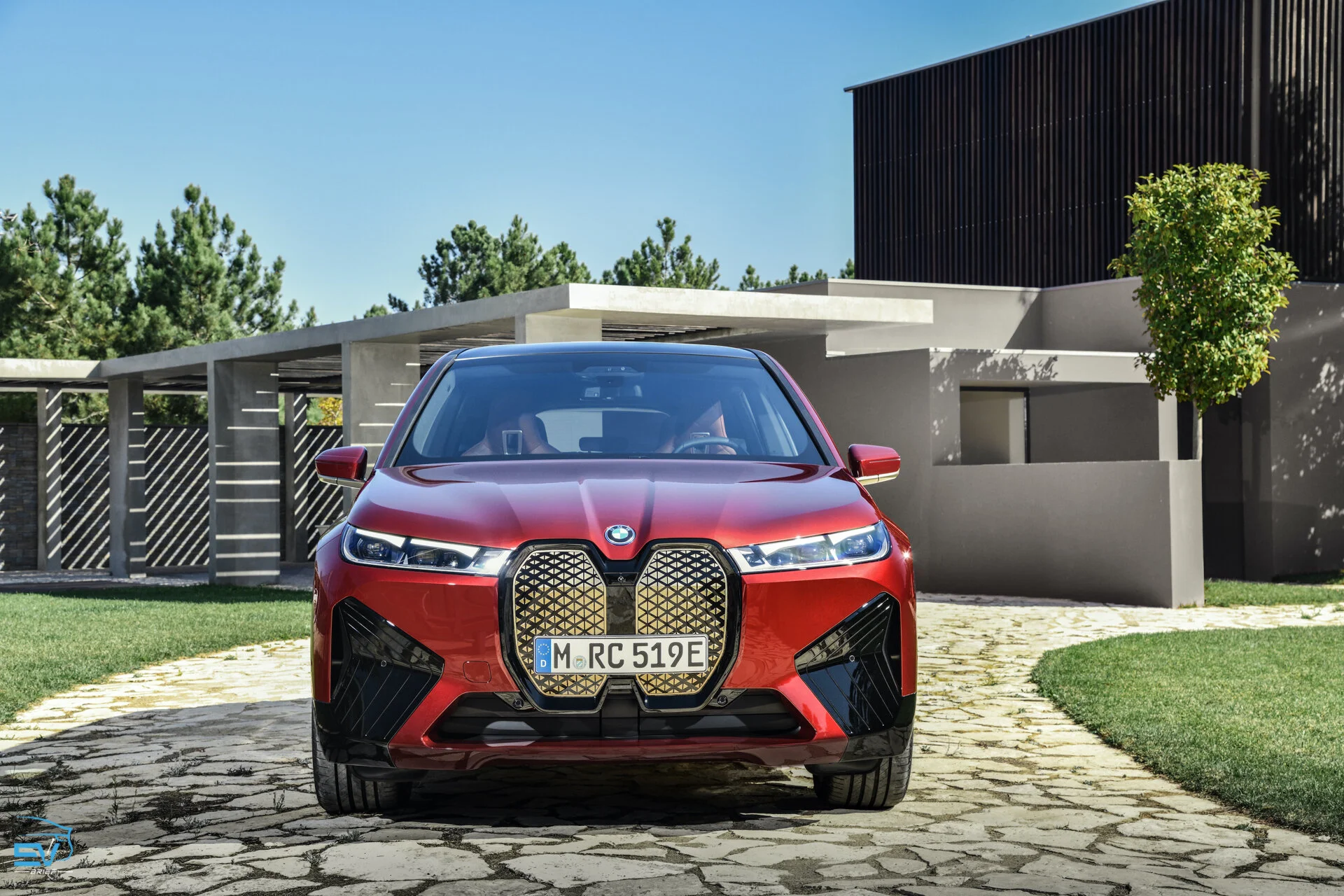
BMW Unveils 2021 Kidney Grille and Attached iX SUV
BMW’s 2021 iX is the production version of the iNext SUV concept, and debuts a new composite/aluminium spaceframe, 200kW DC fast charging, 370kW and energy consumption of less than 21kWh per 100km, but let’s face it, all anyone is going to be talking about is that grille.
Images: BMW AG
BMW’s 2021 iX is the production version of the iNext SUV concept, and debuts a new composite/aluminium spaceframe, 200kW DC fast charging, 370kW and energy consumption of less than 21kWh per 100km, but let’s face it, all anyone is going to be talking about is that grille.
The iNext concept featured a large air intake (that, strangely didn’t take in any air), headlights that resemble Japanese chef’s knives, a pillarless design and bold, clean surface that made for a futuristic interpretation of Munich’s family hauler.
The iX has toned things down a little; a result perhaps of the realities of different markets’ crash test requirements, and simple cost demands. While this vehicle represents a new design language for BMW, ultimately I'm less wowed than when BMW brought out the truly futuristic i3 and i8.
The front end is blunt; the slivered headlights futuristic, but that grille, oh that grille. With Ford’s Mustang Mach-E and Tesla’s Model Y and X shunning pretend air intakes, BMW has gone all in, claiming the grille is an “intelligence panel”. From BMW: “Camera technology, radar functions and other sensors are integrated seamlessly into the grille behind a transparent surface.”
The overall shape isn’t really anything new; it reminds us of an X5 and an X6 at the same time. The largely untextured fenders and doors are highlighted with rather nice polygonal arches; it looks like the designers formed them from clay with a palette knife. The tapered rear window line and split C-pillar are designed to hide the vehicles bulk, but for me this feature makes the iX look more like a minivan. The rear is the most successful view in my eyes, with bold tail light graphics and plenty of wide, horizontal creases accentuating the muscularity and sportiness of the iX.
On the subject of power, the iX features two motors, and 370kW of peak power. A torque figure is not provided by BMW, but it's safe to say the number of Newton metres is likely to be 'lots'; enough to propel the iX to 100km/h in under five seconds. BMW claims an efficiency target of 21kWh per 100 kilometres, aiming for a 600-plus kilometre WLTP range with a 100kWh battery.
The electric architecture provides for a long wheelbase, giving occupants plenty of space front and rear. The frameless doors are a nice touch, allowing passengers to see the carbon unibody construction as they enter the vehicle. Storage appears to be ample in the rear, but unfortunately, and inexplicably, there is no front storage. a gaping oversight or a technical decision?
The iX debuts BMW’s ‘Shy Tech’ concept, where technology is hidden in the background, behind design features and away from the driver’s eye. External cameras are concealed, all autonomous and safety sensors are hidden behind that grille, and the washer fluid reservoir is hidden under the BMW badge.
Shy tech is also aparent (or not) in the interior; the heads up display is recessed, speakers are hidden behind panels, haptic touch sensitive buttons are hidden within the wood trim and clean angles and textures abound. It’s nice to see manufacturers moving away from leather to more sustainable options like recycled fabrics and synthetic SensaTec vinyl. Seats can be optioned in a denim-like fabric, with interesting geometric patterns. Of course, leather will still be an option, but the quality and durability of synthetics is so good these days, there’s no reason to opt for the less sustainable option.
The iX will go head to head with the likes of Audi’s E-Tron, the Mercedes-Benz EQC and Cadillac’s Lyriq when it launches in the second half of 2021. Read the full press release below:
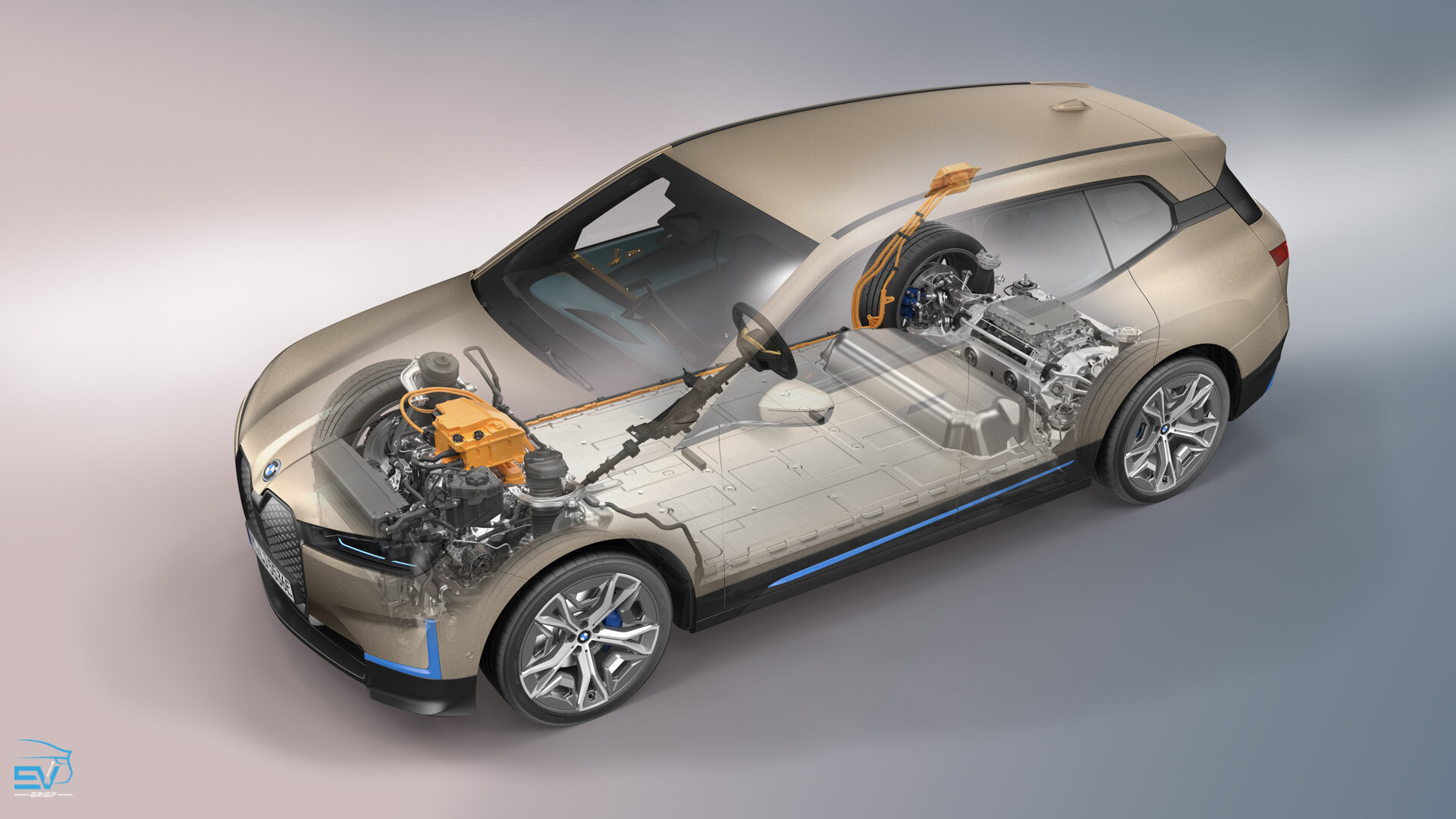
12th November 2020: The progressive all-electric BMW iX, which was shown to the world overnight, will launch in Australia in the second half of 2021.
The new model, which is inspired by the BMW Vision iNEXT, has been conceived from the outset for purely electric mobility and sees BMW redefine the brand’s successful Sports Activity Vehicle (SAV) concept.
With its newly developed precise and minimalist design, the BMW iX is the first representative of a trailblazing generation of vehicles poised to redefine the driving experience, the feeling of space inside and the relationship between vehicles and those on board.
The BMW iX harnesses the latest innovations in the fields of electrification, automated driving and connectivity to deliver a mobility experience that puts people at its heart more than ever before.
Its design has been developed from the inside out. The BMW iX has been created to provide quality of life and wellbeing for drivers and passengers. The clear and minimalist design of its exterior showcases a new form of mobility geared squarely to the needs of the vehicle’s occupants.
Its interior offers occupants innovative options for using the time during a journey while enjoying relaxation, safety, security and a new form of luxury in the process.
BMW Group’s new technology flagship – courtesy of BMW i, the “workshop for the future”
The design and technology of the BMW iX form an overall package that lays the foundations for what is in many respects a new kind of driving experience.
It comprehensively embodies the character of the BMW i brand, whose mission is to transform personal mobility. BMW i plays a central role at BMW Group as a “workshop for the future” and driver of innovation across the company.
“The BMW Group is constantly striving to re-invent itself,” said Oliver Zipse, Chairman of the Board of Management of BMW AG. “That is a central element of our corporate strategy. The BMW iX expresses this approach in an extremely concentrated form.”
The BMW iX will go into production at BMW Plant Dingolfing from the second half of 2021 as the BMW Group’s new technology flagship and will launch in Australia later in the second half of 2021.
It brings together the company’s latest developments in the strategic innovation fields of design, automated driving, connectivity, electrification and services. Added to which, the vehicle concept and design of the BMW iX are rooted in an all-embracing approach to sustainability.
This is reflected in areas of the vehicle such as its optimised aerodynamics, intelligent lightweight design and extensive use of natural and recycled materials, which help to create a cutting-edge sense of luxury and comprehensive feeling of wellbeing on board.
Fifth-generation BMW eDrive technology delivers outstanding efficiency and long range
The fifth generation of BMW eDrive technology – which encompasses the two electric motors, the power electronics, the charging technology and the high-voltage battery – guarantees exceptional efficiency.
The power unit developed by the BMW Group has been manufactured sustainably without the use of critical raw materials known as rare earths and will, by the most recent calculations, develop maximum output of more than 370kW. That will be enough to power the BMW iX from 0 to 100km/h in less than 5.0 seconds.
At the same time, the vehicle’s clear aim is to post an exceptionally low combined electric power consumption figure for its segment of less than 21kWh per 100 kilometres in the WLTP test cycle. A gross energy content of more than 100kWh should enable the latest-generation high-voltage battery to record a range of more than 600 kilometres in the WLTP cycle (All figures relating to performance, energy consumption and range are predicted values based on the car’s current stage of development).
DC fast charging: more than 120 kilometres of extra range in 10 minutes
The new charging technology of the BMW iX enables DC fast charging at up to 200kW. In this way, the battery can be charged from 10 to 80 per cent of its full capacity in less than 40 minutes. Added to which, within ten minutes enough energy can be fed into the battery to increase the vehicle’s range by more than 120 kilometres. It takes less than 11 hours to charge the high-voltage battery from 0 to 100 per cent at 11kW from a BMW i Wallbox.
The batteries fitted to the BMW iX are designed as part of a long-term resource cycle and enable an exceptionally high recycling rate. The power used to produce the battery cells and the high-voltage battery come exclusively from renewable sources.
New technology toolkit underpins further advances towards automated driving
The new technology toolkit making its debut in the BMW iX also provides the platform for significant progress in the areas of automated driving and digital services. For example, the level of computing power has been developed to process 20 times the data volume of previous models. As a result, around double the amount of data from vehicle sensors can be processed than was previously possible.
“We are setting new industry standards with the technology in the BMW iX,” said Frank Weber, Member of the Board of Management of BMW AG, Development.
“The iX has more computing power for data processing and more powerful sensor technology than the newest vehicles in our current line-up, is 5G-capable, will be given new and improved automated driving and parking functions and uses the high-performing fifth generation of our electric drive system.”
Fresh design for a new driving experience
The BMW iX is leading the way for a future generation of vehicles with which the company is redefining sustainability, driving pleasure and what it means to be premium. This trailblazing character is clearly expressed in the new model’s design. It provides the basis for a new kind of driving experience in which familiarity, relaxation and self-determination are the dominant themes.
The exterior of the BMW iX represents a distinctive re-imagining of the powerful proportions of a large BMW SAV. The BMW iX is comparable with the BMW X5 in length and width and is almost the same height as the BMW X6 on account of its flowing roofline. The size of its wheels, meanwhile, brings to mind the BMW X7 flagship.
The minimalist use of character lines and generously shaped surfaces conjure an aura of supreme assurance. The crisp lines, clear structure and almost rectangular contours around the wheel arches contribute to an imposing body design. And the reduced design language steers the eye onto precisely constructed details which accentuate the sophisticated character, brand identity and optimised aerodynamics of the BMW iX.
Front end: expressive, vertical kidney grille serves as an intelligence panel
At the centre of the front end stands the prominent, vertically emphasised kidney grille. Since the electric drive system of the BMW iX requires only a small amount of cooling air, the kidney grille is completely blanked off. Its role has duly turned digital and here it functions as an intelligence panel. Camera technology, radar functions and other sensors are integrated seamlessly into the grille behind a transparent surface.
Developed and produced at the BMW Group’s LuTZ lightweight design and technology centre in Landshut, the kidney grille for the BMW iX presents a technologically lavish advertisement for intelligent mobility. The grille has reinvented itself as an innovative and multifunctional high-tech interface for the advanced driver assistance systems with which the BMW iX paves the way for automated driving.
The kidney grille has an additional protective polyurethane layer that reduces susceptibility to minor damage such as stone chips. Should it sustain minor scratches or chips, it can heal itself within 24 hours at room temperature or five minutes of exposure to hot air.
Clearly designed surfaces, discreetly integrated technology
The exterior design highlights of the BMW iX also include the slimmest headlight units ever to feature on a series-produced model from BMW, the flush-fitted door openers (operated at the press of a button), the frameless side windows, the tailgate – which has no separation joints and extends across the whole of the rear – and the extremely slim rear lights.
The BMW kidney grille is not the only example of how the principle of ‘Shy Tech’ has been integrated into the design of the BMW iX; an array of other cameras and sensors are likewise positioned discreetly, the door openers are flush, the filler neck for the windscreen washer fluid is concealed under the BMW logo on the bonnet and the rear-view camera has been integrated into the BMW logo on the tailgate.
The technology stays in the background and only becomes apparent as and when the relevant functions are called into action.
“The BMW iX shows how we can give new technologies a very modern and emotionally engaging design,” said Adrian van Hooydonk, Senior Vice President BMW Group Design.
“The car is technologically highly complex, but it feels very clear and uncomplicated.
The BMW iX offers a mobile living space in which people will feel at ease and the car’s intelligence is always available without becoming obtrusive.”
Interior design: people at centre stage
A high level of spaciousness, a mixture of high-quality materials, newly developed seats with integral head restraints and an exceptionally large panoramic glass roof immerse all five seats of the BMW iX cabin in a luxurious, lounge-like ambience.
The all-new architecture of the BMW iX cabin underpins a perfectly clear and straightforward functionality that revolves entirely around the needs and emotions of the driver and their fellow occupants.
The drive concept means there is no centre tunnel, adding to the open, airy feel while also allowing extra legroom in the front and rear, sufficient space for storage facilities, and a centre console crafted to look like a high-quality piece of furniture. The minimalistic design language and clearly structured surfaces shine an even brighter spotlight on the feeling of spaciousness inside the car.
The displays and controls are all stripped down to the essentials, further reinforcing the impression of an uncluttered cabin offering a place of relaxation.
The technology of the BMW iX is used intelligently and only becomes visible when it is needed. This makes it intuitive to use rather than seeming overly complex. The interior design conveys a sense of safety and familiarity and engenders a new type of bond between occupants and vehicle.
The Shy Tech approach for the interior can be seen in a number of features, including speakers integrated out of sight, intricately styled air vents, heated surfaces and the discreet recessing of the BMW Head-Up Display’s projector into the instrument panel so it is almost invisible. The hexagonally shaped steering wheel, a rocker switch for gear selection and the BMW Curved Display – which forms part of the next-generation BMW Operating System – clearly advertise the futuristic form of driving pleasure on offer.
Intelligent lightweight design and optimised aerodynamics increase range
The energy and range of the BMW iX benefit from innovative solutions in the areas of lightweight design and aerodynamics. Its body structure, featuring an aluminium spaceframe and innovative Carbon Cage, can claim extremely high torsional stiffness, which in turn enhances agility and maximises occupant protection, while minimising weight.
The intelligent material mix, with a variety of materials employed exactly where their specific properties can be utilised to best effect, is unique in this segment. Combined with superb aerodynamics, the intelligent material mix helps to endow the iX with remarkably composed, relaxed driving characteristics together with instant, precise response to every movement of the accelerator and turn of the steering wheel.
Fully capitalising on the benefits provided by the all-electric drive system and meticulously implementing proven measures from the past in the front end of the vehicle, the underbody section, the wheels and the rear end gives the BMW iX optimised aerodynamics which have a positive effect on both the performance and range of the purely electrically powered SAV.

Hyundai's Kona Electric Debuts a New Look for 2021
Hyundai’s design language, much like the company itself has come a long way over the last few decades. From humble origins echoing the form of best-selling models from Japan and the USA, to the creation of the brand’s own identity under Peter Schreyer, Luc Donckerwolke and SangYup Lee, the 2021 Kona and Kona Electric continue Hyundai’s recently-introduced ‘Sensuous Sportiness’ design theme.
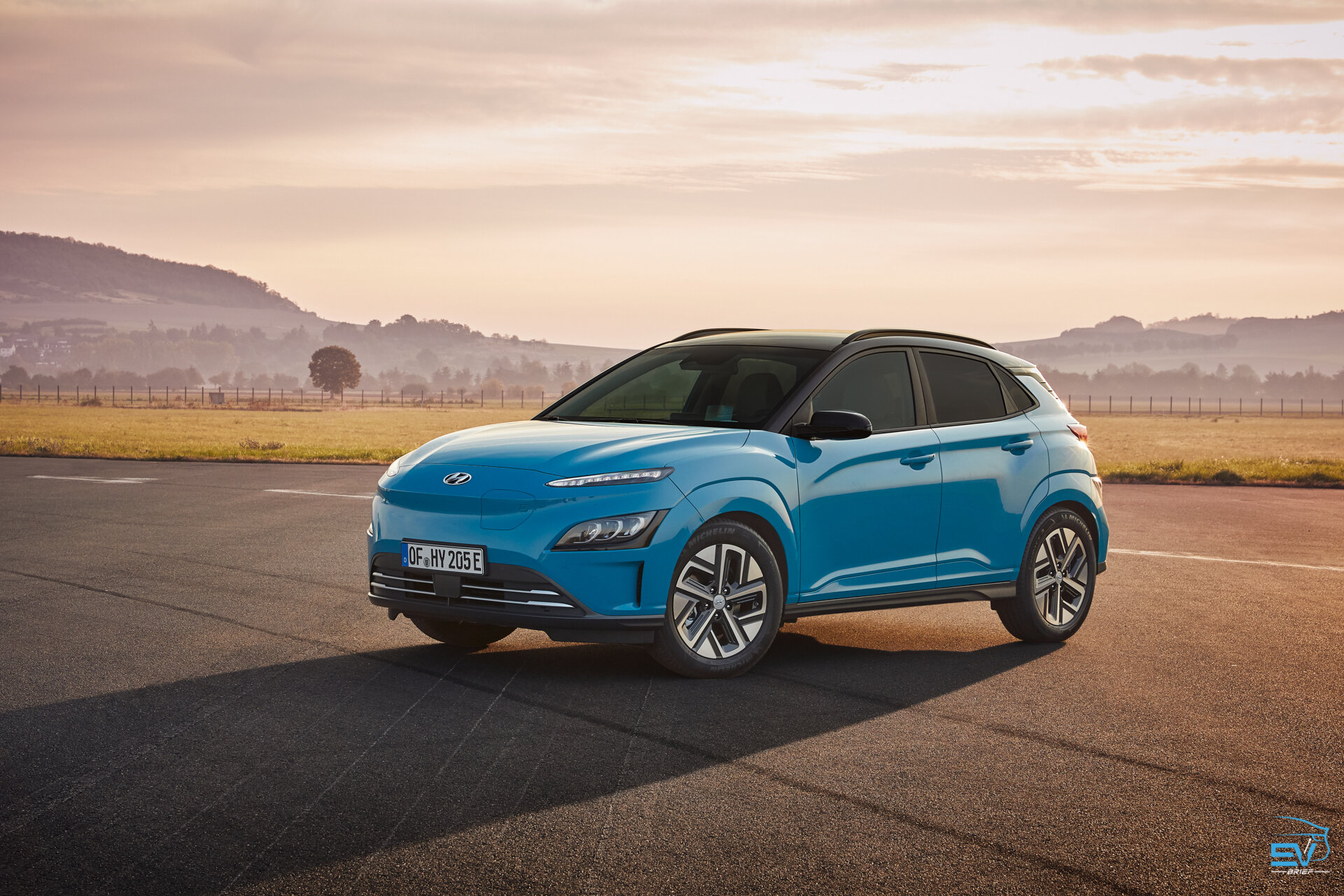
Image: Hyundai Australia
Hyundai’s design language, much like the company itself has come a long way over the last few decades. From humble origins echoing the form of best-selling models from Japan and the USA, to the creation of the brand’s own identity under Peter Schreyer, Luc Donckerwolke and SangYup Lee, the 2021 Kona and Kona Electric continue Hyundai’s recently-introduced ‘Sensuous Sportiness’ design theme.
The result is a handsome SUV; the front end is confident yet elegant, and somehow mananges to avoid the clumsy look carried by Jeep’s split-headlight offerings, no doubt due to the grill-less nose. The side profile is quite simple, but beefy wheel arches accentuate the Kona Electric’s rugged ambitions, and sharp door creases reduce any slab-sided appearance.
The 2021 Kona Electric will be available in the following colours, but availability may be limited by market:
Dive in Jeju [New]
Silky Bronze [New]
Shimmering Silver [New]
Ignite Flame [New]
Misty Jungle [New]
Surfy Blue [New]
Teal [New]
Cyber Grey [New]
Atlas White [New]
The interior is largely unchanged, but the Kona Electric is a fine (if traditional) place to be. With a new 10.25-inch LCD instrument cluster in front of the driver and a 10.25-inch centrally mounted touch screen, information and infotainment is easily at hand.
The Kona Electric comes with a raft of active and passive safety systems under the banner of Hyundai SmartSense:
[NEW] Blind-Spot Collision-Avoidance Assist (BCA)
[NEW] Rear Cross-Traffic Collision-Avoidance Assist (RCCA)
[NEW] Leading Vehicle Departure Alert (LVDA)
[NEW] Safe Exit Warning (SEW)
[NEW] Rear Seat Alert (RSA)
Forward Collision-Avoidance Assist with pedestrian and cyclist detection (FCA-Ped)
Smart Cruise Control with Stop & Go (SCC w/ S&G)
Lane Following Assist (LFA)
Lane Keeping Assist (LKA)
Intelligent Speed Limit Warning (ISLW)
Driver Attention Warning (DAW)
While there are no changes to the drivetrain, this is no bad thing, with the Kona Electric producing 150kW maximum power and 395Nm of torque from it’s 64kWh battery pack. The battery can be charged via 100kW DC fast charging, topping up from 10-80% in 47 minutes according to Hyundai. The company also claims class-leading range, with a WLTP rating of 484 kilometres.
Charging Times
DC Fast Charging (10-80%)
50kW Charger -64min
100kW Charger - 47min
AC Normal Charging (10-100%)
7.2kW on-board charger - 9h 15min
10.5kW on-board charger - 6h 50min
In Cable Control Box (ICCB) Charging (10-100%)
(220V/12A) - 28h
The Kona Electric is expected to arrive in Australia in the first half of 2021, and is currently priced at $60,740 before on-road costs. European and North American customers can expect cars on the road before the end of 2020.
11 November, 2020 - Hyundai Motor has made a series of updates to its successful all-electric small SUV, the Kona Electric. In order to make the new Kona Electric an even better product for its customers, the upgrades revolve around design, technology, and practicality.
Since launching in 2018, demand for the Hyundai Kona Electric has exceeded all expectations globally, thanks to its powerful electric drivetrain, long driving range and stylish SUV looks. In just two years, over 120,000 units have been sold globally.
In August, three production models set a new range record of 1,026km on a single battery charge at the Lausitzring in Germany. Meanwhile, in January, the Kona Electric made it into the GUINNESS WORLD RECORDS™ under the category “Highest Altitude Achieved in an Electric Car”, after being driven to an altitude of 5,731m to Sawula Pass in Tibet.
The new Kona Electric has undergone bold design upgrades for a dynamic new look, as well as featuring safety enhancements and an advanced technology package.
“When we launched the Kona Electric in 2018 as the world’s first fully-electric small SUV, it represented a major step forward for affordable e-mobility,” says Andreas-Christoph Hofmann, Vice President Marketing and Product at Hyundai Motor Europe. “With the new Kona Electric, we’re showing that Hyundai is fully committed to zero-emissions driving, by providing our customers with enhanced driving assistance and safety features, making it an even more desirable package.”
Bold exterior design upgrades for a clean and stylish appearance
The new Kona Electric has undergone a series of bold exterior design updates. By combining a clean and sleek appearance with the protective and bold small SUV body type of the Kona, it expresses its exceptional electric technology while being even more recognisable on the road.
The front with the new-look closed grille features a pure and clean design. This modern look is further enhanced by the new LED Daytime Running Lights, which emphasise the car’s wide stance. The front is complemented by an asymmetric charging port, a feature unique to the Kona Electric which makes a strong statement about driving electric.
New, sharper headlamps stretch around the side of the car. The high-tech headlamp inner bezel now incorporates multifaceted reflector (MFR) technology. The headlamps are connected to the painted wheel arch claddings, giving the new Kona Electric a distinctive and sophisticated look. Vertical air inlets in front of the wheel arch claddings enhance its aerodynamics, substantially reducing turbulence in the front wheelhouse area. Meanwhile, a functional air intake in the lower bumper is visually enhanced by horizontal satin accent bars, which give it a pronounced stance.
The rear bumper retains the accent bars to add value to the overall look of the car, while new horizontally-stretched rear lamps complement the pure appearance of the front.
Like the new Kona with internal-combustion powertrains, the new Kona Electric is 40mm longer than the previous version. This ensures it has a dynamic appearance combined with a strong visual stance.
Segment-leading driving range
Like its predecessor, the new Kona Electric offers zero-emissions battery electric powertrains, with no compromises on performance.
The new Kona Electric retains its 64kWh battery and electric motor, which delivers maximum power of 150kW and a maximum speed of 167km/h.
Delivering 395Nm of immediate torque, ensures the new Kona Electric is fun-to-drive with full power available from the first second.
Since its launch in 2018, the Kona Electric has been equipped with one of the best all-electric driving ranges in its segment. With tyre improvements Kona Electric offers a class-leading range of 484km (WLTP) on a single charge.
The shift-by-wire system enables operation of the car simply by pressing buttons to switch driving modes. It also eliminates the routing space required for housing the mechanical linkages between a normal shifter and the transmission, providing additional storage space in the front of the car.
The Smart Adjustable Regenerative Braking system allows the new Kona Electric to automatically set the regenerative braking level, while paddle shifts behind the steering wheel allow the driver to adjust the intensity of the regenerative braking. The system recuperates additional energy when possible. Regenerative braking is maximised when keeping the left pedal held, allowing the driver to even bring the vehicle to a full stop – without use of the brakes.
Charging the lithium-ion polymer battery from 10 to 80 per cent only takes about 47 minutes using a 100kW direct current (DC) fast charger. The Kona Electric features an optional 10.5-kW three-phase on-board charger, allowing for significantly shorter charging times using public three-phase AC charging stations or with a private compatible wall box at home. Drivers also have the option of charging their car at a compatible regular household power socket using the ICCB-cable (in-cable control box).
An updated interior with progressive technology
For the first time, the new Kona Electric is equipped with a 10.25-inch digital cluster, while the 10.25-inch multimedia screen is carried over from the last update.
Meanwhile, new ambient light technology illuminates the passenger and driver side footwell, emphasising the lifestyle character of the vehicle.
Even more best-in-class safety features
The new Kona Electric features a state-of-the-art Hyundai safety package for peace of mind. Hyundai SmartSense provides comprehensive, best-in-class active safety and driving assistance systems, and the new Kona Electric is now equipped with even more functions than its predecessor.
Upgraded Hyundai SmartSense features that feature on the new Kona Electric include Rear Cross-Traffic Collision-Avoidance Assist (RCCA) and Blind-Spot Collision-Avoidance Assist (BCA), which offer not just warnings to drivers, but also implement the brakes where necessary. RCCA works to avoid a collision when reversing, as the car’s sensors detect approaching vehicles from both sides, with the brakes applied if necessary. Meanwhile, BCA engages the car’s differential brakes to prevent an accident if another vehicle is detected near the rear corner and the driver attempts to change lanes.
Another feature new to this model is Leading Vehicle Departure Alert (LVDA), which alerts the driver if they do not react fast enough when the vehicle ahead of them starts moving.
Further new safety features include Safe Exit Warning (SEW) and Rear Seat Alert (RSA). SEW warns passengers intending to exit the vehicle if it is not yet safe to do so. RSA is a door-checker feature that recognises if the rear doors have been opened prior to departing. When the drive is completed, the car alerts the driver if someone or something is in the back seat when they open the doors.
Hyundai SmartSense safety features:
[NEW] Blind-Spot Collision-Avoidance Assist (BCA)
[NEW] Rear Cross-Traffic Collision-Avoidance Assist (RCCA)
[NEW] Leading Vehicle Departure Alert (LVDA)
[NEW] Safe Exit Warning (SEW)
[NEW] Rear Seat Alert (RSA)
Forward Collision-Avoidance Assist with pedestrian and cyclist detection (FCA-Ped)
Smart Cruise Control with Stop & Go (SCC w/ S&G)
Lane Following Assist (LFA)
Lane Keeping Assist (LKA)
Intelligent Speed Limit Warning (ISLW)
Driver Attention Warning (DAW)
Increased comfort and convenience
A number of convenience features allow for a more comfortable ride, in particular for back seat passengers. As with its predecessor, the new Kona Electric’s second row heated seats allow rear passengers to relax when travelling on longer journeys. The new second row USB port delivers additional power to recharge devices on-board if needed.
Meanwhile, an electric parking brake offers even more reassurance for drivers, and can be activated by the simple push of a button.
Australian Market
Arriving locally in the first half of 2021
Long range 64kWh version only for our market (a smaller capacity 39.2kWh model is also offered overseas)

Meet the MG ZS EV: Australia's Most Affordable Battery Electric Vehicle
Enter MG’s all-new zero emission ZS EV. Priced from $43,990 AUD (inclusive of on-road costs), it takes the crown for the most affordable fully electric vehicle on sale in Australia, undercutting the Hyundai Ioniq BEV by about $15,000

Image: MG Motors
On the one hand, MG traditionalists must be up-in-arms over the manufacturer’s current range of SUVs. Though the MG ZS EV is a long way from the classic MGB GT or elegant MGA, the reality is that the Australian passenger car market is dominated by SUV sales in 2020. Every manufacturer has multiple toes in the crossover pool, and can you blame them? At the top end of the market, Porsche SUV sales have arguably saved the brand, accounting fo 68% of sales worldwide, but across the spectrum, brands are finding new customers with SUVs of all sizes.
Unfortunately for the planet, SUVs aren’t exactly green, and have a large environmental footprint. Enter MG’s all-new zero emission ZS EV. Priced from $43,990 AUD (inclusive of on-road costs), it takes the crown for the most affordable fully electric vehicle on sale in Australia, undercutting the Hyundai Ioniq BEV by about $15,000, and the equivalent Kona Electric SUV by about $23,000.
The MG ZS EV features a 45kWh battery, and is rated to offer up to 263km in combined driving (WLTP) but MG Australia and New Zealand CEO Peter Cao says the car can drive up to 370km in stop-start city traffic. With three driving modes as well as three levels of regenerative braking, the new electric MG has the ability to charge to 80% in 45 minutes at a max charge rate of 85kW.
With 105kW of power and 353Nm torque, the ZS EV can reach 60 km/h in 3.2 seconds, and 100 km/h in 8.2 seconds.
With safety a top priority, the ZS EV has a range of active and passive features, including lane keeping, rear cross traffic alerts, and intelligent speed assist that helps the driver keep to the speed limit and follow the car in front.
The ZS EV offers a good range of standard equipment, including touchscreen infotainment system, Android Auto/Apple Carplay, keyless entry and start and numerous active and passive safety systems.
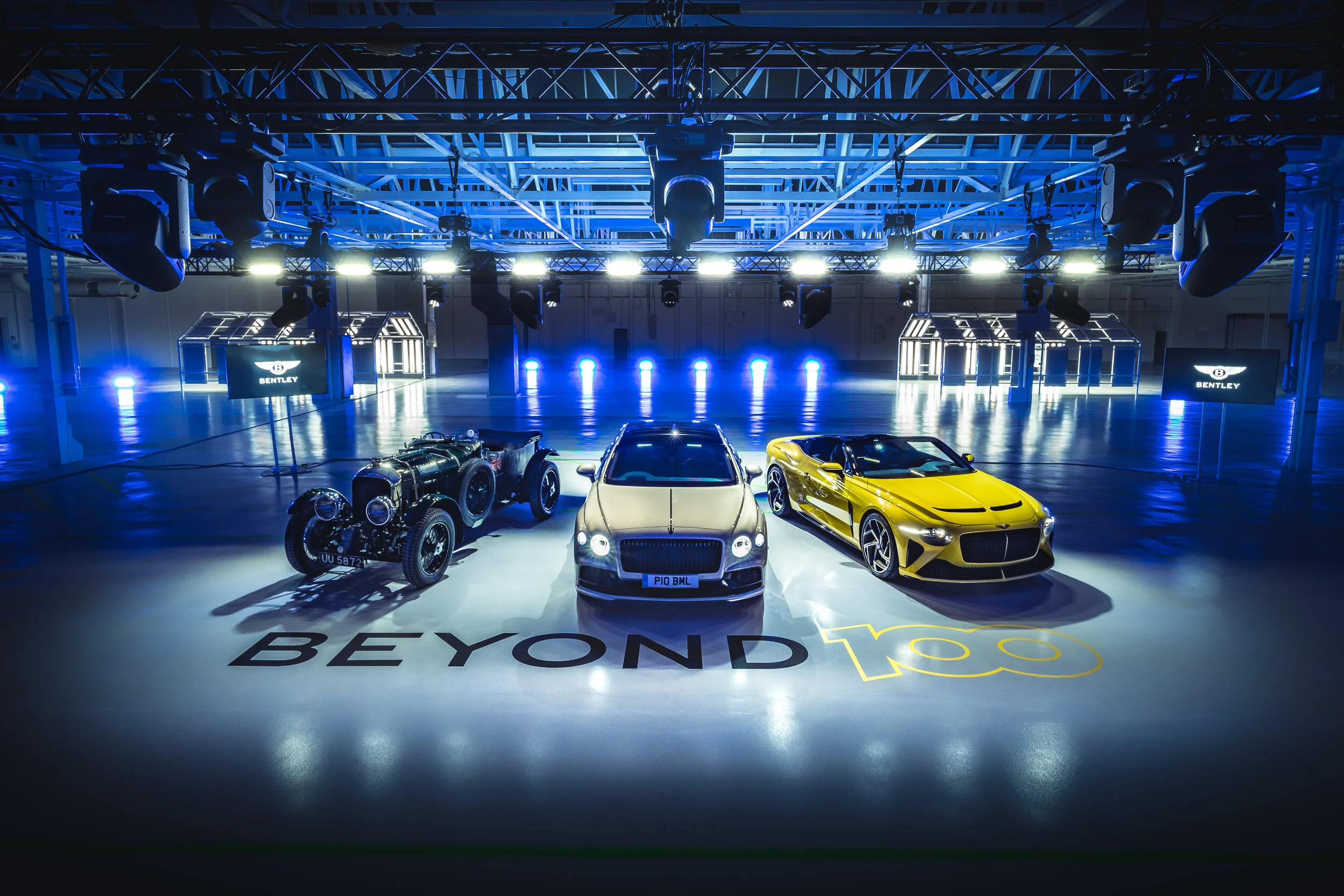
Bentley Targets Sustainable Luxury; Announces Plan to Ditch Internal Combustion by 2030
November 2020 will be remembered as a watershed moment for Bentley Motors; one of the world’s oldest car makers with arguably one of the industry’s most storied histories has announced measures to electrify their new vehicle fleet by 2026.
Image: Bentley Motors
November 2020 will be remembered as a watershed moment for Bentley Motors; one of the world’s oldest car makers with arguably one of the industry’s most storied histories has announced measures to electrify their new vehicle fleet by 2026. Bentley Plans to offer only Battery Electric Vehicles (BEV) or Plug-In Hybrid Electric Vehicles (PHEV) by this date, eventually transitioning to a BEV only range by 2030.
Adrian Hallmark, Chairman and Chief Executive Officer of Bentley Motors, said: “Since 1919, Bentley has defined luxury grand touring. Being at the forefront of progress is part of our DNA - the original Bentley boys were pioneers and leaders. Now, as we look Beyond100, we will continue to lead by reinventing the company and becoming the world’s benchmark luxury car business.
“Driving this change includes, and also goes beyond our products, delivering a paradigm shift throughout our business, with credibility, authenticity, and integrity. Within a decade, Bentley will transform from a 100 year old luxury car company to a new, sustainable, wholly ethical role model for luxury.”
Bentley also plans to implement an end-to-end, business-wide sustainability program. The Crewe factory is already certified carbon neutral, and by the end of 2025, the company will have reduced its emissions, use of solvents and become plastic neutral, with the ultimate aim of a climate positive factory by 2030.
Source: Bentley Motors

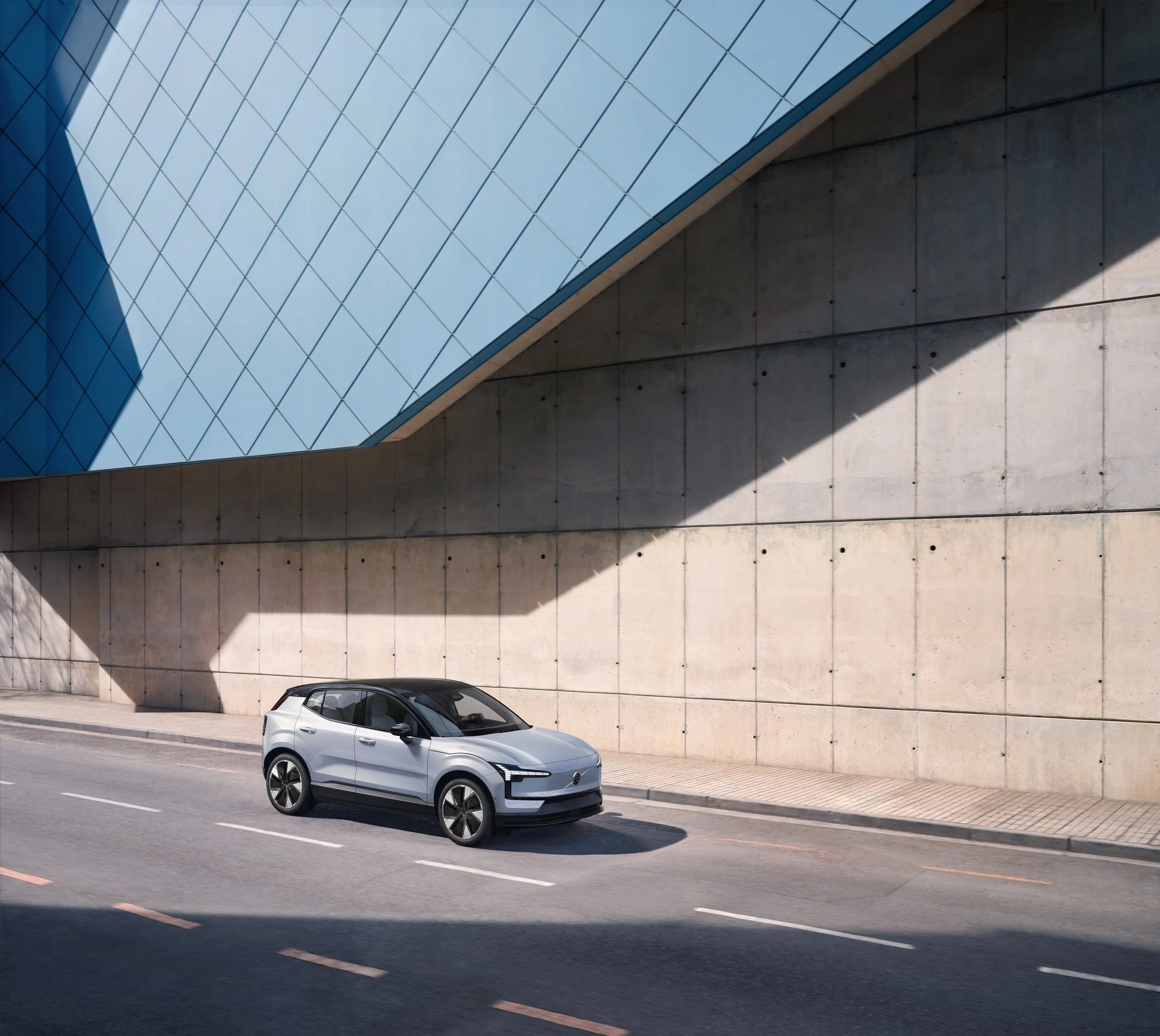


Polestar and Deepal expand Australian operations as they seek growth in the local market