
AGL expands electric vehicle subscription service to Brisbane, Queensland
As traditional energy retailers look for additional revenue streams in the face of falling demand for fossil fuel derived electricity, greater uptake of behind the meter solar and changing consumer preferences, AGL is expanding its electric vehicle subscription service to Brisbane, Queensland, after initially rolling it out in Sydney and Melbourne late last year.

AGL expands EV subscription serivce to third australian city
As traditional energy retailers look for additional revenue streams in the face of falling demand for fossil fuel derived electricity, greater uptake of behind the meter solar and changing consumer preferences, AGL is expanding its electric vehicle subscription service to Brisbane, Queensland, after initially rolling it out in Sydney and Melbourne late last year.
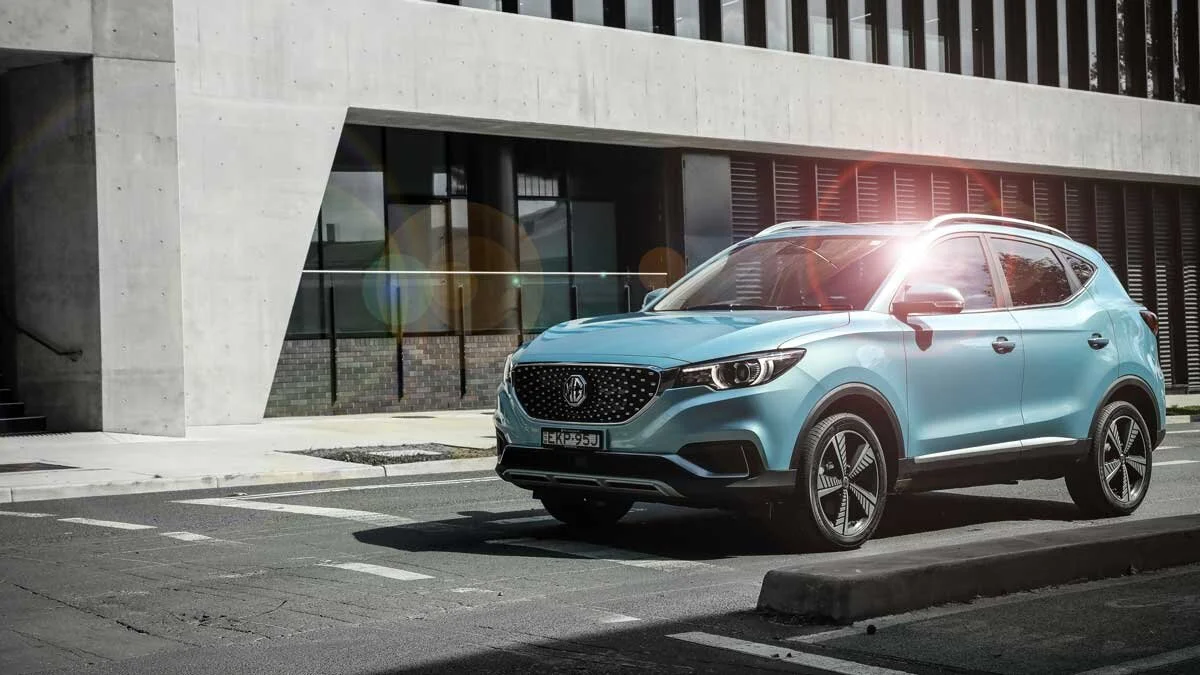
Starting from $299 per week, customers can choose from an MG ZS EV or a Hyundai Ioniq. For $599 per week, customers can get there hands on the Tesla Model 3 Standard Range Plus.
There's a one-off $800 sign up fee, plus a $150 fee if subscribers cancel within the first six months.

AGL is offering a month-to-month all-inclusive EV subscription plan

A range of models are available, including Nissan's Leaf and Hyundai's Ioniq.

For a higher weekly price, subscribers can access the excellent Hyundai Kona Electric or Tesla Model 3.
This equates to $15,152 per year for either the MG ZS EV or Hyundai’s Ioniq. If you’d like to step up to Tesla’s Model 3 Standard Range Plus, it’s going to cost you $29,552 per year (gulp). While there are many benefits to this program—the ability to change vehicles every six months, inclusive serving and insurance and no need to pay a deposit on the vehicle—this still appears to represent poor value compared to just leasing a vehicle over 3-6 years.
If one was to lease a Model 3 in Australia direct from Tesla/Pepper Finance on an 36 month term with a driveaway price of $71,996 for the Standard Range Plus vaiant, One would pay $1,232/mo in the first year for the car, plus the following:
$150 deposit
$2350 12 months comprehensive insurance (approx. average price)
$500 for annual service (approximate)
$1,000 wallbox charger + installation fee (approximate)
$1,000 for tyres (unlikely, but let’s just include it)
If we add those costs to the vehicle repayments of $14,784 for the first twelve months, that’s $19,784 total for the first year of ownership, or around $10,000/$833 per month less expensive than AGL’s plan.
Despite appearing to offer poor value, many consumers not familiar with the EV market, or simply sick of having to deal with dealerships and sales staff may find benefits in a subscription plan like AGL’s. If you want to try a selection of EVs, you have the ability to change vehicles every 6 months, and you also have the peace of mind of no additional costs outside the monthly repayment.

Volkswagen's ID.4 launches in the UK, 1st Edition specification priced from £40,800
VW has launched the ID.4 electric SUV in the UK market, priced from £37,800 after the government Plug-in Car Grant. Initially only available in the 1st Edition trim, the ID.4 features a single rear motor producing 150 kW, with a maximum torque output of 310 Nm.

VW’s ID.4 LANDS IN THE UK, WITH DELIVERIES COMMENCING IN MARCH 2021
Featuring a 77kWh battery with 498 kilometres (310 miles) range (WLTP)
Rear-motor, 150kW/310Nm
Available initially as 1st Edition trim level only
Priced from £40,800 RRP OTR, or approximately £37,800 after Plug-in Car Grant
Available in dealerships from March 2021
VW has launched the ID.4 electric SUV in the UK market, priced from £37,800 after the government Plug-in Car Grant. Initially only available in the 1st Edition trim, the ID.4 features a single rear motor producing 150 kW, with a maximum torque output of 310 Nm.

The ID.4 will be able to rapidly charge up to 125kW. Images: Volkswagen UK
WIth a 77 kWh net capacity, the ID.4 offers an official WLTP range of 498 kilometres (310 miles), however take that with a grain of salt, as real-world driving has shown a 10-15 per cent reduction on this figure. Luckily the ID.4 offers fast charging capacity up to 125kW, allowing ID.4 owners to add around 320km (199 miles) in 30 minutes. The battery pouch cells and pack are manufactured by LG Chem in Poland, featuring the company’s NCM 712 battery cells. These batteries have been in production since 2020, and feature the company’s new chemistry of 7 parts nickel to 1 part cobalt to 2 parts manganese, providing greater energy density, reduced manufacturing costs and a smaller environmental footprint.

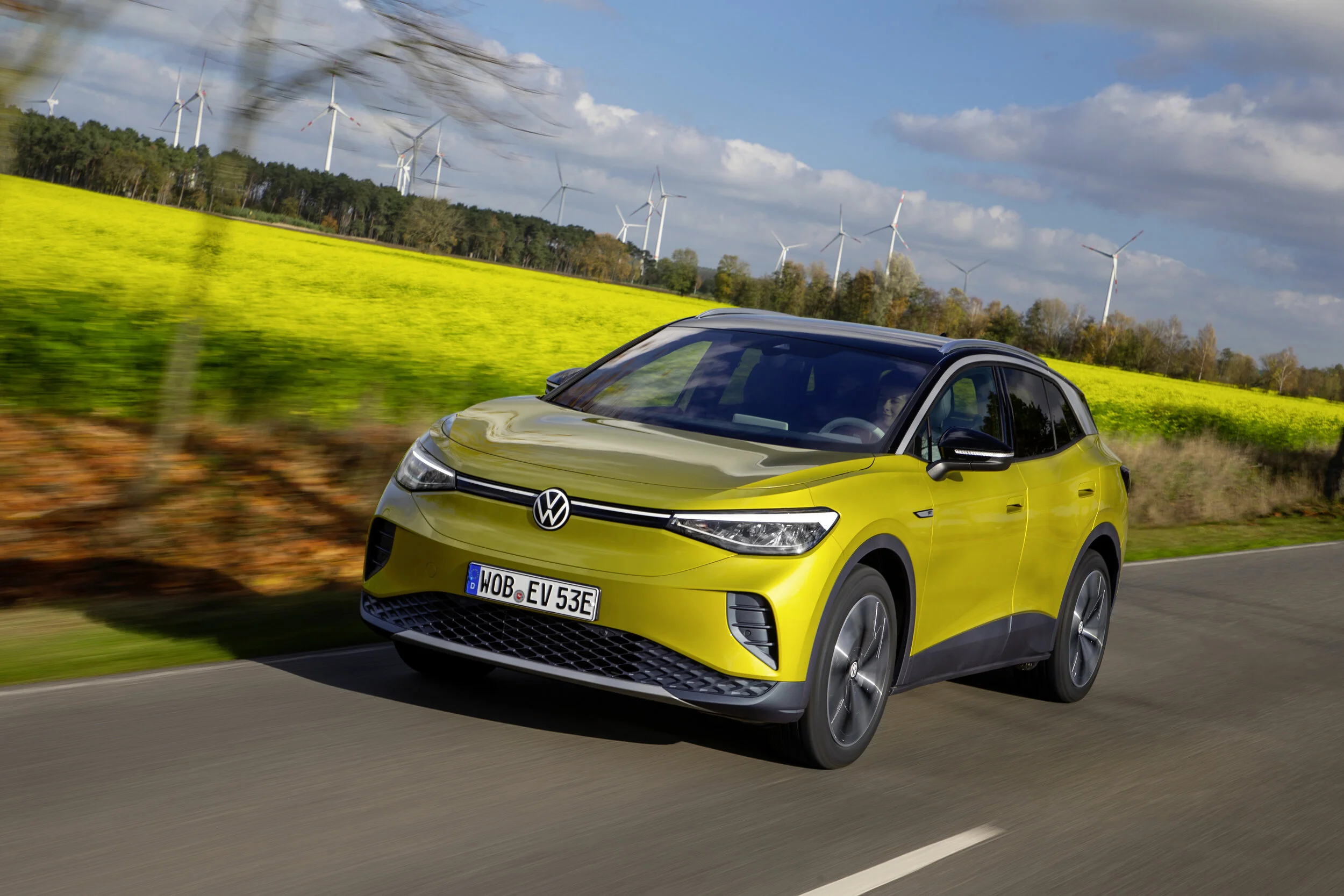
The ID.4 is pictured in striking Honey Yellow with contrasting silver-painted roof arch.
Similar to the launch variant of the ID.3 1ST Edition, the ID.4 first edition features special badging, an interior with Artvelours micro-fleece seats with Florence Brown highlights, and a selection of colours including Glacier White, Blue Dusk, Honey Yellow (pictured) and Manganese Grey.

The VW ID.4 features Artvelours micro-fibre seats, and a driver zone and infotainment system from the ID.3 hatchback.
A full suite of safety features are included, with adaptive cruise control, lane assist with blind spot warning, autonomous emergency breaking and front and rear parking sensors. the 10-inch Discover Pro navigation system is included, and is controlled via a rather prominent screen perched on the dash like the ID.3. The nifty ID. Light is also included, which flashes, pulses and changes colour to communicate various information to drivers such as navigation instructions, charging status or responses to voice input.

The ID.4 is based on Volkswagens Modular Electric Drive Matrix (MEB) platform.
Sadly, There are no plans to bring any electrified Volkswagen model to Australia any time before 2023 according to Car Expert. With little in the way of emissions standards, fuel quality standards or EV incentives, Australia is not seen as a priority for companies like Volkswagen, Mercedes-Benz or Kia. While China, the United States and the United Kingdom have strict CO2 emissions requirements for new vehicles, they also offer incentives for the purchase of zero emissions vehicles, providing an ultimatum for automakers to cease retailing internal-combustion engined cars.


Lucid Motors reveals Arizona factory paint shop; targets 400,000 units per year across four models
On the back of news that Tesla Motors has begun construction on what may be the world’s most advanced automotive paint shop, Lucid Motors has released details on its paint shop under construction in its AMP-1 factory, located in Casa Grande, Arizona.

Lucid’s Arizona factory to produce high-end paint finishes, starting with 30,000 Lucid AIR Sedans per year
On the back of news that Tesla Motors has begun construction on what may be the world’s most advanced automotive paint shop, Lucid Motors has released details on its own paint shop currently under construction in its AMP-1 factory, located in Casa Grande, Arizona.
Lucid Motors’ competitor Tesla has been criticised in the past for many poor (and downright ghastly) paint jobs over the years. Recently however, Sandy Munro was thoroughly impressed with the exterior paint on a brand new 2021 Model—anecdotal evidence of course—which implies things may be improving in Tesla’s paint shop and its QA checks.
For many, Porsche has always been held up as among the best in the business when it comes to high-grade exterior finishes, and Lucid is clearly watching the big German manufacturers and Tesla closely to ensure its vehicles’ paint matches the company’s luxury image.

A Lucid Air after what appears to be the pretreatment and sealer phases of the painting process.
According to Mike Boike, Director of Manufacturing, “We're competing against the best in the world, and we know it.” he added. “So the processes and the materials that we use are nothing but the best in the world. We've got the latest and greatest paint process. We have the latest and greatest materials, and we have a high-powered team of engineers and manufacturing professionals.”
Lucid’s paint shop process involves the following steps:
Pretreatment and Electrocoat: As each Lucid Air comes out of the body shop, it gets rigorously cleaned. Then we apply both a thin film coating and electrodeposition coating, which protect the entire body structure from corrosion.
Sealer: Next we thoroughly seal the vehicle to prevent any type of air or water intrusion that could create road noise or water leakage into the car.
Paint: Once the unit is sealed and sanded, it’s then sent into the paint booth. Here, we’ve integrated the latest innovative process and materials technologies that result in a flawless, luxurious finish.
Finesse: Finally, post-bake, the car is brought to the finesse deck where a team inspects and polishes it to perfection before approving to ship to the customer.

Lucid’s automated painting process
Lucid plans to commence building the Air sedan in 2021, and is aiming for 30,000 vehicles in its first full year of production. According to the company, it’s more economical to build the paint shop based on the eventual full capacity of the plant, which is 400,000 units per year.

Lucid’s second model line, a luxury SUV codenamed “Project Gravity”
Lucid’s second vehicle will be a luxury SUV currently codenamed Project Gravity, which will arrive in 2023.
Source: Lucid Motors
![Tesla Reveals Revised Model S and Model X; Introduces Plaid and Plaid+ Tri-Motor Options [updated]](https://images.squarespace-cdn.com/content/v1/5237a580e4b09510ca448d5e/1611890523192-0MQ4K3Q99FBEGYR4DWCI/tesla-model-s-refresh-210.jpg)
Tesla Reveals Revised Model S and Model X; Introduces Plaid and Plaid+ Tri-Motor Options [updated]
Tesla revealed revised versions of both the Model S sedan and Model X SUV during the company’s Q42020/FY2020 earnings announcement on Wednesday, Pacific time. Though many speculated the company may cut the Model X altogether due to slow sales, Tesla has in fact rolled out a refreshed and upgraded Model X including a Plaid performance variant.

Model S Plaid+ headlines revised range with over 1,100hp and a sub 9 second quarter mile
Model S will come in Long Range, Plaid and Plaid+ variants starting from USD$79,990, C$114,990 and AUD$129,990
Model X will come in Long Range and Plaid variants starting from USD$89,990, C$124,990 and AUD$149,990
Plaid+ boasts 520 mile (836 kilometre) range and will likely features Tesla’s new tabless 4680 cells
Both models feature redesigned interior with three screens, cut off steering wheel
Tesla revealed revised versions of both the Model S sedan and Model X SUV during the company’s Q42020/FY2020 earnings announcement on Wednesday, Pacific time. Though many speculated the company may cut the Model X altogether due to slow sales, Tesla has in fact rolled out a refreshed and upgraded Model X including a Plaid performance variant that may even tempt some buyers out of the Model Y and new Model S.

The revised Model S sedan. Image: Tesla
The revised Model X SUV. Image: Tesla
Exterior
Subtle exterior updates are the order of the day, with both the Model S and Model X receiving blacked out trim covering window frames, exterior mirrors, door handles and rear trunk lid stripbaimilar to the Model 3 and Model Y. There is a new selection of wheels for both models, as well as subtle detail changes to the front air intakes and bumper. It appears that there might be a slight increase in the track of the Model S, with ever-so-slightly wider arches than the 2020 model, but we won’t know for sure until the official dimensions are released.

Blacked-out trim pieces the order of the day for Tesla’s new Model S.
Technology
Under the metal, both the Model S and Model X will utilise the heat pump technology seen on Tesla’s Model Y and 2021 Model 3, known as the Super Manifold (you can see more on this piece of hardware in Sandy Munro’s teardown) and this piece of technology will provide improved cold-weather performance, greater HVAC efficiency without an antiquated electric heating element, and thermal cooling to battery, motor and other systems. The battery packs have also been redesigned, and Tesla claims the 2022 Model S and Model X are capable of 5X more high-speed quarter mile runs than previous battery architecture (for what that’s worth)
Interior
The interiors of the new models are where Tesla fanboys and fangirls will be most gratified, with substantial changes to trim, interior architecture and technology. The first element that grabs the observer is the yoke-style steering wheel that wouldn’t be out of place on a Cessna aircraft. Tesla’s version features a lot more technology however, with the company’s traditional scroll wheels integrated, as well as Ferrari-style buttons for vehicle functions such as indicators and headlights, removing protruding stalks from the steering column. Another benefit of removing buttons and stalks from interiors is that when Tesla rolls out its autonomous Robotaxi fleet, there’s nothing for passengers to potentially interfere with or damage.

The central rear screen will allow rear seat passengers to game away the hours.
One overlooked feature in the press release is a new 960 watt 22 speaker audio system with active noise cancelling. That’s the technology inside your favourite headphones for long haul flying, and it uses microphones to pick up distracting low-frequency noise, and fires back phase-inverted frequencies into your ear to enhance your listening experience. Tesla is looking to tech to solve a problem most other manufacturers try to alleviate with sound deadening insulation, double glazing and acoustic panels. It will be interesting to see its effectiveness.
In addition, Tesla has eliminated the vertical central touch screen, and reverted to a landscape orientation screen like the Model 3. This has been rumoured for some time, however the unlike the Model 3, the Model S and Model X keep the driver’s main screen and also add a rear screen that can be used for gaming via wireless controllers. Tesla says the system features a 10 teraflop processor (as much as a Playstation 5), but it’s not known if the graphics processing unit is the company’s own or one sourced from a third party such as Nvidia. The rear compartment also receives wireless charging pads in the centre armrest behind the cupholders.
[Update] Overclock3d.net reports that a leaked block diagram shows that Tesla will be using Radeon's AMD Navi 23 GPU, with 128-bit memory bus connected to 16Gb (2GB) GDDR6 memory modules that operate at 14Gbps speeds within the car. The graphics chip said to be connected to the rest of Tesla's infotainment system using a PCIe 3.0 x8 connection.

The rear of Tesla’s Model S retains its signature flat floor, and adds a central screen and redesigned door cards with wrap around inlays. Image: Tesla
For our money, the Lucid Air still appears to have the edge in terms of outright luxury and interior tactility, but we’ll reserve our judgement until we can get hands on sometime next year. Tesla offers black and white, all-black and beige interior trim options on both new models, with either timber inlays or carbon fibre inlays (Plaid models only) . Two wheel options per model are available, and are unique to their body styles.

Tesla Model S with standard 19” “Tempest” wheels

Tesla Model S with optional 21” “Arachnid” wheels

Tesla Model X with standard 20 inch “Cyberstream” wheels

Tesla Model X with optional 22 inch “turbine” wheels
Drivetrain and Battery
Both the Long Range Model S and Model X feature Tesla’s 100kWh battery pack, and offer 663 kilometres (412 miles) and 580 kilometres (360 miles) of claimed range respectively. The Plaid and Plaid+ variants are what tje internet is talking about however.
Although full specifications and details about the battery technology are yet to be released, according to Tesla’s website, the Plaid version is the quickest accelerating production car today, and offers a 0-60mph time of less than 1.99 seconds. The Model S and Model X Plaid have three high performance motors, with over 1,020 horsepower, carbon-sleeved rotors and torque vectoring, meaning that drive power sent to each wheel on a driveshaft is variable to optimise traction and performance.
The Plaid+ version of the Model S will feature, according to Tesla, “the quickest 0-60 mph and 1/4 mile acceleration of any production car ever”. Bold claims, but certainly possible with the 1,100+ horsepower and Tesla’s new tabless 4680 cells within the battery pack. It’s expected that said battery will pack way more than 100kWh too; Lucid will be using a 113kWh pack to achieve a 520 mile (836 kilometre) claimed range; whatever Tesla settles on, we’d bet that the Model S energy efficiency will be class leading, and that Tesla will also come close to a 520 mile range for the Model S Plaid+.

2021 Tesla Model X Range and Performance Specifications

2021 Tesla Model S Range and Performance Specifications
Tesla has been upgrading and retooling the Fremont California production lines to build the new models, a move that likely took place in December during the 18-day shutdown of the lines. which include new battery modules, battery packs and drive units, as well as the full suite of revised interior features. Tesla states that production will ramp up in Q1 2021 to full capacity later in the year, with customer deliveries expected as early as February/March in North America, and late 2021/early 2022 in Australia and Europe.
While Tesla is powering ahead with production of its new tabless 4680 cell batteries in California, it will take time for the company to scale up production to cover the entire production output. After selling 499,500 units in 2020, many analysts and commentators are expecting Tesla to sell between 600,000 and 800,000 units in 2021, thanks largely to the first full year of Model Y sales in China. For now, Tesla is still relying on sourcing batteries from Panasonic, CATL and LG Chem to supplement its own production.
See below for more images courtesy Tesla Motors.

The Model S design has aged well, and few exterior changes are made.

The Model S in Deep Blue Metallic


Timber inlays come as standard on the Model S and X, and add a refined touch to the interior.


The Model S and X now share a landscape oriented screen with the Model 3

Elon Musk is known to be a gaming fan, and the new Model S and X feature 10 teraflops of processing power to deal with high end games.

Gone is the split sunroof design from the previous Model S; the 2021 model goes full glass with a single piece panoramic pane

Tesla’s new cut-off steering wheel. Vehicle control functions are moved from stalks to the face of the wheel.

Expect similar a similar experience from the in car entertainment to Tesla’s Model 3.

Australia's Gold Coast first to install Tritium's new scalable 75kW chargers across 10 sites
Queensland based EV charging infrastructure manufacturer Tritium has installed the first of 10 new high-speed scalable 75kW EV charging stations at Broadbeach, on the Gold Coast.

Australia’s Gold Coast sees unveiling of world first scalable EV chargers
Above image: ABC Gold Coast, Kimberley Bernard
Queensland based EV charging infrastructure manufacturer Tritium has installed the first of 10 new high-speed scalable 75kW EV charging stations at Broadbeach, on Australia’s Gold Coast. The Queensland Government and Gold Coast City Council have each contributed AUD$350,000 to the project, and the RTM75 charger can deliver 75km (46 miles) of range to an EV in approximately 10 minutes of charging. The charger unit allows for the simultaneous charging of two vehicles and is the world’s first EV charger featuring Tritium’s Modular Scalable Charging (MSC) hardware platform which enables the unit to be scaled up to a maximum of 350 kW in increments of 25 kW as demand increases, offering cost savings for the charger’s operators.

The charger offers two parking bays, and is located right next to Kurrawa Surf Club, Broad each QLD
According to Tritium, the RTM75 supports all charging standards on the market, including CCS and CHAdeMO, and satisfies the needs of all batteries up to 920V. The RTM75 is equipped with Plug and Charge (ISO 15118) technology, eliminating the need for credit card payments or RFID authentication at the charger.
The RTM75 includes advanced liquid cooling, and is also the first to deliver quiet charging (high-speed EV chargers can be noisy!). The charging unit is sealed to protect it from dust, moisture and other contaminants, reducing the need for maintenance time and cost.
Gold Coast Mayor Tom Tate said council would charge motorists $5 for 10 minutes at the stations, which would allow a charge of around 75 kilometres range. He stated “It's the comfort factor that should they run low, we will have these parking stations throughout [the city where] they can top up,"

Operated by Chargefox, this charger features Tritium's modular scalable technology. Image: EV Brief Podcast
This progress is welcome news in Queensland, and bolsters the state’s commitment to providing EV buyers with the support and knowledge that charging infrastructure will be in place as the world inevitably transitions to electric vehicles. The state government has an “Electric Super Highway” plan, building over 31 fast-charging sites across the state from Cairns to Coolangatta, over 1,800 kilometres (1,118 miles)

Tritium staff at the recent unveiling of the company’s modular RTM75 high speed EV charger
Source: PV Magazine

Sandy Munro Evaluates the Engineering behind the latest 2021 Tesla Model 3
In his down-to-earth yet comprehensive way, Chief Executive Officer Sandy Munro of Munro and Associates has purchased a 2021 Tesla model 3, and proceeded to look under the skin to show us the engineering improvements from the company.
In his down-to-earth yet comprehensive way, Chief Executive Officer Sandy Munro of Munro and Associates has purchased a 2021 Tesla model 3, and proceeded to look under the skin to show us the engineering improvements from the company.
Munro looks at the front trunk or “frunk”, and demonstrates big improvements in design, moulding shape and in the plenum intake. He also takes a look at the company’s improvements in terms of cost savings on unnecessary clips and plastic pieces, and he seems impressed with Tesla’s Octovalve, now named “super manifold”, and overall, in terms of the engineering at least, Munro says that he can’t find any fault under the body panels, and that Tesla’s design and build of core components is excellent.
It’s not all roses and sunshine however, as even on this latest iteration of the Model 3, Sandy Munro finds inconsistency in panel gaps from one side of the vehicle to the other. For all the advanced engineering in the Model 3, Sandy remarks that consistency in production quality is something that Tesla should be able to easily achieve, so why are cars still having issues?

BMW readies electric i4 performance sedan for production with final calibration drive
The BMW i4 is set for production later in 2021, and the German automaker has released more information, photos and video from the vehicle’s final calibration drive. Expected to evolve from the striking Concept i4, it’s likely that—love it or hate it—the bold, elongated kidney grille will make it to the production model.

BMW aims to bring signature dynamics to new EV sedan
2021 is set to be a bumper year as mainstream automakers launch an electric vehicle onslaught in response to changing customer demands and governmental zero emissions mandates around the world.
The BMW i4 is set for production later in 2021, and the German automaker has released more information, photos and video from the vehicle’s final calibration drive. Expected to evolve from the striking Concept i4, it’s likely that—love it or hate it—the bold, elongated kidney grille will make it to the production model.
The 2020 BMW Concept i4. Image: BMW USA
BMW claims the production i4 will sport 390 kW (530 hp), and will scoot to 100kmh (62mph) in just 4.0 seconds. The BMW i4 will feature an 80kWh high-voltage battery pack with 150kW fast charging, and its expected to weigh around 550kg. BMW provides a claimed range of around 600 kilometres (373 miles).
It’s expected the i4 will share many visual similarities with the upcoming 4-series GranCoupe. These photos were taken during a final prototype calibration drive, which BMW claims was used to ensure that “the spontaneous power delivery of the electric motor is combined with precisely controllable handling in every situation, fascinating cornering dynamic, optimised traction in all weather and road conditions and perfectly balanced ride comfort”.
BMW is focusing on ride and handling—typical hallmarks of cars from Munich—and the company claims that “The BMW i4 conveys the feeling of being light and agile yet also solid and authoritative,” according to project manager David Alfredo Ferrufino Camacho. He goes on to add “With its superior directional reliability and high level of cornering stability, it seems to literally attach itself to the road. All electric vehicles are capable of fast straight-line acceleration. But that’s not enough for us at BMW.”
The i4 will likely launch after the compact iX3 and full-size iX SUVs, as the third all-electric model out of five planned by 2025. The company also plans for 12 all-electric vehicles across the BMW Group, which includes, Mini and luxury brand Rolls Royce. It’s all part of a European Union mandate to ensure automakers achieve a target of 50g/km or less of CO2 across 40 per cent of their fleets by 2030.
You can view the press images, a video of the i4 going sideways and the full press release below.
Images: BMW AG

Press Release:
Munich. When an ideal balance is called for between dynamics and ride comfort, the BMW 3 Series and 4 Series models consistently set the benchmark within their segments in the premium market. In terms of electrically powered vehicles, the new BMW i4 is set to take on this role very soon. The first purely electrically powered 4-door Gran Coupé enriches locally emission-free mobility with sheer driving pleasure.
“For the first time, we’ve developed a BMW with sporty DNA for purely electric driving entirely from scratch,” explains project manager David Alfredo Ferrufino Camacho. “The BMW i4 offers everything BMW stands for – and it’s fully electric, too.”
A few months prior to its world premiere, the BMW i4 is currently completing the final phase of driving dynamics testing. The focus here is on the integrated application of all drive and suspension components, ensuring that the spontaneous power delivery of the electric motor is combined with precisely controllable handling in every situation, fascinating cornering dynamics, optimised traction in all weather and road conditions and perfectly balanced ride comfort. For the purpose of this fine-tuning process, the BMW Group applies its technological expertise in the areas of drive and suspension drawn from decades of experience. This gives the new BMW i4 a mature premium character and makes for a driving experience that is unique within the competitive environment.
Excitingly calm: sprinting with the BMW i4.
With a maximum output of up to 390 kW/530 hp, the electric powertrain in the BMW i4 enables impressive acceleration manoeuvres: it reaches the 100 km/h mark in just four seconds from standstill. But even more impressive than its pure sprint capacity is the driving response it conveys. A model-specific damper technology reduces the dipping movements of the body at the moment of set-off, while the actuator-related wheel slip limitation (ARB) developed by BMW with its extremely fast and precise control guarantees optimum traction and perfect straight-line stability at all times – even on slippery road surfaces. This makes the catapult-like sprint in the new BMW i4 an experience that is both exciting and carefree, because it is not affected by drive slip or course corrections.
However, fascinating acceleration is only one aspect of the superior performance characteristics that define the BMW i4. Other distinguishing features include its spontaneous reactions to every movement – not just of the accelerator pedal but also of the steering and the brake pedal. The prerequisites for this high level of agility and precision are anchored in the underlying vehicle concept of the BMW i4. This includes the car's long wheelbase, wide track widths, model-specific camber values, large wheels, as well as the high torsional rigidity and the vehicle’s low centre of gravity and weight balance.
Effortless precision: taking the bend on the ideal line.
All these parameters were taken into account in detail in the integrated application of the drive and suspension components so as to ensure hallmark BMW sporty flair in every situation on the road. The design and tuning of the suspension and damping systems consistently ensure optimum road contact. At the same time, the virtually silent drive in combination with the sophisticated suspension technology gives the impression of an effortlessly floating vehicle even at higher speeds, entirely unaffected by bumps in the road or difficult traction conditions.
“The BMW i4 conveys the feeling of being light and agile yet also solid and authoritative,” says project manager David Alfredo Ferrufino Camacho. “With its superior directional reliability and high level of cornering stability, it seems to literally attach itself to the road. All electric vehicles are capable of fast straight-line acceleration. But that’s not enough for us at BMW.”
The BMW i4 is also effortlessly controllable – even in highly dynamic driving situations. In addition to its neutral self-steering behaviour and its powerful, precisely controllable brakes, the steering in the BMW i4 is a major contributing factor here: it responds directly and with a high degree of accuracy, offering the driver precise feedback at all times while remaining entirely independent of drive forces, even during intensive acceleration or deceleration. Lane changes at high speeds are mastered with ease, while relaxed driving over long distances is ensured by the speed-related Servotronic power steering and the fact that the vehicle is largely insusceptible to any disruption caused by road bumps.
Typical BMW: the unique balance between sporty flair and ride comfort.
The distinctive driving dynamics of the BMW i4 derive partly from the fact that its performance characteristics are not achieved at the expense of driving comfort. The purely electrically powered Gran Coupé is characterised by unrestricted suitability for day-to-day use. Fitted with a high-voltage storage system featuring the latest battery cell technology that enables a range of up to 600 kilometres (WLTP), the chassis technology of the BMW i4 is designed for long-distance comfort, too. It is based on the high-quality damper technology, supplemented with model-specific components and separately tuned. This effectively reduces body vibrations due to road unevenness and on bends. The model-specific fine-tuning of the suspension and damping contributes significantly to the harmonious driving characteristics of the BMW i4.
At the same time as the final calibration runs are being held, preparations are underway for the production start-up at BMW Group Plant Munich. (See link to related press release.)
Here, every single production step is currently undergoing validation before the BMW i4 receives its final stamp of approval for characteristic BMW delivery quality.

Rivian announces new funding windfall; company valued at $27.6 billion
Rivian has raised USD$2.65 billion as it readies itself for production of the all-electric R1T pickup truck this July.

Rivian closes January 2021 investment round with $2.65 billion
Rivian has raised USD$2.65 billion as it readies itself for production of the all-electric R1T pickup truck this July.
Spearheaded by funds and accounts advised by T. Rowe Price Associates Inc, investors included Fidelity Management and Research Company, Amazon’s Climate Pledge Fund, Coatue and D1 Capital Partners as well as “several other existing and new investors” according to Rivian.
Rivian has already raised close to $USD8 billion since early 2019, but as we all know, manufacturing a vehicle is not an inexpensive task. Rivian has spent almost $1 billion on the former Mitsubishi factory in Normal Illinois where it plans to commence manufacturing operations this year. The company plans to produce the R1T Pickup, R1S SUV as well as the Rivian/Amazon delivery van there.
Rivian CEO and founder RJ Scaringe said in a statement “The support and confidence of our investors enables us to remain focused on these launches while simultaneously scaling our business for our next stage of growth,”
According to Chicago Business, a person familiar with the workings of Rivian’s funding said that the company is presently worth around US$27.6 billion. Any suggestions that Rivian might be going public with an IPO sometime soon have been quashed by Scaringe, who stated in the video below that “the company is focused on the product and back-end operations for the next year”, indicating we’re unlikely to see an IPO in the shirt term.
Source: Rivian

2022 Mercedes-Benz EQA brings electric drivetrain, "EQ" styling and badge appeal to compact SUV class
Mercedes-Benz has unveiled the second “EQ” battery electric vehicle to join the range. Essentially an EV variant of the automaker’s recently released GLA SUV, the EQA joins the larger EQC in 2021, and Mercedes-Benz expects to release further electric derivatives of popular models over the coming 2-3 years

Mercedes-Benz reveals 2022 EQA compact SUV
Initially offered with a 66.5kWh battery and 140kW (187hp) / 375Nm (275 ft-lb) front-engined motor
Confirmed for release in Europe and Australia, but North American release uncertain
Performance-oriented version likely in the model’s future
Mercedes-Benz has unveiled the second “EQ” battery electric vehicle to join the range. Essentially an EV variant of the automaker’s recently released GLA SUV, the EQA 250 joins the larger EQC in 2021, and Mercedes-Benz expects to release further electric derivatives of popular models over the coming 2-3 years; namely the EQE and larger EQS sedans, and an EQB based on the GLB SUV.
Despite a 7.5 per cent downturn in global sales for 2020, most likely due to COVID-19, Mercedes-Benz reported 2,164,187 units for the year. Depending on how you look at it, the company is either a product planner’s dream or nightmare, with Mercedes-Benz occupying almost every market segment imaginable. With eight SUVs already available — GLA, GLB, GLC, GLC Coupe, GLE, GLE Coupe, GLS and EQC — one could be mistaken for thinking the company has more than enough variants available to cater to market needs.
Mercedes-Benz thinks differently, and the EQA will launch in Germany in 2021 at a price of €47,540 — USD$57,700/AUD$74,000 — competing directly with the likes of Volvo’s XC40 Recharge, BMW’s iX3, Volkswagen’s ID.4 as well as the Tesla Model 3 and model Y. It’s likely to make it to Australia too, but we think that given the size and performance of the vehicle, for the US dollar equivalent of €47,540 Mercedes-Benz North America won’t see a compelling case for bringing the EQA to North America.
Exterior Design
No one will accuse Mercedes-Benz designers of being too avant-garde with their designs. The EQA is a pleasingly soft interpretation of a mix of EQC and GLA design cues. While other fully electric vehicles eschew traditional design cues such as grilles and intakes and long front ends, the EQA still looks like a combustion-engined vehicle. It’s almost as if it doesn’t want to be the odd one out amongst its peers.
Call us strange, but if a design element serves zero function and provides no net benefit, wouldn’t it be better to remove it? Nevertheless, the EQA is sure to attract present Mercedes-Benz customers who are comfortable with the corporate design language. Mercedes-Benz claims the vehicle’s “electro-aesthetics” of the design are indicative of the Progressive Luxury within; what this actually translates to is blue “EQ” lettering, a high-gloss black front grille, multi-spoke aerodynamic wheels and an LED rear light bar strip.
With a wheelbase of 2.729cm, it is slightly shorter than VW’s ID.4 at 2.766cm, and considerably shorter (17cm) than the Tesla Model Y’s 2.891cm wheelbase. Overall length of the EQA is 4.463cm, and the width is 1.834cm. This compares to the GLA’s dimensions of 2.699cm (-3cm) for the wheelbase, 4.445cm (-1.8cm) for the length and 1.804cm (-3cm) for the width.

The EQA brings Mercedes’ signature “EQ” styling to the compact SUV class
Interior Design
On the inside, you’re greeted with the now familiar twin 7-inch displays (European base specification) or twin 10.25-inch displays that Australian and North American Benz owners would recognise. The Mercedes-Benz User Experience(MBUX) system has a number of different display presets available, and a degree of configurability. The dashboard and doorcard design is very similar to that of the GLA, with turbine-style air vents, a recessed dash inlay area, and conventional shapes and materials. Rose gold metallic-look detailing around buttons and air vents, a-la Mercedes-EQC is a must-have option for those looking to add a touch of the current fashion zeitgeist; think Apple’s rose gold iPhone, or the last Michael Kors watch you saw on someone’s arm and you get the picture.
Blue has become the de rigeur colour to signify an electrified variant; think about it. From Nissan’s Leaf, to the range of BMW’s “I” vehicles, blue is a colour used to represent electricity, possibly due to the fact that is how the human eye “sees” it. It’s no surprise then that Mercedes splashes blue all over the interior, from the dash, to the seating, trim and ambient lighting.
The Interior of the EQA will be familiar to those who drive an A-Class or GLA
Battery and Drivetrain
The performance of the EQA will be adequate if not scintillating; with a 66.5 kWh (net) double decker lithium ion battery comprised of 200 cells, Mercedes-Benz claims the 140kW (187hp) / 375Nm (275 ft-lb) motor will reach 100km/h in 8.9 seconds, and hit a top of 160kmh (99mph). Mercedes-Benz claims a WLTP combined range of 426km (265mi) and due to the battery mass, the EQA is a bit of a porker, at 2,040kg (almost 4,500lbs). Mercedes states the EQA launch variant will hold an energy efficiency of 15.7 kWh/100km.
Mercedes announced last year that they would be teaming up with CATL for future battery projects, but it is not known at this stage whether the EQA is a result of this collaboration, or whether its energy platform comes from the wholly owned subsidiary Deutsche Accumotive based in Kamenz, Germany.
The EQA utilises permanent magnet technology, whereby the AC motor incorporates magnets. The magnets – and thus the rotor – follow the rotating alternating current field in the winding of the stator. The engine is described as synchronous, because the rotor turns at the same rate as the magnetic field of the stator.
The EQA also features an intelligent recuperation system, which continuously generates coasting simulations in the background during motion. Depending on the state of charge of the battery and the traffic situation, the car computes whether the vehicle should ideally be allowed to coast with the lowest possible driving resistance with the driver's foot off the pedals, or whether it should be decelerated so that the battery can be charged.
Eco Assist functions also take into account route profiles, speed limits and traffic flow to assist with the vehicle’s efficiency strategy. According to Mercedes-Benz, the driver can select the recuperation function manually from a choice of five different modes using the two paddles behind the steering wheel. The paddle on the left increases the level of recuperation, the paddle on the right reduces it.
Mercedes-Benz utilises a double decker battery design for the EQA
Autonomy and Vehicle Technology
Mercedes-Benz has long been a leader in advanced vehicle safety systems, and features that were once only available on an S-Class are now widely seen across the range. On top of the now expected active safety systems, the EQA features Active Distance Assist DISTRONIC with the braking for stationary vehicles in front, and extended, automatic moving off in a traffic jam. The Active Speed Limit Assist with Evasive Safety Assist reacts to changing speed limits in conjunction with Traffic Sign Assist, carries out route-based speed adjustment ahead of bends, roundabouts, toll booths etc and when approaching a traffic jam.
The Navigation with Electric Intelligence system takes into account the electric range, the current electrical consumption, the topography of the proposed route (due to the energy requirements) and the temperatures along the way (due to the duration of the charge). It also looks at the traffic situation along the planned route, as well as the available charging stations to be found there and their capacity. Mercedes states that the customer does not necessarily always have to take on board a full charge, but will be given a specific recommendation as to the required charging time at the charging station. The charging station stops will be planned in the way that is most favourable for the overall travelling time. In other words, for those familiar with Tesla’s route planning, the car will advise shorter, more frequent stops rather than one long charging stop if it results in a faster overall trip. This is similar to the software from A Better Route Planner.
The EQA features a heat pump, that utilises waste-heat from the drivetrain and uses it to warm the cabin. The driver can also pre set the desired temperature of the cabin before commencing a journey.
The EQA 250 with a 66.5 kWh battery and 140kW motor will be the first to launch in Europe mid-2021, and in Australia/New Zealand by the end of 2021. It’s likely that more performance-oriented versions will appear from 2022.
Full suite of press images below. Courtesy Mercedes-Benz AG


Hyundai kona electric becomes first EV to enter service with New South Wales Police
Hyundai’s Kona Electric has become the first all-electric vehicle enter service with a police force in Australia. The NSW Police Force has been loaned the vehicle from Hyundai Australia for a period of twelve months.
Kona electric to join Australian police duties
The NSW Police Force has been loaned the vehicle from Hyundai Australia for a period of twelve months.
Hyundai’s Kona Electric has become the first all-electric vehicle enter service with the NSW Police Force. The vehicle is on loan from Hyundai Australia for a period of twelve months.
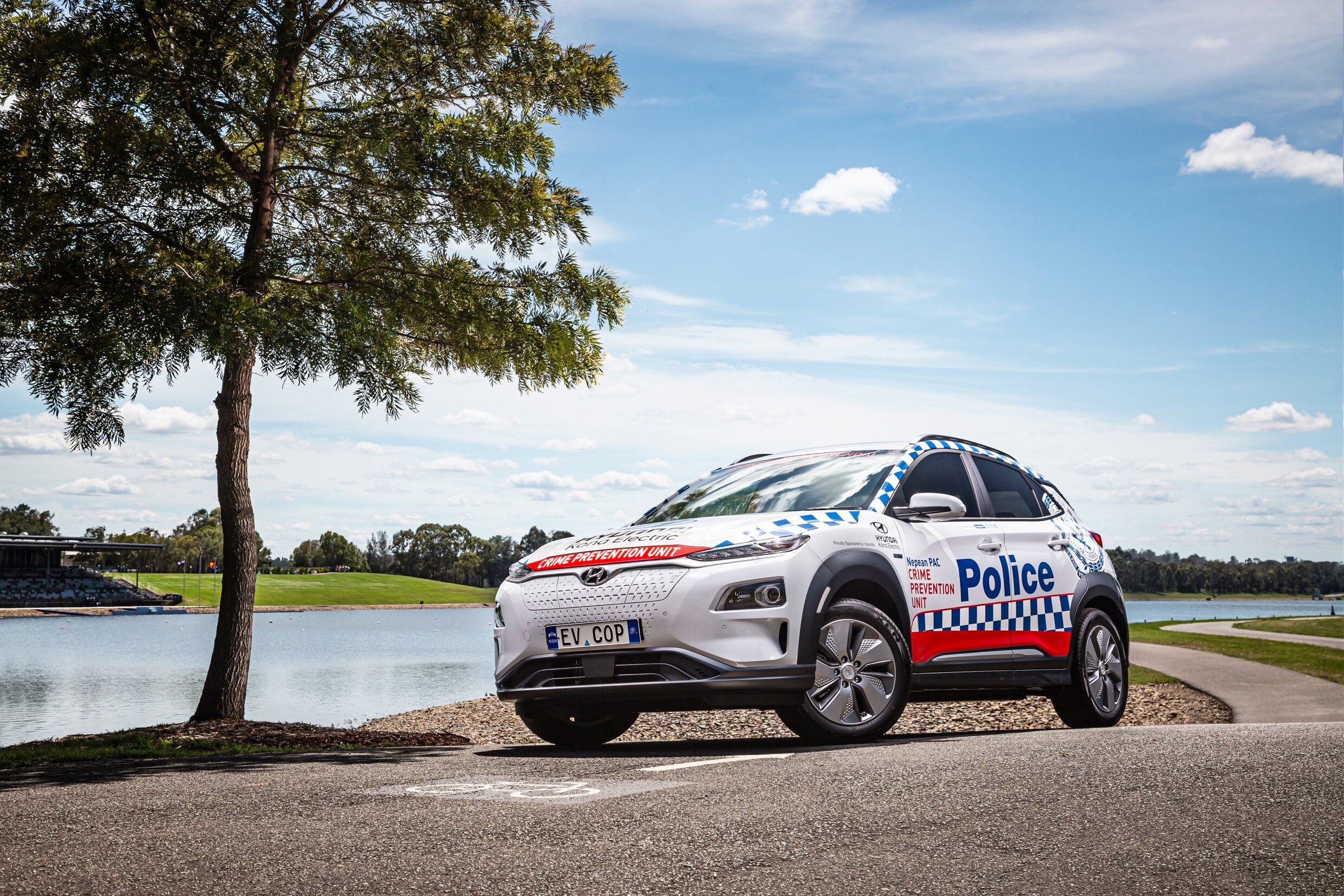
Kitted out in a striking blue and red livery pack, the Kona Electric won’t be used as a patrol vehicle, rather it will join the Crime Prevention Unit and will be used for community engagement.
According to the automaker, “The addition of a Kona EV to its fleet for 12 months will provide the Nepean Police Area Command with the opportunity to experience the practicality, convenience, driveability and safety of a zero-emission vehicle over the course of their daily patrols. In addition, pressing the Kona EV into service for community engagement events will let the public sample the model’s unique benefits, to win new EV fans.”
Hyundai Motor Company Australia Chief Executive Officer, Jun Heo said “We’re delighted to provide a Kona Electric for use by the NSW Police Force. Deploying Kona Electric within the Nepean Area Command Crime Prevention Unit as well as for community engagement is a terrific opportunity for the NSW Police Force and the public to experience the unique benefits of our long-range, zero-emission battery-electric SUV,”
An AC charger installed in the Penrith Police Station underground secure carpark will allow recharging overnight as well as during the day. With a real-world range of close to 400km (250mi), it’s unlikely that the Kona Electric will need charging between duties.
Although this is little more than a goodwill and marketing exercise, we hope that this short program gets some police officers thinking differently about their patrol vehicles. A number of police departments in the United States are trialing Teslas for general duties, and the results so far have demonstrated considerable savings over internal combustion engined vehicles.
Hyundai will be launching a refreshed Kona Electric sometime in 2021.
Images: Hyundai Australia
![Porsche set to Release Rear-Wheel-Drive Taycan EV Outside Chinese Market [Updated]](https://images.squarespace-cdn.com/content/v1/5237a580e4b09510ca448d5e/1611098249414-4HUAUSBE8P4GAEHBU8ET/Taycan_Basis_5.jpeg)
Porsche set to Release Rear-Wheel-Drive Taycan EV Outside Chinese Market [Updated]
Porsche has hinted at the imminent arrival of the rear-wheel-drive Taycan EV, releasing a shadowy teaser image. It has long been expected that the company would include a more affordable two-wheel-drive variant to compliment the Taycan 4S, Taycan Turbo and Taycan Turbo S.

Porsche introduces the Taycan
Entry-level Taycan joins the EV sedan family
[Update] Overnight, Porsche has confirmed the Taycan will join the range, with a single-deck Performance Battery with a gross capacity of 79.2 kWh fitted as standard. The two-deck Performance Battery Plus is available as an option with a gross capacity is 93.4 kWh. Range, in accordance with WLTP, is up to 431 or up to 484 kilometres respectively.
The Taycan accelerates from a standing start to 100 km/h in 5.4 seconds, whichever battery is specified. Its top speed is also 230 km/h in both configurations, while its maximum charging capacity is up to 225 kW (Performance Battery) or up to 270 kW (Performance Battery Plus). This means that both batteries can be charged from five to 80 per cent SoC in 22.5 minutes and that power for a further 100 kilometres is achieved after only five minutes.
The Porsche Taycan will start at $79,990 (MSRP) in the US before federal tax credit, while the Porsche Taycan with Performance Battery Plus will start at $85,680 (MSRP). The Porsche Configurator in the US has been updated to reflect the introduction of the new model.
January 18 2021: Porsche has hinted at the imminent arrival of the rear-wheel-drive Taycan EV, releasing a shadowy teaser image. It has long been expected that the company would include a more affordable two-wheel-drive variant to compliment the Taycan 4S, Taycan Turbo and Taycan Turbo S.

The image features a Taycan Turbo in Gentian Blue, a Taycan Turbo S in what looks to be Coffee Beige and a Taycan 4S in Neptune or Miami Blue. The final vehicle, painted in Frozenberry Metallic is unfortunately too dark to reveal any badge on the rear, (the Porsche marketing department has blacked out a lot of the detail in the image file) however it makes sense that after filling the initial demand from the launch of the vehicle in the Chinese market that Porsche would open the order books up to the rest of the world this year.
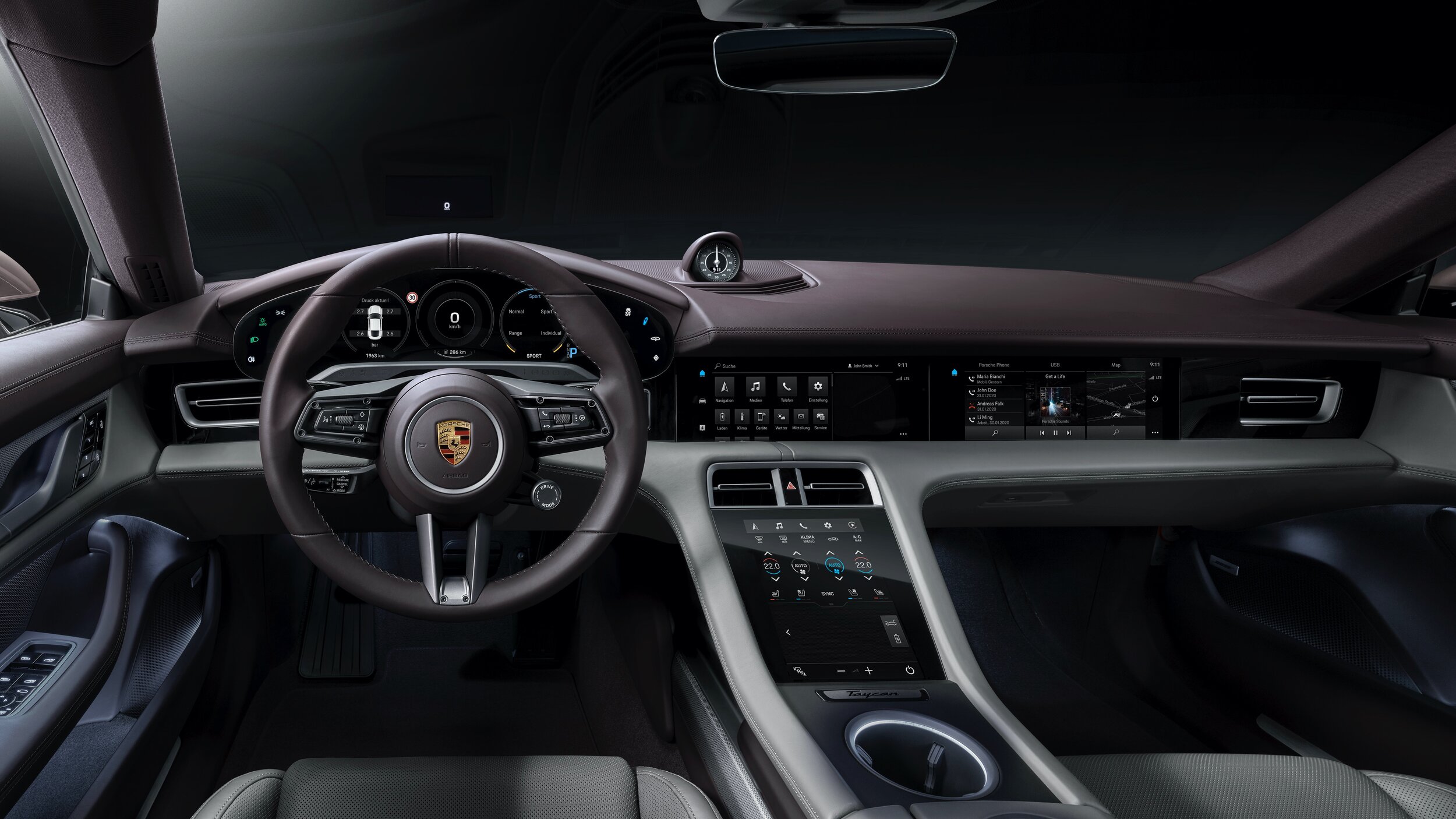
While this won’t be a Taycan for the people —it’s expected to have a starting price around $80-85,000USD— it will bring the electric Porsche within the realm of affordability for buyers of performance combustion-engined vehicles such as Audi’s RS5 and the Mercedes-Benz C63 AMG.
While it’s expected that Porsche will eventually pad out the Taycan range with GTS and anniversary variants, personally we at EV Brief are more excited for an all-electric wagon; namely the Porsche Taycan Cross Turismo. This svelte estate will feature the Taycan’s storming performance, in an aerodynamic and practical body. It’s expected to launch sometime in 2021.



Meet SAIC Motors' New Premium Electric Vehicle Brand Zhiji Auto
As electrification drives the convergence of traditional manufacturers and big Tech, SAIC Motors has announced a joint venture with Alibaba Group and Shanghai’s Zhangjiang Group to release electric vehicles under a new brand dubbed “IM”

Zhiji IM sedan launching in 2021
As electrification drives the convergence of traditional manufacturers and big Tech, SAIC Motors has announced a joint venture with Alibaba Group and Shanghai’s Zhangjiang Group to release electric vehicles under a new brand dubbed “IM”, which also signifies “Zhiji Motor” in Mandarin Chinese. “IM” stands for “Intelligence in Motion”, and will join the suite of brands in SAIC Motors’ stable including Roewe Motors, MG, Maxis and SAIC.
The company has yet to release detailed information about the future models under the “IM” brand, but has announced that it is working on a luxury sedan to rival NIO’s new ET7. The “IM” sedan measures 5,000mm long, 1,960mm wide and 1,485mm tall; similar to NIO’s upcoming sedan. Electrive reports that Liu Tao, the co-CEO of Zhiji Automobile, said in an interview with Chinese media that the IM brand was there to “kill” Tesla.
Sources have stated that the sedan will feature energy dense batteries from Contemporary Amperex Technology Co. Limited (CATL), autonomous driving capabilities from Nvidia’s drive technology, and based on the released images, roof-mounted Lidar.
There will be 93 kWh or 115 kWh options, which will be available for order in Q2 2021. In 2022, Zhiji Motor will launch a luxury SUV.
With murmurings around a partnership between Apple and Hyundai, this joint venture makes a lot of sense; SAIC will focus on manufacturing — something it obviously excels at as China’s largest automaker — and Alibaba will hold responsibility for AI technology and the data side of vehicles.
More information is expected as April’s Shanghai Auto Show nears;
Source: Gasgoo

Groupe Renault Launches Nouvelle Vague (New Wave) Vehicle Roadmap with Seven Fully Electric Vehicles by 2025
French Automaker Groupe Renault has heralded their new strategic product roadmap with the unveiling of the Renault 5 electric prototype. While strictly for show at this stage, the concept captures the original car’s boxy and angular aesthetic beautifully, but adds a taught muscularity with sharply-creased lines giving the R5 the appearance of a tight skin wrapped over the body.
Images: Groupe Renault
French Automaker Groupe Renault has heralded their new strategic product roadmap with the unveiling of the Renault 5 electric prototype. While strictly for show at this stage, the concept captures the original car’s boxy and angular aesthetic beautifully, but adds a taught muscularity with sharply-creased lines giving the R5 the appearance of a tight skin wrapped over the body.
Many of us growing up in the 80’s and 90’s fondly remember the screaming mid-mounted Renault 5 Turbo carving up the international rally scene, and Renault has captured and re-made elements of that car beautifully.
Renault claims that these styling elements are more than nostalgia, rather they hide very high tech features. The bonnet air intake hides the charging hatch (that paintwork is going to get scratched in no time from the charging cable, but let’s allow Renault their fun), the rear lights include aero flaps, and the fog lamps in the bumper are daytime running lights. The side guard and wheels feature the numeral ‘5’, and the front end and the textile roof are supposedly drawn from the world of furniture.
The front and rear logos light up, bringing the car ‘to life’. The French flag in the rear-view mirrors to underline the “invented in France” side of the vehicle, the headrest lights and the name displayed on the small transparent screen on the dashboard, invite you to hop in for a ride.
A shift from the Carlos Ghosn era
In a marked departure from leadership under disgraced former boss Carlos Ghosn, Chief Executive Luca di Meo has told the Financial Times the company is undergoing a strategic shift from “volume to value”, and that cutting the number of its vehicle platforms, overhauling its factories, and sharing 80% of components with Nissan vehicles will lead to a 3 per cent operating margin by 2023, rising to 5 per cent by 2025.
Renault will aim to evolve into a brand of three tranches, as outlined below:
- a Tech brand, with an ecosystem approach that aims at creating world-leading, next-generation mobility OEMs and suppliers. This ecosystem called “Software République” will allow Renault, other founding members and future partners to develop joined expertise, build European know-how and defend our sovereignty in key technologies from big data to electronics. It will also allow Renault to equip its vehicles with leading artificial intelligence and cyber-security systems.
- a Service brand, offering the best connectivity and high-tech services embedded natively in our vehicles. In 2022, Renault will be introducing My Link, a new infotainment system with Google Built-in. Renault will be the first carmaker to bring Google services to mass-market cars.
Becoming more intelligent everyday, our vehicles will gain value over time. They will also live longer. Further, Renault will try to break the consumerist cycle and generate value up until vehicles’ end-of-life, all thanks to its Re-Factory in Flins (France). The plant will recondition more than a 100,000 used cars per year, repurpose Diesel LCV and convert them into biogas and pure EV. Renault also has a clear advantage when it comes to second life and end of life of batteries. The control of these parts of the value chain has the potential to generate new business cases and value.
- a Clean Energy brand, becoming a leader of the energy transition. Challenging leaders on the hybrid markets thanks to its revolutionary E-TECH technology, Renault will sustain its leadership on the electric market with new families of products based on our two dedicated electric platforms CMF-EV and CMF-B EV. The brand will also offer market-ready, end-to-end hydrogen solutions for LCVs. The target is to reach the greenest mix in European market.
Where this really interests us is is that Renault plans to double-down on both electrification and mix improvement. With a new line up of vehicles on new platforms sharing a greater number of components, Renault plans 7 new all-electric models by 2025. Whether the company can achieve this remains to be seen; Renault and Nissan have both been hit hard by the COVID-19 pandemic of 2020, and Renault plans to cut investment in electrification from 10 per cent of revenue to 8 per cent from this year.
Read the full press release here: RENAULT’S “ NOUVELLE VAGUE ”

Hyundai Teases First Images of IONIQ 5 EV: First Production Vehicle Based on New E-GMP Platform
The IONIQ 5 features angular design, and 20 inch aero wheels. Images: Hyundai Motor Company
Hyundai Motor Company has released two teaser images, and a selection of short video clips to highlight design elements and Vehicle-to-Load (V2L) capabilities of its upcoming IONIQ 5 SUV, ahead of the vehicle’s worldwide reveal in February.
According to the company, a new era of clean mobility begins with the IONIQ sub-brand, as the IONIQ 5 will debut the use of the Electric-Global Modular Platform (E-GMP), an architecture developed by Hyundai specifically for electric vehicle drivetrains.
The IONIQ 5 also debuts a new design language for the company, which from what we can see so far is crisp, geometric and unlike Hyundai’s mainstream models. According to Hyundai, these new design elements take inspiration from Parametric Pixels, the smallest unit of digital imaging, and are most clearly observed in the front and rear design details. To our eyes, the IONIQ 5 posesses a delightful hint of Alfa Romeo SZ in its front end (call us crazy), and is unlike anything else on the market today, with other EV manufacturers such as Tesla, Mercedes-Benz and Volkswagen opting for a more curved, softer design language.
The IONIQ 5’s front end features arrays of pixel-inspired lights suggestive of the digital technology within, and is capped off with a clamshell hood that spans the entire width of the car, for a clean and high-tech look.
While we don’t have a firm launch date from the company, prototypes have been seen out and about with increasing frequency. One IONIQ 5 was recently spotted fast-charging in Australia, and another was spotted in Korea with the vehicle’s widescreen display revealed.

Porsche Taycan 4S Outperforms EPA Range Estimates
The Porsche Taycan has faced a lot of criticism for underwhelming range and efficiency, but the good news is that similar to Porsche’s performance and power output figures for its internal combustion engined models, the company seems to quote quite a conservative range for its first all-electric model range.
The Porsche Taycan has faced a lot of criticism for underwhelming range and efficiency, but the good news is that similar to Porsche’s performance and power output figures for its internal combustion engined models, the company seems to quote quite a conservative figure for its first all-electric model range.
According to the EPA, the Porsche Taycan 4S has a range of 203 miles (325km) from a single charge, which seems quite inefficient for a brand new EV with a 79kWh battery pack. The good news for Taycan 4S owners is Inside EVs tested the vehicle in real-world conditions. Although the test vehicle had the largest optional wheels available, Using range mode with the air-conditioning switched on, the team drove the fully charged Taycan 4S, cruising at 70 mph (112kmh) and managed to cover 278 miles (447km) until the vehicle literally came to a stop in the middle of the road. An impressive effort for such a heavy, performance oriented EV.
Source: Inside EVs

500MW Battery Storage Project by Neoen Planned for Australia
Following the success of Neoen’s first battery storage project in Australia, as well as plans for battery storage combined with renewables projects in the Australian Capital Territory and Victoria, the company has submitted a scoping report with the appropriate NSW Government agency, outlining the importance of this large battery project as part of the Central-Orana Renewable Energy Zone (REZ)

Rendering of the 500MW Western NSW Battery Energy Storage System. Image: Neoen
Following the success of Neoen’s first battery storage project in Australia, the Hornsdale Power Reserve, as well as plans for battery storage combined with renewables projects in the Australian Capital Territory and Victoria, the company has submitted a scoping report with the appropriate NSW Government agency, outlining the importance of this large battery project as part of the Central-Orana Renewable Energy Zone (REZ) located about 100km west of Sydney, the first of the NSW government’s Renewable Energy Zones planned to drive the state towards zero emissions power generation.
According to Neoen’s scoping report, “The large-scale Battery Energy Storage System (BESS) that would be delivered by the project would operate unlike any other device currently connected to the NSW network, and would provide a range of services with extremely fast response times to support a stable network and security of supply. The energy storage capacity provided by the project would allow for increased installation of renewable energy sources while maintaining network stability and security,”
The battery could be operational by 2023, and would be built near the site of the 1,000MW Wallerawang coal power station that was mothballed in 2014. Neoen says that the new battery would provide additional energy system support services including frequency control, and would utilise some of the infrastructure that was used by the former coal plant.

NIO Reveals Striking ET7 Sedan with 1,000km Range
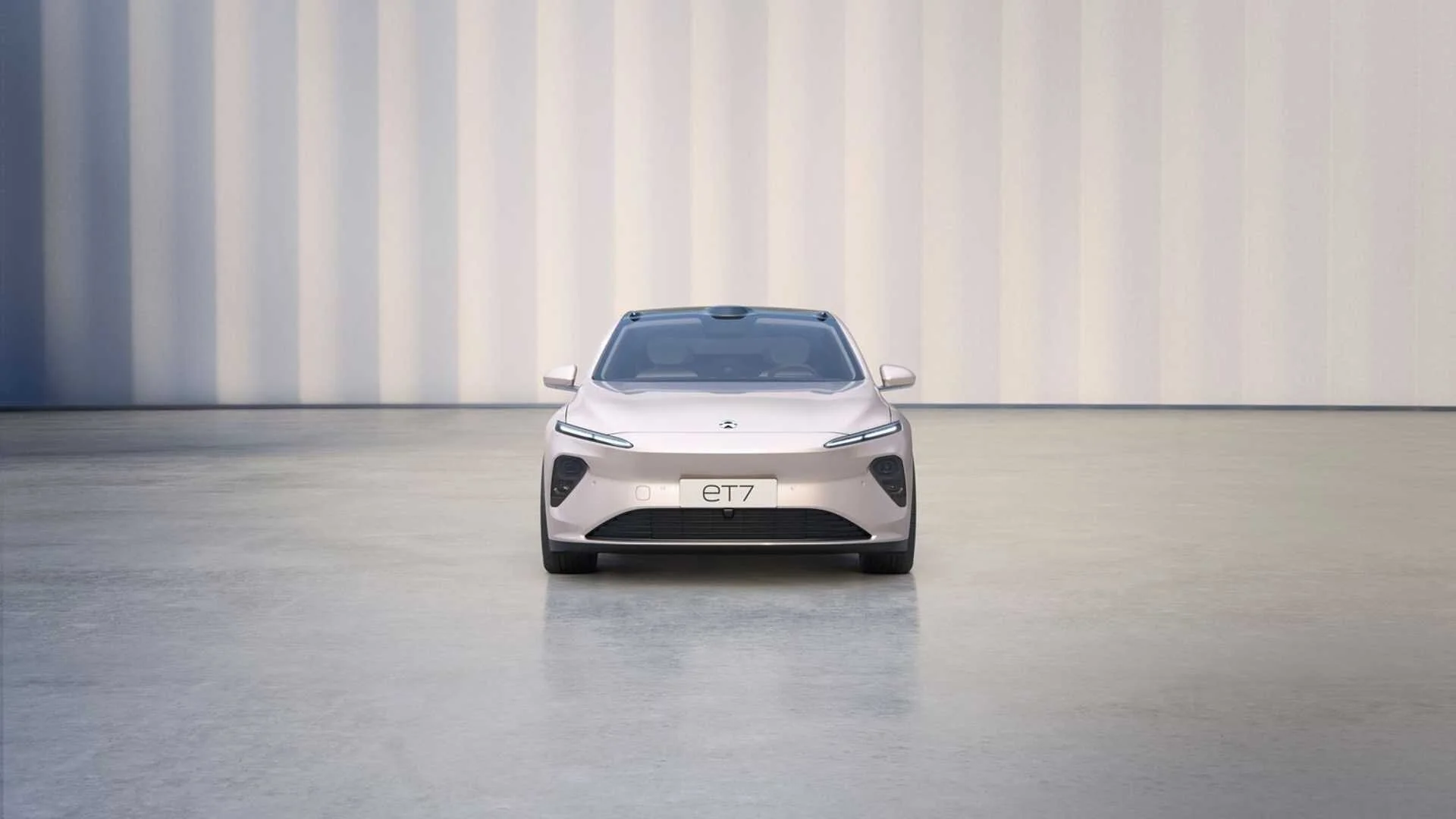
NIO has pulled the covers off the new ET7 Sedan at its annual NIO Day. NIO claims exceptional range, performance and luxury from this striking sedan, as well as the introduction of Lidar technology — a first in all-electric consumer vehicles — to aid autonomous operation.
NIO has pulled the covers off the new ET7 Sedan at its annual NIO Day. NIO claims exceptional range, performance and luxury from this striking sedan, as well as the introduction of Lidar technology — a first in all-electric consumer vehicles — to aid autonomous operation.
Exterior Design
Clearly carrying cues from the ET Preview displayed in 2019, the ET7 is objectively a handsome car. The short, squat front end is muscular and sporty, and its small, narrow headlights and grille-less front end are reminiscent of Hyundai’s 2021 Kona. The deliberate, triangular slots for the additional front lights remind us of the Kia Stinger (no bad thing).
Images: NIO
With a large glasshouse profile, NIO designers have kept the side of the vehicle simple yet cohesive. One accentuating crease near the top of the door plays beautifully with light, while a rising ‘power line’ on the lower part of the doors is reminiscent of Audi’s A5 and A7 Sportback models.
The tapering rear roofline and chunky three quarter panel remind us of the Polestar 2, without the squared-off edges. It’s elegant — if a little unexciting — but does well to give the rear presence while masking the bulk of the vehicle.
The rear itself shares design elements the Audi A7 and Tesla Model 3, with what looks to be an integrated retractable spoiler as well as a fixed ducktail lip in the boot (trunk) lid, and plenty of horizontal lines to accentuate dynamism and presence. Plus the (now ubiquitous) LED light bar running the width of the vehicle as seen on vehicles from Polestar to Porsche.

Interior
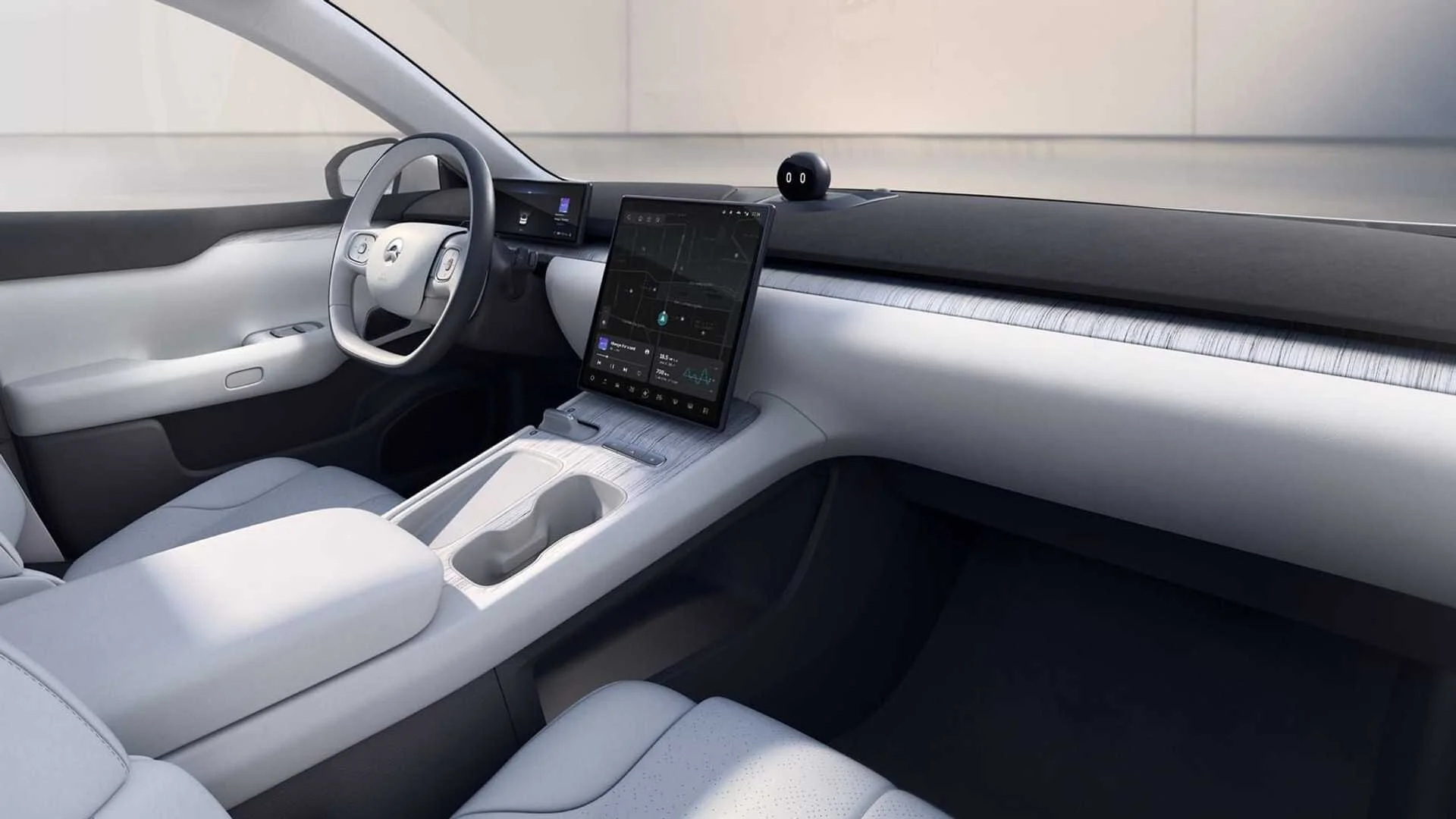
The interior is a clean combination of Volvo Scandi-minimalism, Tesla austerity and familiar design cues from the NIO family. NIO has made a big deal about "invisible" smart air vents on both front and rear row, frameless windows and soft close doors with flush door handles.
NIO has compared the interior of the ET7 to a second living room, and it appears to be a comfortable space for four adults on a long trip. Standard equipment includes smart air suspension, heating, ventilation and massage functions all round. There is a full length glass roof, a 23 speaker audio system, dual-LCD screen dashboard and NIO’s Nomi; the automotive world’s first in-vehicle digital assistant.


Battery and Drivetrain
The NIO ET7 will initially be offered with two battery options; a 70 kWh with 500km (310 miles) of range, and 100 kWh with 700km (440 miles) range.
NIO plans a version with a solid-state battery packing 150 kWh and a density of 360wh/kg for later in 2022, which the company claims will offer 1,000km (620 miles) of range. While a number of automakers including Toyota have publicly discussed plans to develop solid state batteries and claim many advantages over Tesla’s technology, for now, solid state batteries have inferior cycle life to batteries with liquid electrolytes, such as Tesla’s setup.
NIO has also revealed Power Swap 2.0, it’s battery-as-a-service (BaaS) swap technology. While many — including us to a degree — remain sceptical about the scalability of this battery swap model, many NIO owners and Chinese customers generally are fond of the technology, which allows drivers to either turn up or book in a time to swap their vehicle’s battery pack in a matter of minutes. NIO claims the stations will be able to store 13 battery packs and provide up to 312 battery swaps per day. NIO plans over 500 battery swap stations by the end of 2021. NIO will offer a monthly payment option for this battery swap technology.
The ET7 offers an all wheel drive dual motor setup, with a permanent magnet motor in the front and an induction motor in the rear. It has a peak system output of 480 kW and 850 Nm of torque. NIO quotes a 0 to 100 km/h (62 mph) time of 3.9 seconds.
Autonomy and Vehicle Technology
One hundred million. That’s the number of real-world kilometres driven using Tesla’s Autopilot system, and its the reason Tesla will be so hard to beat when it comes to autonomous driving. During NIO’s presentation of the ET7, the company praised the new NAD (NIO Autonomous Driving) system, with its Lidar, eleven eight-megapixel cameras and crazy powerful — 1,016 Tera Operations Per Second (TOPS) — Nvidia chip, but what they didn’t talk about was software.
Elon Musk has long dismissed Lidar on passenger vehicles as unnecessary, and has even claimed “LiDAR is a fool's errand…anyone relying on LiDAR is doomed.” Tesla has stuck with a system of cameras and radar for the “eyes” of its autopilot system, but Tesla has had vehicles gathering data in the real-world for years now, with its Neural Network processing trillions of data points. In the video by Whole Mars Blog, a Tesla Model 3 successfully navigates from San Francisco to Los Angeles with almost zero human intervention, with just its computing power, and Tesla’s radar and camera system. Seriously impressive.
The NIO ET7 is due for release sometime in 2022, and pricing is as follows:
NIO ET7 (70 kWh)
448,000 yuan (US$69,185)
with BaaS: 378,000 yuan ($58,375) plus 980 yuan ($151) per month
ET7 (100 kWh)
506,000 yuan (US$78,142)
with BaaS: 378,000 yuan ($58,375) plus 1,480 yuan ($229) per monthET7 Premier edition (100 kWh)
526,000 yuan (US$81,230)
with BaaS: 398,000 yuan ($61,463) plus 1,480 yuan ($229) per month




Xpeng Teases new Electric Sedan
Chinese automaker Xpeng or Xiaopeng Motors is set to unveil the third model in its lineup after the G3 and P7. The company has announced that the vehicle will utilise LiDAR technology, with CEO He Xiaopeng stating in November that Xpeng will be the first production vehicle to market with the technology.
Image: Xpeng Motors via Twitter
Chinese automaker Xpeng or Xiaopeng Motors, also known as XMotors.ai is set to unveil the third model in its lineup after the G3 and P7. The company has announced that the vehicle will utilise LiDAR technology, with CEO He Xiaopeng stating in November that Xpeng will be the first production vehicle to market with the technology. It’s likely that this will be utilised for various driver assistance systems, rather than for a Tesla-like autonomous Autopilot system. Further detail on specifications will have to wait for the unveil, expected sometime in Q1 2021.
This new model from Xpeng appears smaller than the company’s P7 sedan, and features an interesting front LED light signature, mimicking the Xpeng logo. In China, the P7 sedan starts at a price of 229,900 yuan (US$32,470) after green vehicle subsidies. The company is pushing for rapid growth in the increasingly competitive BEV market, with global expansion on the cards for 2021. In December, Xpeng commenced delivery of the first 100 G3 SUV models to Norwegian customers, at a price of 358,000 NKr (US$41,000).

Mercedes-Benz Reveals Unique Hyperscreen for Upcoming EQS EV
Mercedes-Benz is premiering its new MBUX (Mercedes-Benz User Experience) multimedia interface, which will debut in the upcoming EQS battery electric sedan. Dubbed MBUX Hyperscreen, the digital experience promises to transform how we interact with the vehicle, and provide a “wow” effect according to Mercedes-Benz.
The new MBUX Hyperscreen comprises three individual OLED displays underneath a single piece of Gorilla Glass. Images: Mercedes-Benz AG
Mercedes-Benz is premiering its new MBUX (Mercedes-Benz User Experience) multimedia interface, which will debut in the upcoming EQS battery electric sedan. Dubbed MBUX Hyperscreen, the digital experience promises to transform how we interact with the vehicle, and provide a “wow” effect according to Mercedes-Benz.
The marketing video (below), was almost like one which you might expect from Apple or Samsung, with the carmaker spruiking the technical specs of the computing power behind the new in car system. With 8 CPU cores, 24-gigabytes (GB) of RAM and 46.4 GB per second RAM memory bandwidth, Mercedes-Benz is promising a next-generation infotainment system that delivers an intuitive experience, and actually learns driver behavior.
According to Gorden Wagener, Chief Design Officer Daimler Group, “We merge technology with design in a fascinating way that offers the customer unprecedented ease of use. We love simplicity, we have reached a new level of MBUX.”
Sajjad Khan, Member of the Board of Management of Mercedes-Benz AG and CTO states that the MBUX Hyperscreen continually gets to know the customer better through machine learning, and delivers a personalised infotainment and operating offering before the driver has to even access or scroll through menus.
With context sensitive awareness, the MBUX system proactively displays the right functions at the right time for the user, supported by artificial intelligence. The system is optimised by changes in the surroundings and user behaviour. The so-called zero-layer provides the user at the top level of the MBUX information architecture with dynamic, aggregated content from the entire MBUX system and related services; deep menu layers — a criticism of complex current generation infotainment systems — are a thing of the past.
Mercedes-Benz provides these four examples as use cases:
The user can accept or reject the respective suggestion with just one click:
If you always call a certain friend on the way home on Tuesday evenings, you will be asked to make a corresponding call on that day of the week and at this time of day. A business card with its contact information appears, and - if stored - its image appears. All MBUX suggestions are linked to the user's profile. If someone else drives the EQS on a Tuesday night, this recommendation is not made – or there is another, depending on the preferences of the other user.
If the EQS driver regularly uses the massage function according to the hot stone principle in winter, the system learns and automatically suggests the comfort function in wintry temperatures.
If the user regularly switches on the heating of the steering wheel and other surfaces for seat heating, for example, this is suggested to him as soon as he presses the seat heating.
The chassis of the EQS can be lifted to provide more ground clearance. A useful function for steep garage entrances or sleep policemen. MBUX remembers the GPS position at which the user made use of the "Vehicle Lift-Up" function. If the vehicle approaches the GPS position again, MBUX independently proposes to lift the EQS.
In terms of design, Mercedes-Benz has integrated ambient lighting behind the glass, making the display unit appear to float on the seamless instrument panel. There is also a separate passenger display, a-la Porsche Taycan. If no passenger is seated, the display becomes an animated decorative pattern of stars, so as not to distract the driver with additional infotainment content.
Central and passenger displays utilise OLED technology, where non-active pixels remain switched off, meaning that they appear as deep black rather than a greyish black that is visible on many computer monitors. With a multifunction camera and light sensor to adjust the brightness of the display and pre-empt driver actions, it’s expected that the EQS’ active and passive safety systems will work seamlessly with the MBUX Hyperscreen.
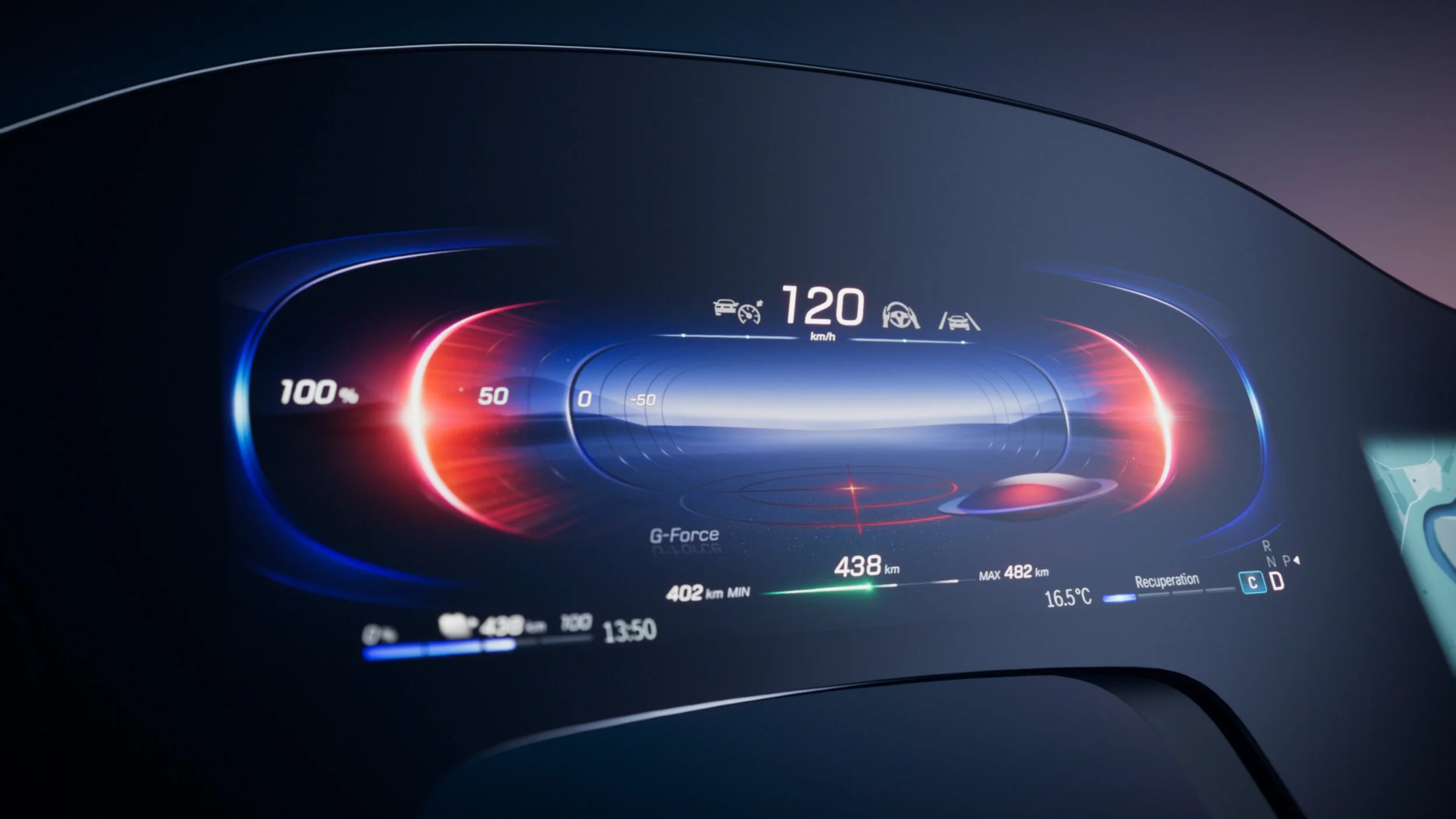
It appears the MBUX Hyperscreen takes the best of the 2021 Mercedes-Benz S-Class infotainment system, and builds upon it, seamlessly integrating multiple displays into a single panel. It’s a distinctly different approach from other EV manufacturers such as Telsa, who prefer to combine all features into a single, centrally-mounted touchscreen. Mercedes-Benz spends billions on R&D and probably millions determining customer preferences, so it’s likely their customers still prefer something akin to a traditional instrument cluster.
While the Mercedes-Benz system provides haptic touch feedback, There’s much criticism about the trend to remove all buttons from a vehicle’s interior. While we think it’s great to seamlessly integrate all system functions into one unit, presumably minimising cost and improving reliability, if that comes at a cost — the ease of quickly operating essential controls — then its not worth it. We hope Mercedes’ “zero-layer technology” and voice control systems can make basic actions like adjusting the climate control temperature or re-routing a navigation destination quick and painless, but we’ll have to wait until the vehicle’s reveal for more information. Mercedes-Benz will reveal the EQA SUV on January 20, and we think the EQS should break cover sometime in the first quarter of 2021.


Up to 14 Megawatts of Power From One Wind Turbine: Meet the GE Haliade-X
The Haliade-X generates almost 30 times more electricity than the first offshore machines installed off Denmark in 1991. Although this prototype is currently located on land at Rotterdam Harbour, it will ultimately be manufactured to withstand deep sea conditions.
The Haliade-X Turbine from GE
Source: GE
The New York Times recently visited a test site for the world’s largest wind turbine in Rotterdam, The Netherlands. Operated by GE, the turbine is 260 m or 853 ft tall, 220 m in diameter, and comes in three variants with a choice of 12, 13 or 14 megawatt outputs, enough to light up a town of roughly 12,000 homes. In fact, GE claims one rotation could power a single home for two days.
The Haliade-X generates almost 30 times more electricity than the first offshore machines installed off Denmark in 1991. Although this prototype is currently located on land at Rotterdam Harbour, it will ultimately be manufactured to withstand deep sea conditions.
GE came up with the Haliade-X with the knowledge that turbine size will be crucial in future auctions for wind power generation sites. According to GE, the Haliade-X offers many benefits: larger turbines mean more electricity, fewer individual turbines per wind farm, more profit and reduced operating and maintenance costs. These factors will be crucial to GE’s customers in providing the maximum power output at the lowest price.
Danish Company Orsted has already placed a preliminary Order with GE for 90 units of the Haliade-X, to be a part of the Ocean Wind Project, off the coast of Atlantic City, New Jersey.
Sources: The New York Times , GE




Polestar and Deepal expand Australian operations as they seek growth in the local market