

Audi Q4 e-tron, Q4 Sportback e-tron debut with up to 520km range, 220kW power
Audi’s Q4 e-tron has been unveiled, and features rear and all wheel drive variants with two different battery sizes, all wrapped in the brand’s progressive, modern design language. Wheels pushed to each corner, aggressive light graphics and sharp angles; this SUV is all about muscular presence.

Two battery sizes, three model variants for Audi’s newest EV
Three versions available in Sportback and regular body styles:
35 e-tron with 52 kWh battery/341-349 km (211-216 mi) range
40 e-tron with 77 kWh battery/520 km (323 mi) range
50 e-tron quattro with 77 kWh battery/488-497 km (303-308 mi) range
Based on Volkswagen’s modular electric drive matrix (MEB), shared with VW ID.4
Charging up to 100/125 kW depending on model
Audi claims carbon neutral production footprint for Q4 e-tron
Priced from EUR 41,900 in Germany, and “below $45,000 US” in the United States before federal EV tax credits
Audi’s Q4 e-tron has been unveiled, and features rear and all wheel drive variants with two different battery sizes, all wrapped in the brand’s progressive, modern design language. Wheels pushed to each corner, aggressive light graphics and sharp angles; this SUV is all about muscular presence.
Underpinned by Volkswagen’s Modular Electric Drive matrix (MEB) architecture, this vehicle shares a platform with VW’s ID.3 and ID.4 range, and is likely the first of many electric Audis to be based on this modular architecture.
The Q4 e-tron even shares a production line with its VW siblings, manufactured at the group’s Zwickau, Germany plant. Audi even claims a carbon-neutral manufacturing footprint for the Q4 e-tron, from battery and materials supply chains to the Zwickau plant itself.

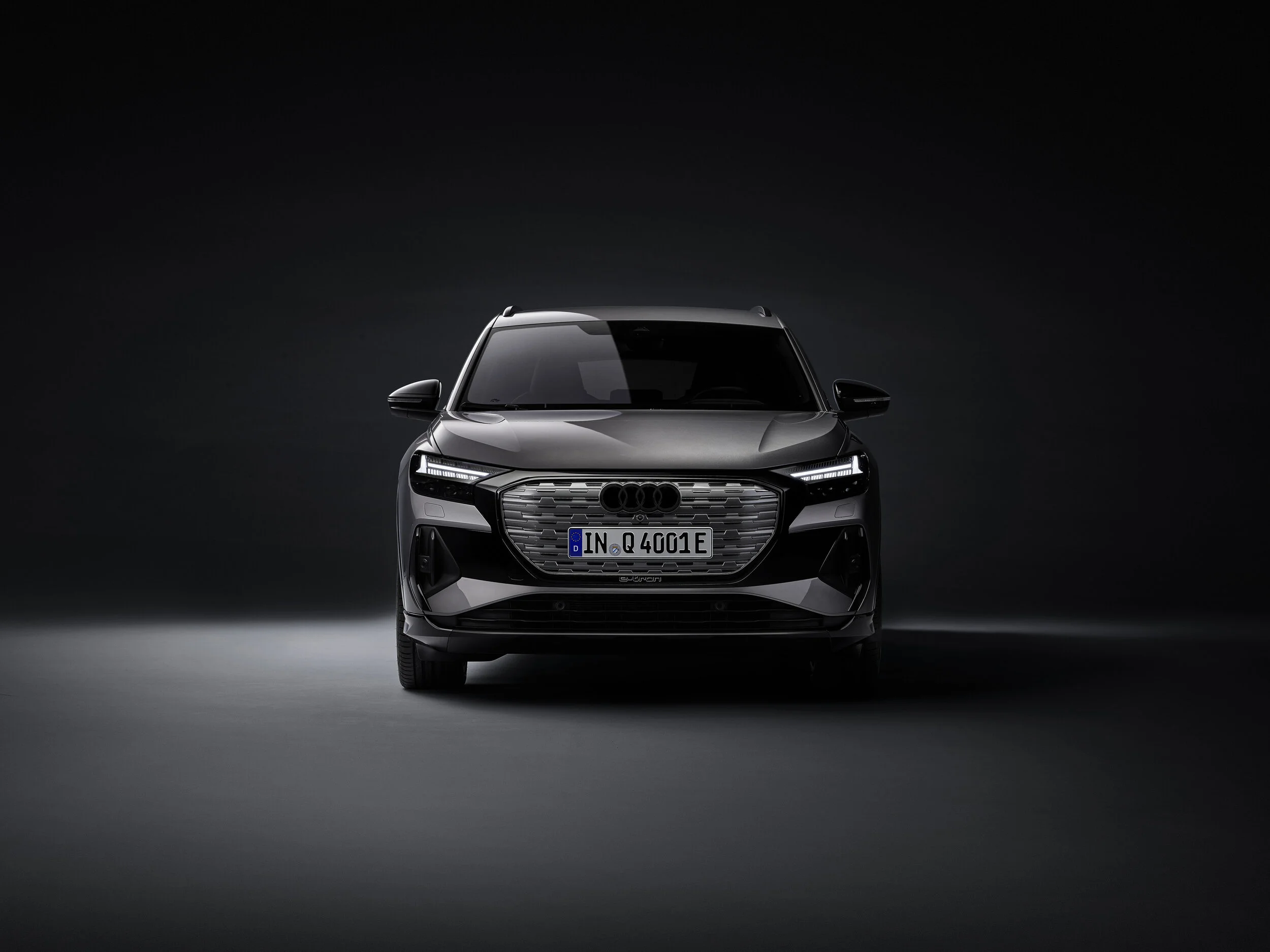
Audi’s Q4 50 e-tron quattro. Image: Audi AG
Exterior Design
Reassuringly familiar yet refreshingly modern; these are traits that Audi designers somehow manage to weave into each new model. We feel a number of contemporary Audi models have become quite fussy in their designs, but the Q4 e-tron, whilst muscular, is all about width and horizontal lines.
The front of the Q4 e-tron is dominated by the requisite single-frame grille, however the gently cascading hood and three dimensionality of the front surfaces and headlights present a design that is less brutish and better resolved than say the larger Q8 SUV.
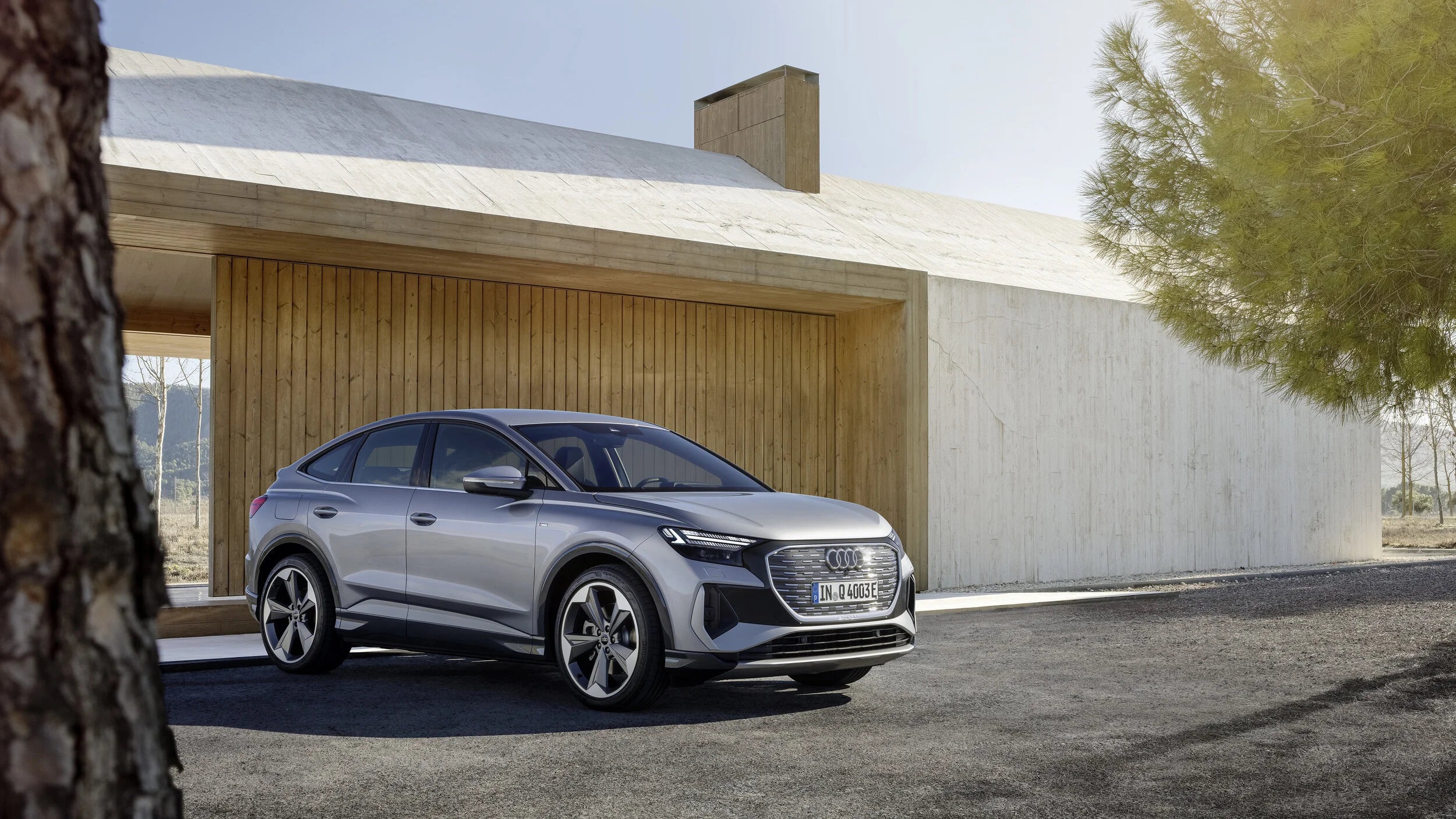
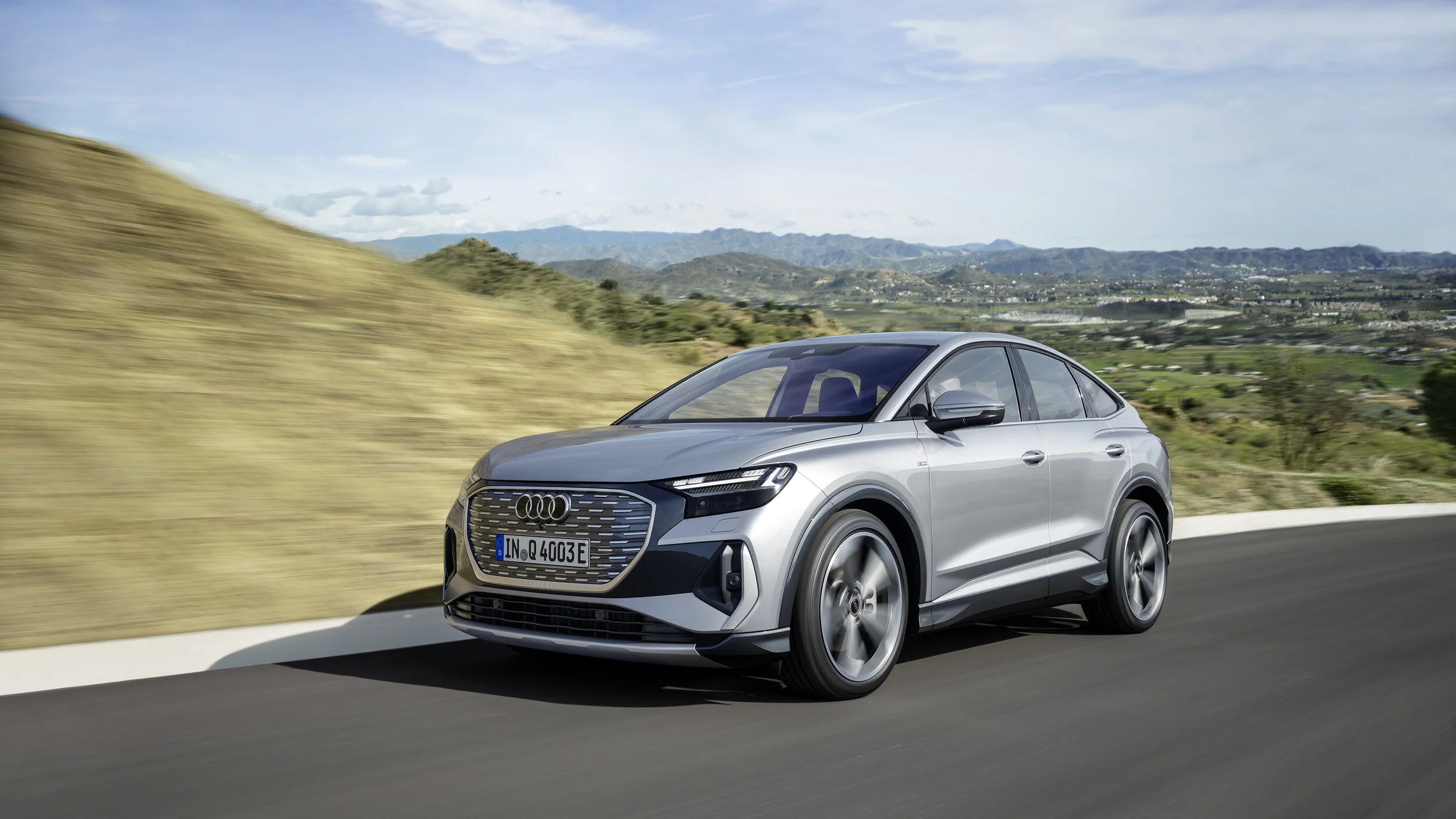
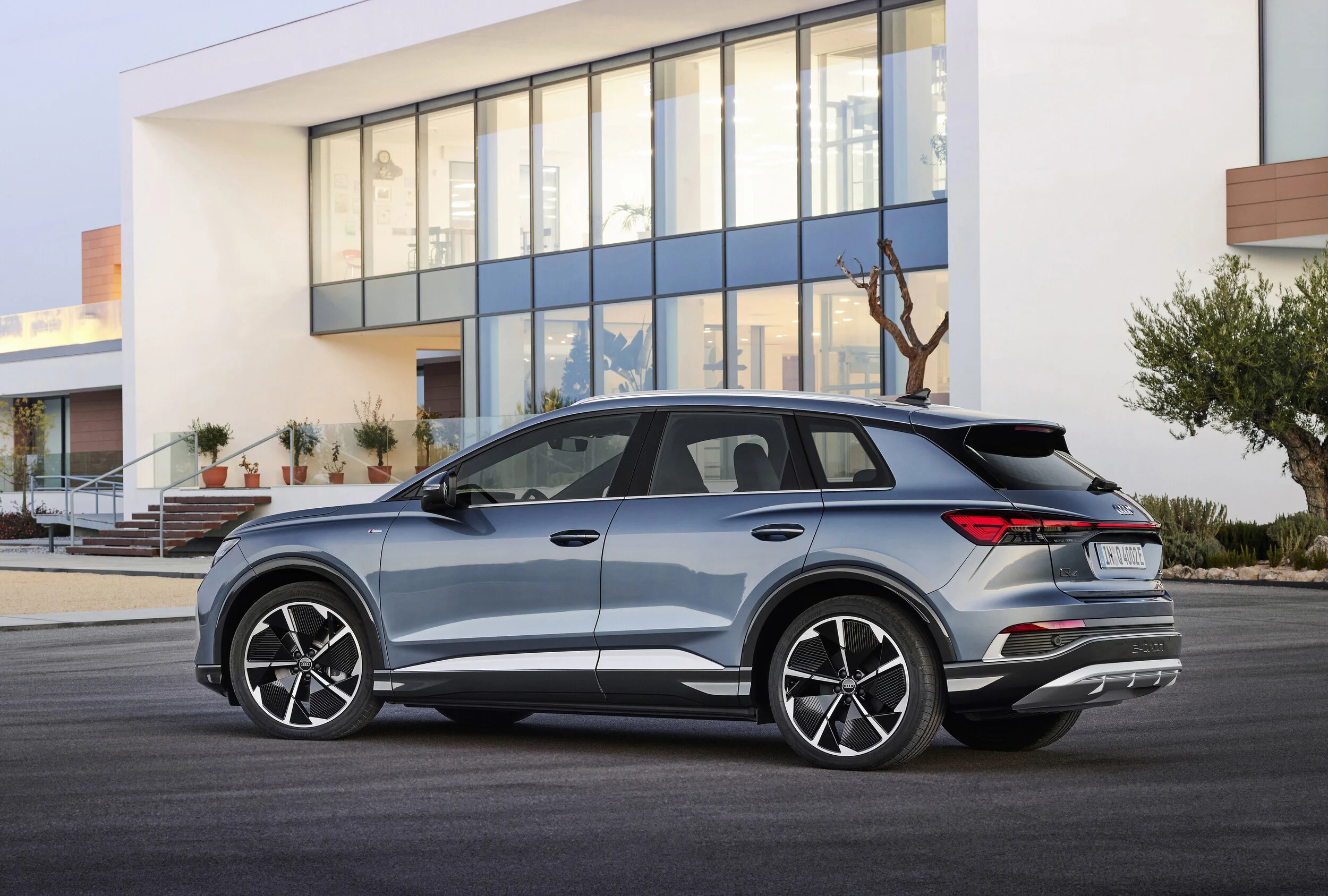
Pronounced hip lines and bulges in the lower doors help to accentuate the wheels, and reduce any slab-sided appearance to the side profile of the Q4 e-tron. The rear again accentuates width and aggression through a de rigueur horizontal light bar, and contrasting diffuser. S-Line versions of both Q4 e-tron and Q4 Sportback e-tron are available, and provide an enhanced exterior styling package.
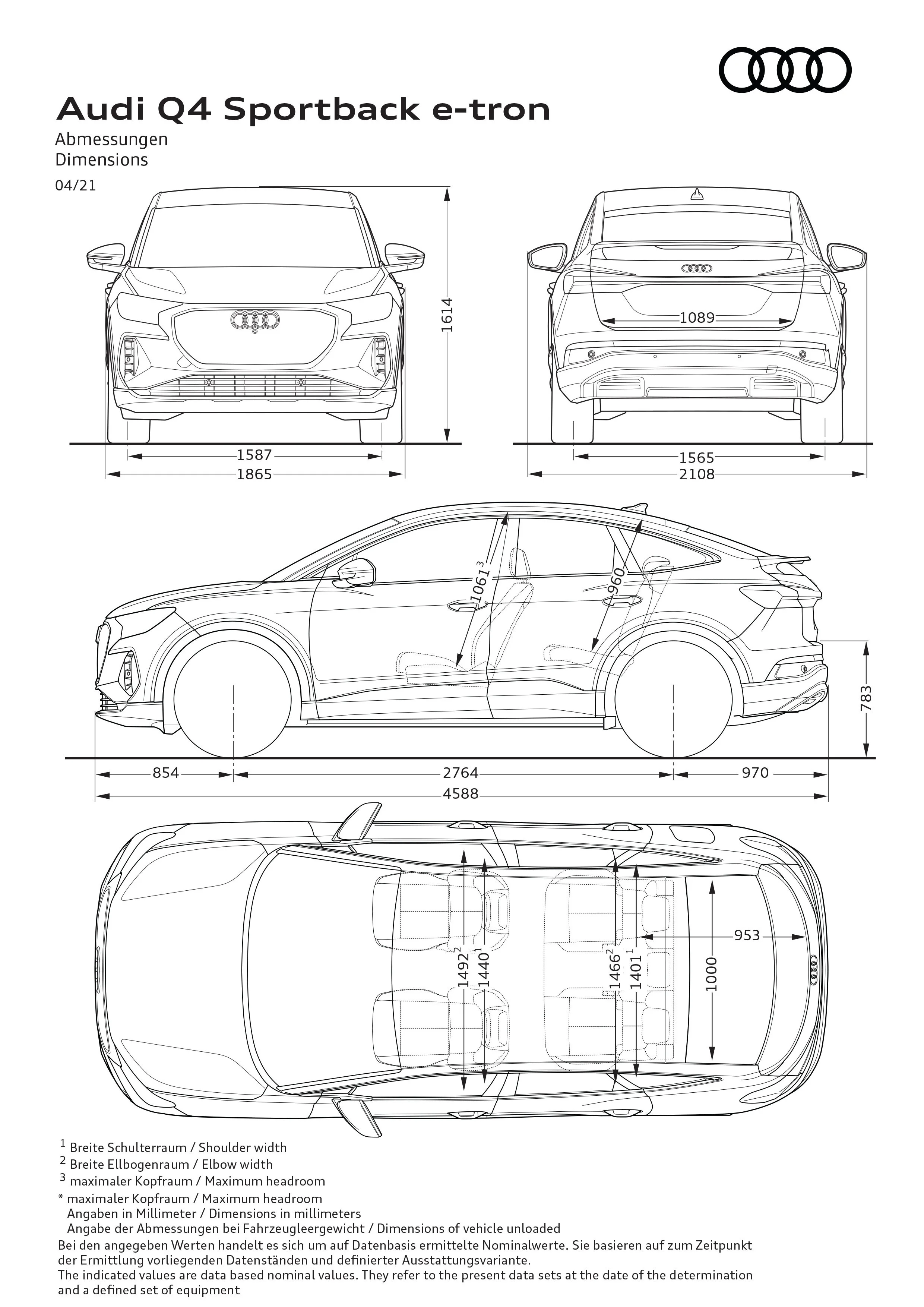
Exterior dimensions are as good as identical to Volkswagen’s ID.4; 4,588 mm long, 1,865 mm wide, 1,632 mm tall with a wheelbase of 2760 mm. There’s a familiarity in the proportions between the two sister products, without a feeling of sameness.
Audi Q4 50 e-tron quattro Edition One gallery




Interior Design
The first thing you notice about the interior of the Q4 e-tron is that new floating console; gear selection, power on/off, hazard lights and drive modes remain accessible by the driver in the form of hard buttons. There’s also a small touch sensitive pad for passengers to adjust volume and select audio tracks.
This floating console frees up a large storage area underneath, with two USB-C ports, a 12V outlet, and wireless phone charging. Just below the main infotainment screen, many (including us) will be pleased to see hardware buttons for the HVAC system; far superior for quick climate adjustment to a touchscreen when powering down a bumpy road.
Moving up to the top of the dash, and it appears Audi is going for a Lamborghini-lite aesthetic, with plenty of angular surfaces, chunky air vents and an LCD screen — available in 10.1 or 11.6 inches — angled towards the driver. The main instrument cluster features Audi’s Virtual Cockpit, and the steering wheel controls are all digital, with slide or press control for various functions. Helpfully, they provide haptic feedback, replicating an old fashioned button.
An optional panoramic glass sunroof extends over the passenger cabin, and provides a sense of space for front and rear seat passengers. Leather upholstery is still the norm in the Q4 e-tron, but the optionally available S line interior provides the possibility of specifying a combination of artificial leather and Dinamica or Puls upholstery, which utilises secondary raw materials such as recycled plastics and old PET bottles.
Q4 e-tron interior Gallery


Battery and Drivetrain
Customers have the option of regular Q4 e-tron and Q4 Sportback e-tron body styles, the latter being Audi’s terminology for a coupe-style SUV. For those with a performance bent, the Q4 50 e-tron quattro will be the model to choose, offering a 77 kWh battery with 220 kW (299 PS) and 460 Nm (340 lb ft). This model offers 488 km (303 mi) and 497 km (308 mi) of range respectively for the e-tron and the Sportback e-tron. If absolute range is your priority, the rear wheel drive Q4 40 e-tron offers 150 kW (204 PS) and 310 Nm (228 lb ft) as well as 520 km (323 mi) range.
All models feature a permarmanent magnet synchronous motor on the rear axle, mated to a single-speed transmission with differential. The motor has a maximum speed of 16,000 rpm, and Audi claims a low weight of 90 kg (198 lb) for this motor. quattro all wheel drive variants add an asynchronous motor to the front wheels with a coaxial layout; Audi claims this setup reduces driveline drag when inactive and that the weight of the front unit is around 60 kg (132 lb).
Audi’s Q4 e-tron range features advanced thermal management, with two coolant circuits to control the temperature of the electric motors, the charging system, the DC/DC converter and more. This system aims to increase battery temperature soon after setting off on a drive, with a target temperature of around 30 degrees celsius (86F). Interestingly, a heat pump —now standard across other manufacturers’ models— is optional for the Q3 e-tron. This device essentially uses waste heat from electric components that would otherwise be lost to the atmosphere to power things like the HVAC system.
Q4 Sportback 50 e-tron quattro gallery




Safety, Technology and Autonomy
Q4 e-tron models feature front radar, four surround-view cameras, one front view camera, rear radar and eight ultrasonic sensors as part of an extensive driver assistance system. Audi’s autonomous braking system known as Audi pre sense front also features a turn assist system, that intervenes in a dangerous system in a left hand turn (for left hand drive vehilces) or a right hand turn (for right hand drive vehicles). Predictive efficiency assist evaluates navigation data, traffic and speed signs, and helps a driver save energy. Audi’s adaptive cruise control, in conjunction with adaptive cruise assist controls the distance between the Q4 e-tron and the vehicle travelling in front, and also ads lane guidance to keep drivers in their lane.
There’s two dynamic packages available, lowering the body by 15 millimeters, and adding dynamic handling within the Audi drive select system. The second ‘dynamic package plus’ adds adjustable suspension with damper control, and constantly evaluates the driving situation by regulating oil flow in the dampers. This change oil viscosity within each damper can produce a variety of ride comfort options, and Audi first debuted this technology back in the B7 RS4 and 8J TT models.
On the inside, there’s a new augmented reality head-up display, providing a visual overlay of navigation and assist systems before the drivers’ eyes. Using a processing unit within the modular infotainment system known as the AR Creator, symbols and graphics can be rendered at 60 frames per second and are adapted to the geometry of the projection optics on the fly, while the system calculates objects and their location relative to the environment, and compares this to radar, GPS and camera data. Sounds complicated? Audi claims this system’s software alone consists of roughly 600,000 lines of programming code; 50 percent more than the entire control system of the first generation Space Shuttle.
The Q4 e-tron is the second all electric SUV in Audi’s line up, and is part of the Volkswagen Group’s commitment to electrified vehicles and reduced fleet emissions. The automaker plans a one size fits all cell design, and hopes to have six battery ‘gigafactories’ across Europe producing battery cells and packs for its vehicles by 2030. Scroll down for galleries of the Q4 e-tron and Q4 Sportback e-tron.
Scroll down for galleries of additional imagery.
Audi Q4 50 e-tron quattro gallery




Q4 e-tron technical renderings




![Xpeng P5 EV set for April 14 reveal; company posts all time quarterly sales record for 2021 [UPDATED]](https://images.squarespace-cdn.com/content/v1/5237a580e4b09510ca448d5e/1617864573620-OW94O0V3EMOMDV212S2D/Xpeng-P7.jpg)
Xpeng P5 EV set for April 14 reveal; company posts all time quarterly sales record for 2021 [UPDATED]
Chinese electric vehicle manufacturer Xpeng (also known as XMotors.ai and Xiaopeng Motors) will reveal their P5 mid-size electric sedan online on April 14 at 2pm ET/8pm CET/4am 15/4 AEST prior to the media and public reveal at the Shanghai Auto Fair.
Xpeng’s upcoming P5 sedan
[Updated]: Chinese electric vehicle manufacturer Xpeng (also known as XMotors.ai and Xiaopeng Motors) will reveal their P5 mid-size electric sedan online on April 14 at 2pm ET/8pm CET/4am 15/4 AEST prior to the media and public reveal at the Shanghai Auto Fair. This follows the recent sighting of camouflaged prototypes undergoing final development testing on the streets of China, and the following teaser image from XPeng:
XPeng’s Chairman He Xiaopeng has hinted in previous discussions with Chinese media that the P5 will be the first production vehicle with Lidar technology — now confirmed in the above tweet — and that the P5 will be equivalent in size roughly to the Toyota Camry and Honda Accord (and obviously, Tesla’s Model 3)
The P5 carries the company’s contemporary styling cues, and appears to offer two driver displays in the interior. The vehicle architecture is shared with the company’s G3 crossover, and customer deliveries are expected to commence towards the end of 2021.

XPeng’s P5 undisguised. Credit: reddit.com/wyboongk
XPeng posts best ever monthly and quarterly sales results
Admittedly, XPeng’s 2020 sales didn’t hit expectations due to a number of factors—only 6 months of P7 sedan sales as well as the COVID-19 pandemic—but the company has posted strong numbers for this year, with 13,340 sales from January to March 2021, versus 1,419 for the previous period in 2020. The company sold 7,974 P7 sedans, and 5,366 G3 SUVs, and also surpassed a cumulative total of 50,000 vehicles.
According to XPeng, "The Company attributed the record quarterly deliveries to its growing brand recognition and product appeal, expanded product portfolio and its relentless efforts in broadening sales, marketing and supercharging service networks across China."
Xpeng is working hard to continue growing its sales as well as its brand in China, and faces stiff competition from BYD, NIO, upcoming Zhiji Auto and of course, Tesla. XPeng is growing its DC fast charging network across China, with over 935 sites across 139 cities available by the end of 2021. The company has also reached an agreement with NIO for customers of either brand to be able to share fast charging stations. In addition, Xpeng has brought in a lower-priced lithium iron phosphate (LFP) battery option from CATL, designed for city-based customers for whom a longer battery range is of limited value. Customers who opt for the LFP battery option can expect to save around RMB 20,000 ($3,000 US) per vehicle.

Rivian partners with Samsung SDI in electric truck battery deal
American electric vehicle startup Rivian announced today that it had reached a successful deal with South Korea’s Samsung SDI Co Limited to supply battery cells for its R1T and R1S electric trucks.

The Rivian R1T
American electric vehicle startup Rivian announced today that it had reached a successful deal with South Korea’s Samsung SDI Co Limited to supply battery cells for its R1T and R1S electric trucks.
“We’re excited about the performance and reliability of Samsung SDI battery cells combined with our energy-dense module and pack design,” said RJ Scaringe, chief executive officer of Rivian.
Samsung SDI currently has battery supply deals with BMW and Volkswagen, estimated to each be valued around $3-4 billion US over 10 years. The value and terms of the Rivian deal is undisclosed, and it is unclear whether the deal also includes batteries for the company’s electric delivery vans.
Rivian is planning to start production of its R1T and R1S models by mid-2021, and is backed by some big players, including the Ford Motor Company and Amazon.com Inc. The automaker recently announced a successful funding round led by T. Rowe Price, raising $2.65 billion US.
It’s obviously going to be a big year for Rivian, but it could get bigger; the company is likely planning an Initial Public Offering (IPO) later in 2021. Bloomberg reported in February that Rivian is in talks with banks.
A number of EV startups have made the leap to publicly traded companies recently via reverse mergers with shell companies known as special purpose acquisition companies (SPAC). These include Xpeng, Nikola Motors, Lordstown and Canoo. It’s also expected by some analysts that Lucid Motors will go down this route.
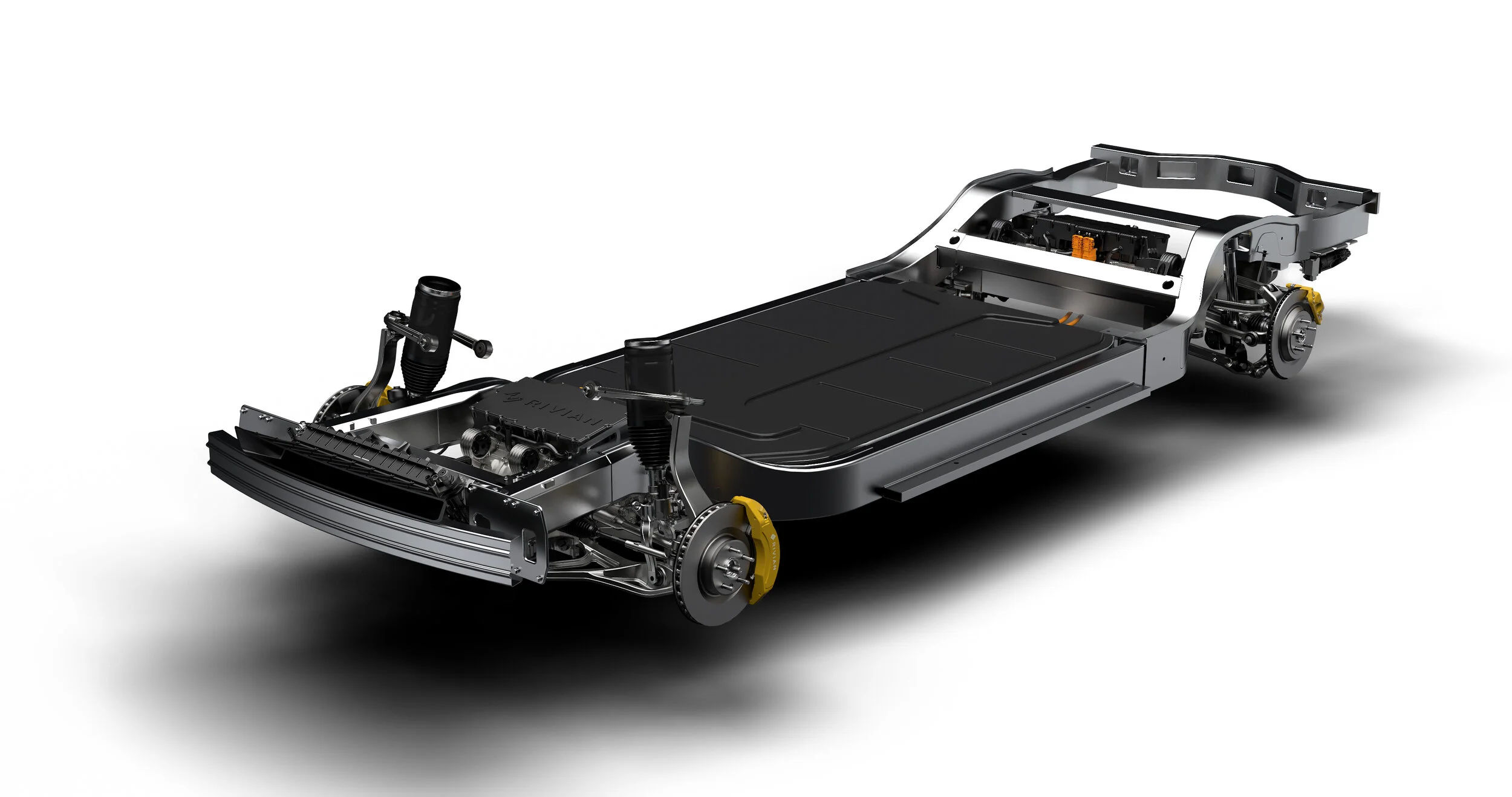
Rivian’s skateboard platform. Image: Rivian

Mercedes Benz EQS and Audi Q4 electric vehicles to debut this week
It’s a big week for German manufacturers Mercedes Benz and Audi, as the automakers from Stuttgart and Ingolstadt premiere two important electric vehicles in their respective line ups.
It’s a big week for German manufacturers Mercedes Benz and Audi, as the automakers from Stuttgart and Ingolstadt premiere two important electric vehicles in their respective line ups.
Mercedes Benz will be unveiling their flagship electric vehicle, the EQS sedan on April 15, and the company has teased some technical details and some images, we’re still very keen to see the vehicle in all its glory.
You can watch the livestream below at the following times:
15/4/21 - 6pm CEST
4/15/21 - 10am PDT
16/4/21 - 2am AEST
Audi’s Q4 E-Tron is an important vehicle for the Ingolstadt manufacturer, as it is the first mid-size SUV based on the new modular electric MEB architecture. Again, the automaker has teased plenty of information and images of the Q4 E-Tron, but we can’t wait to see final specifications, colour and trim options. The Q4 E-Tron will go head-to-head with BMW’s iX3 and Tesla’s Model Y, but also with new competitors in the compact to mid-size SUV category. This is the first time South Korean manufacturers are competing in the premium segment with genuinely innovative, class-leading vehicles in the form of Kia’s EV6 and Hyundai’s Ioniq 5 , and we would expect many buyers to be seriously cross-shopping these vehicles when they hit the market.
Audi’s Q4 E-Tron livestream is also available below at the following times:
15/4/21 - 7pm CEST
4/15/21 - 11am PDT
16/4/21 - 3am AEST

BYD achieves record new energy vehicle sales in China for Q1 2021, strong 2020 net profit
Chinese automaker BYD has had a strong sales start to 2021, with 53,380 passenger vehicle sales in the first quarter, comprising battery electric vehicles (BEVs) and plug-in hybrid electric vehicles (PHEVs). That represents a 148 percent increase over the same period last year.

BYD achieves 148 percent increase in NEV sales for Q1 2021
Chinese automaker BYD has had a strong sales start to 2021, with 53,380 passenger vehicle sales in the first quarter, comprising battery electric vehicles (BEVs) and plug-in hybrid electric vehicles (PHEVs). That represents a 148 percent increase over the same period last year, where 21,520 new energy vehicles were sold.
2020 sales were obviously heavily affected by the COVID-19 pandemic in China, but it’s important to see automakers in China returning to strong numbers, even in what is a traditionally quiet sales period after January’s pre-Chinese New Year sales rush.
March 2021 marks the seventh consecutive month of year-on-year growth for BYD’s new energy vehicle sales, and the company is continuing to innovate, with improvements to its in-house lithium iron phosphate (LFP) ‘Blade Battery’, including the claim of over 3,000 available charge cycles or 1.2 million kilometres from the new cells.
BYD’s revenue and profit soars in 2020
BYD has also posted annual revenue figures for 2020, and despite COVID-19, posted a revenue figure of 156.598 billion yuan ($23.87 billion USD). This represents an increase of 22.59 percent over 2019. Net profit attributable to shareholders also headed for the sky, with a 162.27 percent increase over 2019, to 4.234 billion yuan ($645.349 million USD).
All this despite the company’s 2020 output of new vehicles—including fossil fuel powered vehicles and commercial vehicles—declining 5.08% year over year:
BYD 2020 sales
Total new vehicle sales: 431,954 units (down 5.08%)
Total passenger vehicle sales: 394,608 units (down 3.62%)
Total new energy vehicle sales: 162,893 units (down 12.52%)
Total fossil fuel passenger vehicle sales: 231,715 units (up 3.81%)
Analysts have forecasted that BYD's net profit attributable to shareholders for the first quarter of 2021 is forecasted to reach 200 million to 300 million yuan ($30.482 million to $45.723 million USD), an increase of somewhere between 80 and 160 percent from the first quarter of 2020.
BYD is going from strength to strength, trouncing rivials NIO and Xpeng in sales volume (however both manufacturers also had strong first quarter results, despite lower volumes), and recently announcing a slew of new passenger vehicles for 2021 (which will exclusively use BYD’s in-house ‘blade battery’) and the expected unveiling of a new EV brand in the next few weeks.

The BYD Tang SUV interior. Image: BYD
Source: Gasgoo

2021 Hyundai Kona Electric crossover to launch in Australia with fresh looks, additional range
Hyundai Australia has confirmed pricing and specifications for the revised 2021 Kona Electric range. The Highlander model starts from $62,000, while the Elite model starts from $66,000. The additional $4,000 buys you a glass sunroof, heated front and rear seats and LED headlights among other items.

More style and equipment for Kona Electric refresh, available to order now
Available in Highlander and Elite trim levels with 150kW motor and 484km WLTP range from $62,000 AUD
Hyundai Australia has confirmed pricing and specifications for the revised 2021 Kona Electric range. The Highlander starts from $62,000, while the Elite starts from $66,000. The additional $4,000 buys you a glass sunroof, heated front and rear seats and LED headlights among other items listed at the bottom of this article.
Mechanically there’s nothing new to differentiate the 2021 Kona Electric from the outgoing model, but that’s no bad thing. This compact crossover has always offered excellent performance, refinement and range, and now Hyundai is making the Kona Electric an even better value proposition. There’s a 150kW (203 PS) single-speed motor, with 395 Nm (291 lb ft) of torque.
Although the battery size remains the same at 64 kWh, WLTP-rated combined range has actually increased by 7.8 percent to 484 kilometres. That puts the Kona Electric up there amongst the most efficient BEVs on sale, and far beyond the rated range of more expensive offerings such as the Audi E-Tron, Jaguar i-Pace and Porsche Taycan 4S.


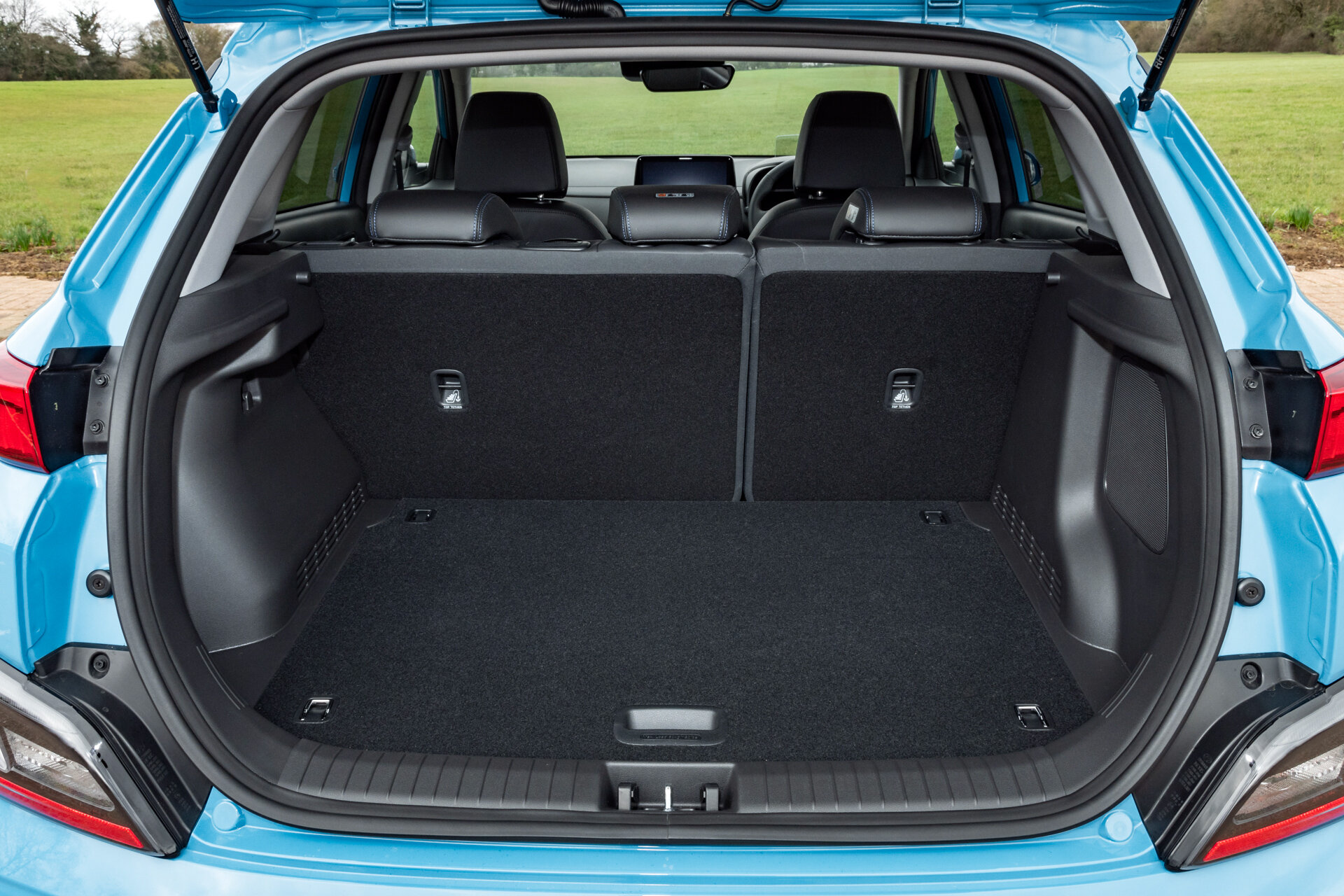

What’s new with the Kona Electric on the outside?
The front end receives a contemporary look, with the arrow-like daytime running lights and body coloured front complemented by a small lower air intake, vertical air intakes and the recessed light cluster. It’s an evolution of the pre-facelift model, but it’s fresh and well-considered. Without a front “grille”, the charge port door appears to be quite obvious, but hey, at least people will know this is a plug-in from the front.
The new Kona Electric is 25mm longer than the outgoing model, but you’d hardly notice it. New 17 inch alloy wheels—shod in Michelin Primacy4 low rolling resistance tyres—and painted wheel arches give the crossover a hot hatch appearance from the side profile, while a new rear valance and LED tail lights spruce things up at the rear.
The driver’s zone of the 2021 Hyundai Kona Electric.
Is there new technology for 2021?
The 2021 model now includes Hyundai’s suite of SmartSense safety features, including Lane Following Assist, Rear Cross Traffic Assist, Blind Spot Collision Assist and, something we’d like to see from more manufacturers, Safe Exit Warning which alerts occupants to approaching vehicles using the vehicle’s radar sensors should they open a door into traffic.
On the inside, a fully digital 10.25 inch LCD screen functions as the instrument cluster, and is customisable by the user. The Kona Electric also includes remote start, Qi-standard wireless charging, a Harmon Kardon premium audio system, and a leather interior. We’d have liked to see animal-free seating options, but Hyundai is saving that for the E-GMP-based IONIQ 5.
The only options across both models of the Kona Electric are premium paint for $595, and a black/grey interior option for $295. A Phantom Black two-tone roof is also available as a no-cost option, at the expense of a sunroof.
The Kona Electric is on sale in Australia now; we’ll be posting a full review in a few weeks time.
Kona Electric Elite and Highlander Specifications - Australia


Electric Chevy Silverado pickup gets green light, will be manufactured in Detroit
In a move set to anger coal-rolling pickup drivers yet guarantee the future viability of Chevrolet, the company has announced that a fully electric version of it’s popular Silverado pickup truck will be manufactured at it’s Factory Zero electric vehicle only manufacturing site in Detroit and Hamtramck.
In a move set to anger coal-rolling pickup drivers yet guarantee the future viability of Chevrolet, the company has announced that a fully electric version of it’s popular Silverado pickup truck will be manufactured at it’s Factory Zero electric vehicle only manufacturing site in Detroit and Hamtramck.
The fact that General Motors (GM) is going electric not only signifies GM’s commitment to electrification, but represents a significant future shift in the market. The Chevrolet Silverado is the second most popular new and used vehicle in the United States, selling close to 600,000 new units in 2020.
The Chevrolet Silverado electric will be a full-size pickup based on the company’s Ultium EV architecture, and according to GM will travel more than 400 miles (642 kilometres) on a full charge. General motors has committed billions not only to the new Factory Zero site, but also to electrifying its entire model line up, and its Ultium Cells joint venture with LG Chem LLC.
A release date for the Silverado electric is not yet known, but GM president Mark Reuss said at an event on Tuesday this week that the company will also make fleet-focused versions of the truck for commercial customers.
The current 2021 Chevrolet Silverado. Image: General Motors

Mercedes-Benz releases technical details of electric EQS sedan ahead of April 15 launch
Following the recent reveal of the Mercedes Benz EQS interior, we now have a full suite of technical details for the S-Class segment EV from the German automaker. Set to arrive in three variants, the EQS sedan will be a technological tour-de-force based on the automaker's dedicated EV architecture dubbed EVA

Mercedes-Benz EQS 580 4MATIC flagship to offer 770km range, 385kW power
Following the recent reveal of the Mercedes Benz EQS interior, we now have a full suite of technical details for the S-Class segment EV from the German automaker. Set to arrive in three variants, the EQS sedan will be a technological tour-de-force based on the automaker's dedicated EV architecture dubbed EVA, with an aerodynamic drag coefficient of 0.20cd (Tesla’s revised Model S promises a drag coefficient of 0.208cd), rear and all wheel drive options, sophisticated thermal management, and two battery options with net usable capacities of 90 kW and 107.8 kW. Let’s take a look at the range:
Mercedes Benz EQS 450+
single permanent magnet synchronous motor, rear wheel drive
245 kW (333 PS) / 568 Nm (418 lb ft), WLTP combined energy consumption 20.4-15.7kWh/100 km, range not stated
90 kWh nickel, manganese cobalt (NMC) modular battery, pouch cell design with 400V architecture, 200 kW DC fast charging
Mercedes Benz EQS 580 4MATIC
front and rear permanent magnet synchronous motors, all wheel drive
385 kW (523 PS) / 855 Nm (630 lb ft), WLTP combined energy consumption 21.8-17.4 kWh/100 km, range up to 770 km (478 miles)
107.8 kWh NMC modular battery, hard case cell design with 400V architecture, 200 kW DC fast charging
Is there anything special about the technology in the EQS?
In typical Mercedes Benz fashion, the press kit is a weighty tome. The largest battery available is a whopping 107.8 kWh, good for a claimed 770 kilometres (478 miles) of range on the WLTP combined cycle. Mercedes-Benz states the battery management system is designed for over the air updates, and that the batteries’ cell chemistry has been revised to reduce cobalt use, with the optimised active material constituting nickel, cobalt and manganese in a ratio of 8:1:1.
AC charging is available up to 22 kW, and DC charging can pump 200 kW into the EQS, good for 300 kilometres (186 miles) of charge in 15 minutes.
In terms of the drivetrain, Mercedes-Benz has worked with Bosch to develop synchronous motors for the EQS, unlike the asynchronous type found in the EQC. This means that the speed of the stator's magnetic field is equal to the motor's rotor speed, eliminating slip, and providing greater refinement, precision and efficiency. The motor on the rear axle features six-phase operation with two windings of three phases each, and stators with pull-in winding.
Mercedes-Benz claims a particularly strong magnetic field, improving energy efficiency, performance and reducing space in these new motors. The 4MATIC all wheel drive system continuously distributes the drive torques between the front and rear axles.
Braking recuperation is available, with drivers able to select from three stages. The recuperation output is up to 290 kW, with the ability to brake to a stop.

How smart is the EQS?
Tesla’s navigation route guidance has the ability to accurately calculate projected energy consumption versus real time consumption to your destination based on driving inputs, traffic and topography has always been considered industry leading. Mercedes-Benz will be introducing Navigation with Electric Intelligence on the EQS, which promises to calculate routes based on projected energy demand including topography of route, ambient temperature, energy consumers and more, as well as responding dynamically to congestion and changes in energy demand.

Mercedes-Benz promises smart navigation on the EQS.
Critically, the charging process must be simple for the EQS. Mercedes-Benz will be attempting to lure current S-Class owners into their flagship EV, and will also be looking to make conquest sales from the likes of Tesla, Porsche and BMW. It is critical that the charging process requires minimal effort for EQS owners, and Mercedes-Benz is promising a plug-and-charge service at European Ionity chargers where the vehicle and charger will automatically perform a handshake and sort out payment. It’s expected that United States EQS owners will have access to the Electrify America (EA) DC fast charging network, but it’s imperative that this flagship vehicle avoid charging issues seen by many on the Electrify America network.
The Mercedes-Benz EQS will be revealed in full on April 15.
Source: Mercedes-Benz

Lexus LF-Z Electrified EV is a preview of the brand's future direction
The Lexus LF-Z Electrified has been revealed in the form of concept renderings, and the Japanese automaker claims that we’ll see a production version around 2025.
Visually Striking Lexus LF-Z Electrified is heavy on style, light on details
The Lexus LF-Z Electrified has been revealed in the form of concept renderings, and the Japanese automaker claims that we’ll see a production version around 2025. According to Lexus, the LF-Z features “ideal dynamic balance achieved through the optimal placement of the battery and electric motors, as well as, among others, a new four-wheel driving force control technology known as "DIRECT4" that generates a superior and highly flexible driving performance, setting the LF-Z Electrified apart from conventional vehicles.”


So far, that all sounds rather vague. While most major automakers have committed to decarbonising their product line-ups and reducing manufacturing and supply chain emissions, Toyota Motor Corporation’s President Akio Toyota has recently criticised electric vehicles as overhyped, and stated that the transition to electrification is happening too quickly. While Toyota has been a pioneer in petrol-electric hybrid technology since the original Prius launched in 1997, the company has firmly refused to adapt to the current trend of electrification, and the LF-Z is the only sign that Lexus is serious about attaining market share in key European and American markets.
Exterior Design
The LF-Z Electrified retains some familiar Lexus design signatures; the aerodynamic ‘tick’ headlights, complex side-profile surfacing and cab-rear stance tie the LF-Z to the current model line up. The vehicle’s designers have added some pleasing new elements such as the swooping glasshouse, Aston Martin-esque wraparound rear with ducktail spoiler and vertical brake lights.

The Lexus LF-Z Electrified has a striking side profile.
The interior is bare, futuristic and laden with screens, and since it is just a concept at this stage, we can’t glean much about Lexus’ cabins of the future. The cockpit was designed based on the company’s concept of "Tazuna" ("tazuna" is Japanese for "rein"). and according to Lexus they were “inspired by the relationship between horse and rider, who communicate through a single rein, steering wheel-mounted switches and the vehicle's head-up display have been highly coordinated to create a space in which various functions, such as the navigation system, audio system, and driving mode selection, can be performed while concentrating on driving and without movement of the driver's line of sight or need to operate complicated switches.”

The interior of the Lexus LF-Z
The company has not hinted at any drivetrain or battery specifications, except to say that the LF-Z will be based on a dedicated electric vehicle platform. Lexus aims to offer electric variants of all its models by 2025, with the sales ratio of electric vehicles exceeding that of gasoline-engine vehicles. Lexus hasn’t specified how many of these will be Plug In Hybrid Electric Vehicles (PHEV) and how many will be fossil fuel free however. Given that the LF-Z is the company’s first fully electric vehicle, we don’t expect to see BEVs dominating the Lexus lineup within the next 5 years.
Source and Images: Toyota Motor Corporation

Meet the Dacia Spring - an electric crossover you can purchase in Europe for a ridiculous price
If one needed proof that European manufacturers are getting serious about decarbonising their passenger car fleets, look no further than the Dacia Spring.
The Dacia Spring is the cheapest BEV on sale in Europe
If one needed proof that European manufacturers are getting serious about decarbonising their passenger car fleets, look no further than the Dacia Spring. A Romanian manufacturer dating from 1966, Automobile Dacia is now wholly-owned by Groupe Renault, and produces a number of passenger and commercial vehicles with an emphasis on practicality and price.
The price of the Dacia Spring varies by country; in Germany it lists for €20,490, in the UK for £14,500 and in Romania for €18,100. Factor in electric vehicle/environmental grants available, and those numbers drop to €10,920 (€-9,570) in Germany, £12,000 (-£2,500) in the UK, and €8,100 (€-10,000) in Romania. Yes, with a generous state grant for environmental vehicles in Romania under the Rabla Plus (Clunker Plus) scheme, this Dacia costs less than some two-wheeled vehicles.
So what’s under the skin? There’s a 33 kW (45 PS) front-mounted electric motor with 125 Nm (92 lb ft) of torque, a 26.8 kWh battery and a compact crossover body that seats five. Before you start decrying the range and performance of those specifications, there’s one more number to consider: Curb weight. At 921 kg (2,030 lb) The Dacia Spring is incredibly light for an electric car, and therefore provides acceptable performance for a city car, and provides a useful range of 225 km (139 miles) on the WLTP combined cycle. That’s perfectly fine for a few days driving around town.
We believe that the future of electric vehicles may look something like the Dacia Spring. It will require a mindset-shift in consumers, but we will no longer be looking for a one-car-fits-all solution, and the Dacia spring is a perfect city car/car-share prospect. The nature of electrification and battery technology means that less mass simply means greater efficiency and range, and therefore a market will emerge for smaller, lighter (and cheaper) BEVs that are designed exclusively for commuting. According to the European Parliament Resolution on Sustainable Urban Mobility, by 2050, 82 percent of Europeans will commute outside an area in which they live (though this may change post COVID-19). Obviously, public transport is key to moving greater numbers of people more efficiently, but Europeans—and Australians and Americans—love their cars, and cheap, efficient urban commuter vehicles will be key to the phase-out of fossil fuel vehicles this decade.


Tesla posts record Q1 production and delivery results, almost exclusively from Model 3 and Model Y
In the first quarter of 2021, Tesla produced 180,338 vehicles and delivered 184,800 vehicles. That’s a record for what is traditionally a quiet quarter, and represents a 76 percent increase from 102,672 vehicles, and a nine percent increase from 88,400 vehicles produced and delivered respectively in the first quarter of 2020.
In the first quarter of 2021, Tesla produced 180,338 vehicles and delivered 184,800 vehicles. That’s a record for what is traditionally a quiet quarter, and represents a 76 percent increase from 102,672 vehicles, and a nine percent increase from 88,400 vehicles produced and delivered respectively in the first quarter of 2020.
These results also eclipsed the fourth quarter of 2020—traditionally a strong quarter—where Tesla produced 179,757 vehicles and delivered 180,570 vehicles.

Looking at the numbers above, the Model S and X contributed just over one percent of deliveries to Tesla’s Q1 2021 results, due to the fact that production ceased late last year as production lines are set up and retooled for the refreshed Model S and Model X Long Range, Plaid and Plaid+ due to launch this year. in the fourth quarter of 2020, Model S and Model X sales comprised approximately 10% of total vehicles produced and delivered. Years ago, critics mocked Elon Musk when he stated that Model S and Model X sales are “not all that important” in the long term.

Tesla’s Semi, likely to be introduced in 2022. Image: Tesla Motors
Despite strong forward demand for the revised Model S and Model X ranges, it’s now clear that Musk’s plan is coming to fruition; the more affordable Tesla Models are indeed contributing to the bulk of production and delivery numbers. China’s Gigafactory has been ramping up production over the last few months, and strong demand for Model Y in both China and in North America has clearly been a winner for Tesla.
With the installation of the Gigapress die-casting machines in Tesla’s factories, the company is able to realise even greater efficiencies in production, and maintain production to meet demand. 2021 will be an interesting year for Tesla; there’s the refresh of the Model S and X which will increase premium category sales and boost profitability, Both the Texas and Berlin Gigafactories are set to come online, Shanghai is expanding, and there is talk internally at Tesla that one million vehicles produced and delivered might be achievable.
Source: Tesla Motors

Genesis unveils X Concept high-performance electric GT coupe
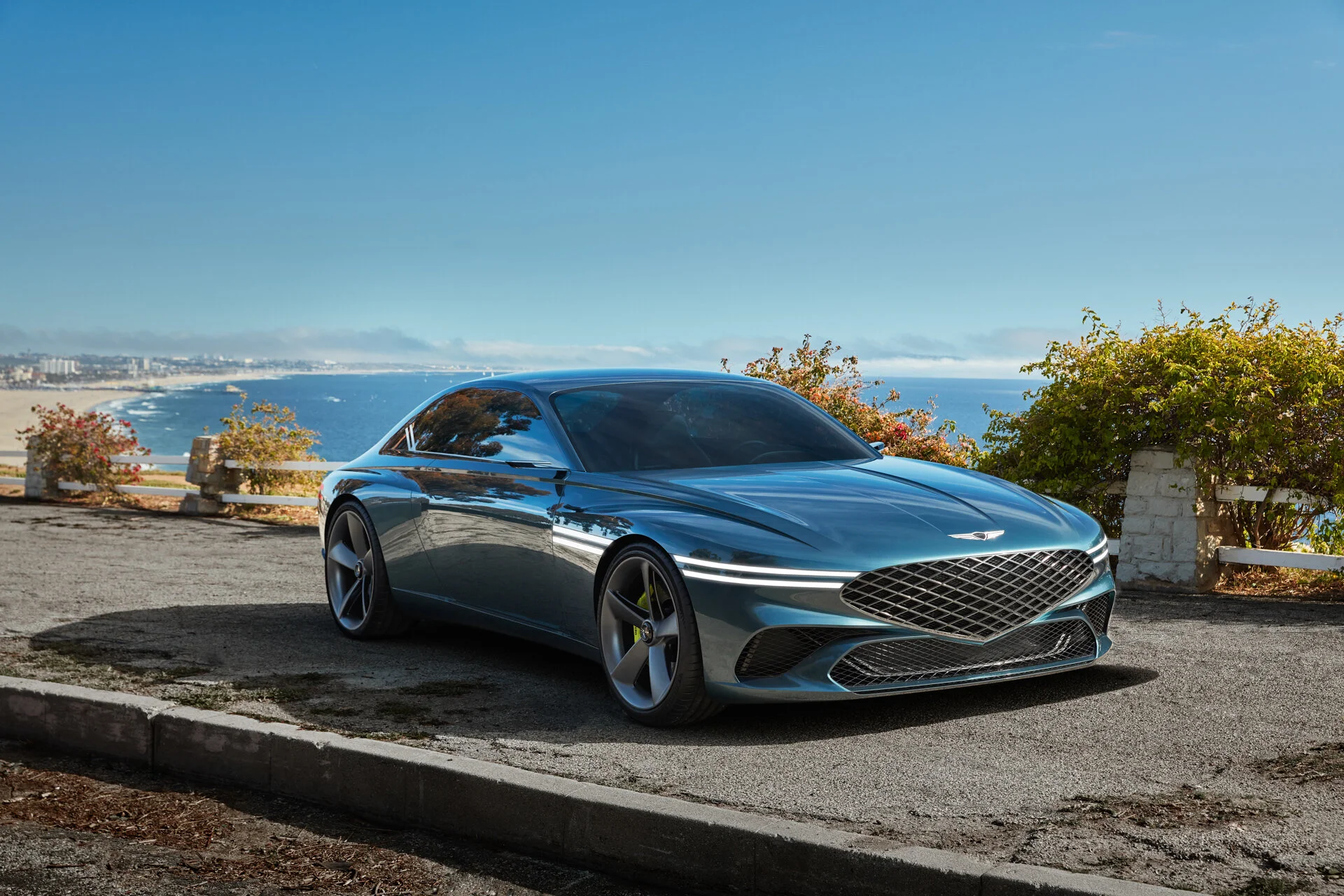
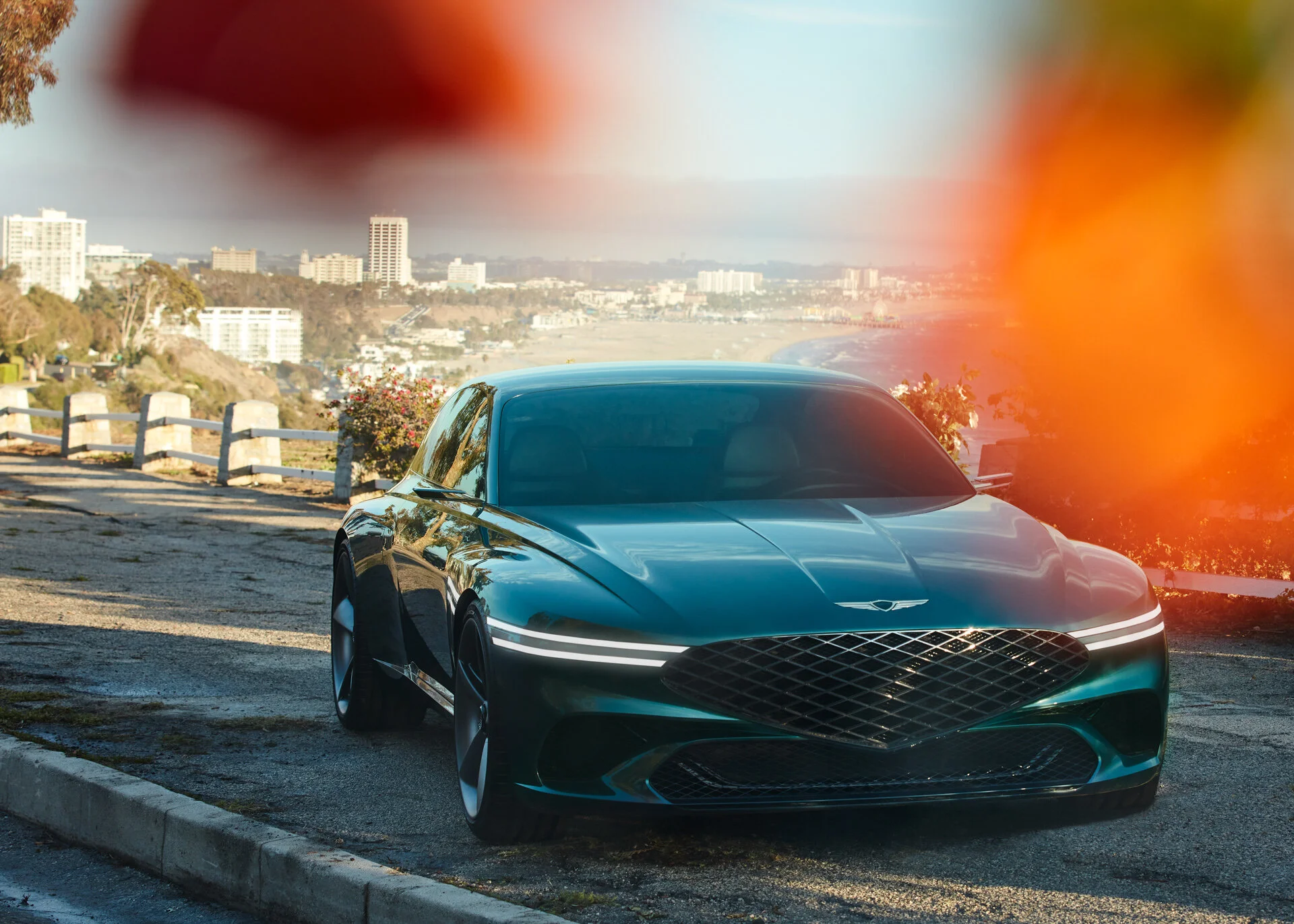
Light on details, but big on style. That’s the point of a concept car isn’t it? The Genesis X Concept is an electric grand tourer; a Bentley Continental or BMW 8 series for a future world of strict emissions standards.
Genesis X Concept is a luxurious, futuristic design study
Light on details, but big on style. That’s the point of a concept car isn’t it? The Genesis X Concept is an electric grand tourer; a Bentley Continental or BMW 8 series for a future world of strict emissions standards. Hyundai Motor Group has been flexing its design muscle of late and clearly working overtime, following the recently revealed IONIQ 5 and Kia EV6 models presenting all-new design languages for their brands.
The Genesis X Concept is low, wide and aggressively-styled, and is centered on Genesis’ ‘Two Lines’ design concept. The broad Two Line tail lamps and headlamps accentuate the wide wheel arches, and the integrated hood and fender produce a large clamshell piece reminiscent of an Aston Martin (the winged logo also aides this comparison).
The Genesis X Concept can be described as the ultimate vision of Athletic Elegance, the inherent design language of Genesis," said SangYup Lee, Head of Genesis’ Global Design. "The signature Two Lines theme and sustainable luxury will be blueprints for the futuristic designs and state-of-the-art technologies that Genesis seeks to adopt in its future models."
The side follows the traditional GT model design with a long hood and a short rear, and the two-lined lamps leading to the headlamps, which will likely not carryover to the production version. The arching side parabolic line gives the impression of a car ready to accelerate, though we can’t help but notice the ratio of glass-to-metal gives an appearance of slightly odd proportions. It’s a good looking car for sure, but the side and rear angles look a little droopy. And if it’s an electric vehicle, why does it need a hood that long?
The very Aston Martin-esque hue is known as Lençóis Blue, and “the color was developed to express the level of sustainable luxury that Genesis pursues. It is inspired by the lagoons of Maranhenses National Park in Brazil, where a lake forms only during the rainy season.” according to Genesis’ press release. Err, right. It’s a lovely colour, but there is such a thing as too much marketing.
The interior has a futuristic, swooping free-form display, and in our eyes is a tech-ier take on Bentley-esque luxury. Metal-backed bucket seats and sumptuous leather surfacing welcomes passengers, and the floating centre console features only a metal drive selector, and touch screen buttons. Genesis claims that the use of upcycled materials were used for the safety belts, parts of the steering wheel, and the airbag cover, highlighting the concept car’s eco-friendliness.


![[Photo]GenesisXConceptInterior(2).jpg](https://images.squarespace-cdn.com/content/v1/5237a580e4b09510ca448d5e/1617190468068-QHHOEV8O3DSSSOG9D9LH/%5BPhoto%5DGenesisXConceptInterior%282%29.jpg)
![[Photo]GenesisXConceptInterior(1).jpg](https://images.squarespace-cdn.com/content/v1/5237a580e4b09510ca448d5e/1617190468157-496W0QFRVJR7611EDELM/%5BPhoto%5DGenesisXConceptInterior%281%29.jpg)
![[Photo]GenesisXConceptInterior(3).jpg](https://images.squarespace-cdn.com/content/v1/5237a580e4b09510ca448d5e/1617190473880-M3QVGK5TX7216DWLR1ZQ/%5BPhoto%5DGenesisXConceptInterior%283%29.jpg)


Kia's EV6, and high performance EV6 GT revealed; headed for Australia, US and Europe in 2021
Another day, another good looking electric vehicle from Korea it seems. Kia is making a big deal about its first EV to be based on the E-GMP platform shared with Hyundai, and for good reason; the EV6 leads the automaker’s rollout of 11 new BEVs by 2026, and is fundamental to Kia’s ambitions to grow BEV sales to 880,000 units worldwide by 2030.
The KIA EV6 Range
Three models available; EV6, EV6 GT-Line and EV6 GT
800V architecture with 510km max. range, 0-80% charge in 18 minutes
58 kWh and 77.4 kWh battery sizes available; 2WD and 4WD variants
EV6 GT fastest Kia ever with 0-100km/h (0-62mph) in 3.5s from 430 kW, 740 Nm dual motors
Another day, another good looking electric vehicle from South Korea it seems. Kia is making a big deal about its first EV to be based on the E-GMP platform shared with Hyundai, and for good reason; the EV6 leads the automaker’s rollout of 11 new BEVs by 2026, and is fundamental to Kia’s ambitions to grow BEV sales to 880,000 units worldwide by 2030.



Exterior Design
Kia’s EV6 debuts the company’s new design philosophy known as ‘Opposites United’, which “takes inspiration from the contrasts found in nature and humanity”. Karim Habib, Senior Vice President and Head of Kia Global Design Center, elaborated: “EV6, as the first dedicated Kia EV, is a showcase of human-centred, progressive design and electrified power. We strongly believe EV6 is a compelling and relevant model for the new EV era. With EV6 we aimed to create a distinctive, impactful design by using a combination of sophisticated, high-tech features on pure and rich volumes while providing a dedicated EV aiming to define our future.”
The EV6 sports the high-riding semi-crossover look of the Polestar 2, thanks to its battery pack in the floor. Interestingly, the wheelbase of 2,900mm (115 inches) is 100mm shorter than its sister Hyundai IONIQ 5, and almost the same as Tesla’s Model Y (2,891mm).
It’s a sporty—if a little understated—look; the short front overhang and plunging hood works well with the ‘tiger face’ angular headlights, and the big wheels offset the slab-sided profile view. The rear of the EV6 is highlighted by that nifty ducktail spoiler, and the descending highlight that blends into the side sill.
Kia’s EV6 GT-Line has some very pleasing design elements. Images: Kia
Interior Design
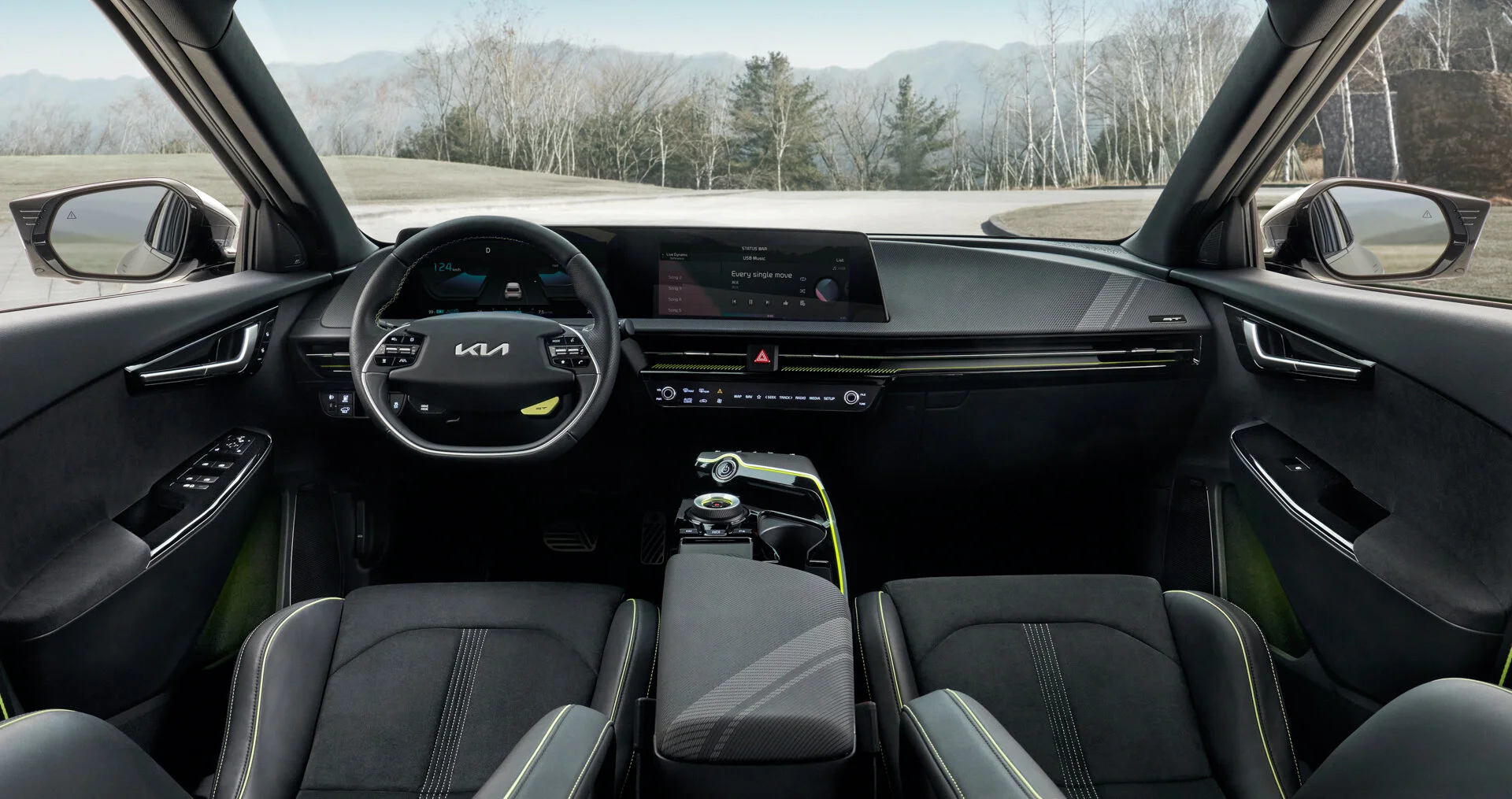
The EV6 interior is somewhat familiar to the IONIQ 5, but still retains its own identity. The dual screens, floating centre console and elevated driving position are similar to the Hyundai, but darker interior tones, sport-themed highlights and textures, and figure hugging seats differentiate the GT-Line and GT models. If the IONIQ 5 aims to offer the high-end ambience of a living room, the EV6 is positioned as the choice for sportier drivers.
Speaking of those seats, they’re made from recycled plastics, and demonstrate a trend of the auto industry moving to cruelty-free interiors ultilising natural fibres, recycled materials and animal free surfaces. That long wheel base translates to trunk space of 520 litres, and plenty of rear legroom.
The dual 12-inch screens are connected behind one piece of reinforced glass, and the EV6 also features an augmented reality head-up display system, as we’ve seen on Mercedes-Benz vehicles. Like the IONIQ 5, the vehicle-to-load (V2L) feature can supply up to 3.6kW of power to devices, and can even charge another EV.
The EV6 GT-Line interior, is sporty, premium, and shouldn’t scare away first-time EV buyers.
Battery and Drivetrain
Let’s get one thing straight; in GT trim, this is the fastest Kia ever. Battery and electric motor technology is so advanced now that BEVs simply leave petrol, diesel and hydrogen cars in their wake. In base trim, the EV6 features a 58 kWh battery, with a single rear motor, 125kW (203 PS) and 350Nm (258 lb-ft). It’s good enough to propel the EV6 to 100 km/h (62 mph) in 6.2 seconds.
Step up to the EV6 GT, and you’re rewarded with a 77.4 kWh battery, 430 kW (584 PS) and 730 Nm (538 lb-ft), from two electric motors. That’s enough grunt to propel the EV6 GT to 100km/h (62 mph) in 3.5 seconds, and it makes Kia’s previous king of performance—the Stinger GT with 274 kW, 510NM and a 0-100 km/h time of 4.9 seconds—look like a steam locomotive.
Full specifications are below; if you’re a customer who is interested in the model with the best efficiency/range for your dollar, the rear-wheel-drive 77kWh EV6 long range is the one to go for with 510 km (316 miles) WLTP range.
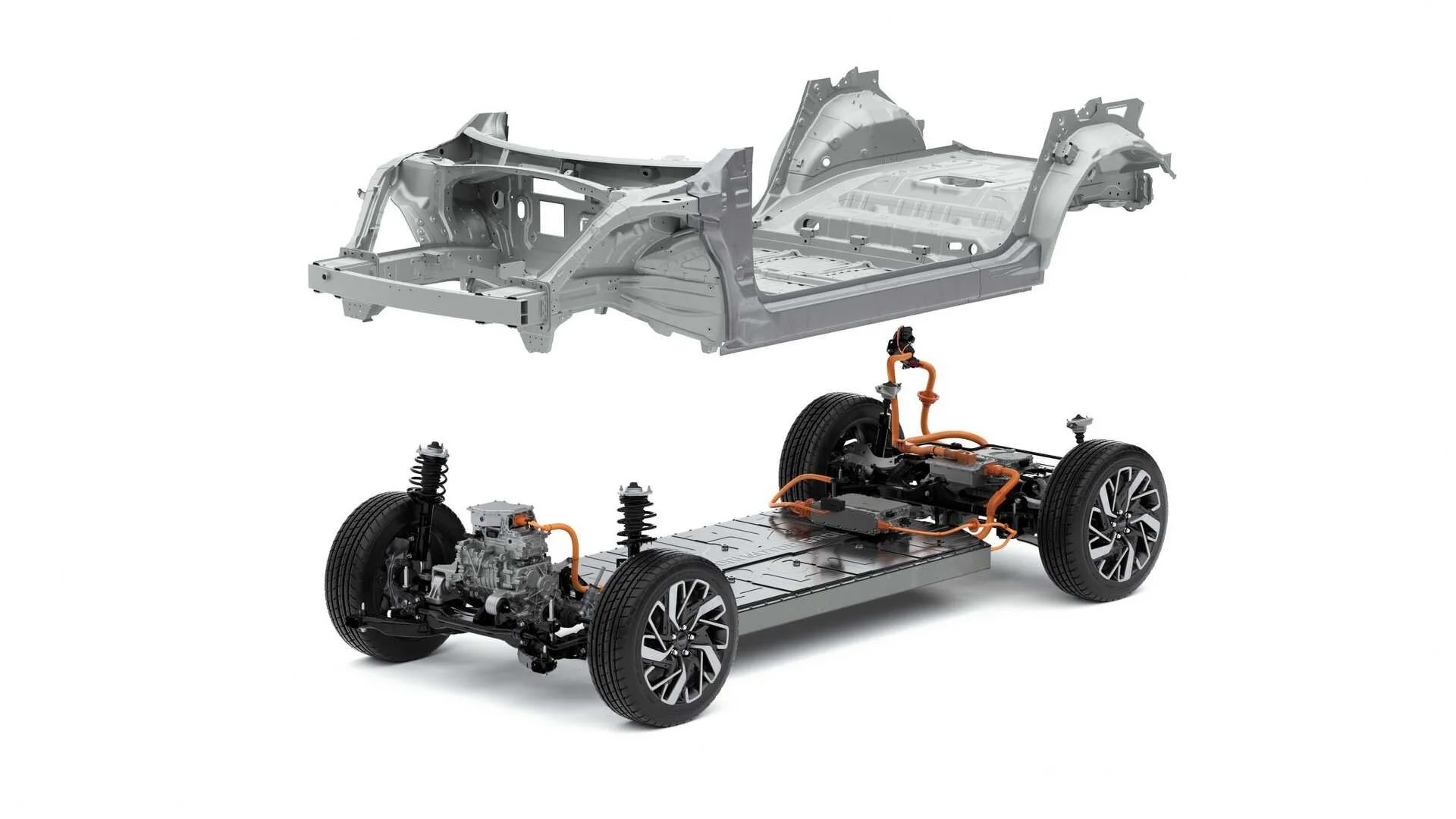
Hyundai Motor Group’s E-GMP platform underpins the Kia EV6.
Like Hyundai’s IONIQ 5, the EV6 features 400V and 800V electrical architecture, across all models. Kia quotes the ability to charge from 10 to 80 percent in just 18 minutes on all variations, or a top-up charge of 100km of driving range in less than four and a half minutes when pairing 2WD with the 77.4-kWh battery option.
With an Integrated Charging Control Unit (ICCU), the EV6 allows for vehicle-to-load (V2L) functionality, supplying up to 3.6 kW of power to charge another EV (albeit slowly) or power household items such as a laptop, or, according to Kia, a 55 inch television and an air conditioner for 24 hours.
Under the hood, there’s an energy efficient heat pump, which recovers waste heat from vehicle systems, and helps to improve range. Energy recuperation is also standard, and can be controlled by the paddles on the back of the steering wheel. Six recuperation modes allow drivers to customise the drive to their liking; many EV fans will be pleased to know one-pedal driving is possible with the Kia EV6.

Kia EV6 specifications supplied by Kia Motors
Autonomy and Technology
We mentioned the augmented reality head-up display earlier; this system projects driving information onto the base of the windscreen in the driver’s line of sight, including alerts from the car’s Advanced Driver Assistance System, details of vehicle speed, and turn-by-turn navigation instructions.
Kia Connect is included, promising real time services and over-the-air updates. Kia Connect will also allow drivers to find EV charging points, plan charging schedules, and check the range radius based on remaining charge and consumption.
Lane Following Assist (LFA) centers the Kia EV6 in the middle of the lane, and in conjuncion with Highway Driving Assist 2 (HDA 2), the EV6 can steer, brake and even change lanes autonomously. Remote Smart Parking Assist—a feature found on most new EVs and premium Euro models now— helps remotely park or exit a tight parking spot via a smartphone app or key.
It’s an exciting time for Kia; new brand identity, new platforms, drivetrains and a solid path towards a fully electric model line up over the next decade. The EV6 should be a car that suits many different buyers from long range highway cruisers, to parents doing the school run.
Pricing is expected to kick off around $45,000 USD or £40,895 in the UK, before government incentives. Australians will have to wait a bit longer for pricing information, but we believe the EV6 will start in the $70,000 price bracket. Northern Hemisphere customers can expect to start seeing cars in summer 2021, while down under, Kia has confirmed the EV6 will go on sale in Australia and New Zealand in the second half of the year.

Jeep announces 4xe Charging Network to provide EV charging stations
Hot on the heels of Rivian’s announcement of the Rivian Adventure Network, Jeep has partnered with Electrify America to roll out level 2 EV charging stations at Jeep Badge of Honor off-road trailheads around the United States.

Jeep to partner with Electrify America, providing Level 2 Charging at popular off-road trailheads
Hot on the heels of Rivian’s announcement of the Rivian Adventure Network, Jeep has partnered with Electrify America to roll out level 2 EV charging stations at Jeep Badge of Honor off-road trailheads around the United States.
The launch of these trailhead chargers coincide with the launch of the 2021 Jeep Wrangler 4xe plug-in hybrid model, and the company states that they will support future fully electric Jeep models. Jeep 4xe charging stations are initially scheduled to open this spring at three of the most-popular off-road sites and icons for the Jeep brand – Moab, Utah; the Rubicon Trail in Pollock Pines, California; and Big Bear, California.

“Electrification opens a new chapter in the Jeep brand story, and it brings an entirely new level of excitement and enjoyment for our enthusiastic owners,” said Christian Meunier, Jeep Brand Chief Executive Officer – Stellantis. “Key to making Jeep brand the greenest SUV brand is assuring our owners can enjoy the benefits of electric propulsion wherever they go, including the most iconic off-road trails in the country.”
Jeep is working with leading public charging network Electrify America to establish the trailhead charging sites and install the charging equipment. Jeep 4xe owners will be able to login to unlock free charging via a custom mobile app by Electrify America, which also allows drivers to initiate and monitor their charging session.
“It is our goal to provide electric vehicle drivers with the freedom to get to where they want to go – whether it be on a highway or off-road – and we look forward to bringing Jeep enthusiasts along on the journey,” said Giovanni Palazzo, president and chief executive officer of Electrify America. “Through the customizable electric vehicle charging offerings of our Electrify Commercial B2B brand, we were able to work with Jeep to identify where their drivers will need charging access most, and make it a reality.”

The jeep Wrangler and an Electrify America solar charger
The Jeep 4xe Charging Network trailhead chargers will deliver Level 2 (240-volt) charging, meaning the 17 kilowatt-hour battery pack in the Jeep Wrangler 4xe can be fully recharged in about two hours, delivering up to 21 miles (33 km) of electric range.
The 4xe charging stations will be either directly connected to the power grid or use solar power to generate electricity, though the company has not stated exactly how much power will be generated by renewables.
We’re not certain how many hybrid Jeep owners would bother to plug in to charge while they’re off-roading or hiking, but it’s a small gesture towards Jeep’s—and Stellantis’—all electric future.

Mercedes-Benz reveals EQS EV interior before worldwide debut on April 15th
Mercedes-Benz has shown us the production ready interior of its upcoming EQS sedan, and its a thing of illuminated beauty if timber, glass and OLEDs are your thing. The EQS is the flagship vehicle for Mercedes-Benz’ EQ brand—literally the S-Class of the electric world—so you can expect that the designers have gone all out.


Mercedes-Benz has shown us the production ready interior of its upcoming EQS sedan, and its a thing of illuminated beauty if timber, glass and OLEDs are your thing. The EQS is the flagship vehicle for Mercedes-Benz’ EQ brand—literally the S-Class of the electric world—so you can expect that the designers have gone all out.
The MBUX Hyperscreen is the (optional) pièce de résistance, combining all features of the drivers’ instrument panel, dashboard and infotainment into a single glass panel. Mercedes-Benz likes to reference historical details, and the thin silver shadow frame around the screen, combined with the single ventilation band and a narrow leather frame are reminiscent of classic instrument panels according to the automaker.
If one doesn’t option the Hyperscreen, the interior looks quite similar to the latest W223 S-Class. with a single, vertically mounted touchscreen. The EQS is set to debut on April 15, before going on sale in July/August 2021. Scroll down for 10 interesting facts about the interior of the EQS:

The EQS interior with hyperscreen and floating centre console.
10 interesting facts about the interior of the EQS:
With the MBUX Hyperscreen, multiple displays merge seamlessly to create an impressive curved screen band over 141 centimetres wide. The area perceived by the occupants measures 2432.11 sq. cm.
The large glass covering the MBUX Hyperscreen is curved in three dimensions in a moulding process at temperatures of approx. 650°C.
The HEPA filter (High Efficiency Particulate Air) as part of the optional equipment ENERGIZING AIR CONTROL Plus cleans the incoming outside air at its very high filtration level. Over 99.65 percent of particles of all sizes are eliminated, and the adsorption area is equivalent to about 150 football fields.
The key applications are always offered on the top level in the field of vision, depending on the situation and context, as part of Mercedes’ “zero-layer design”.
The "Mercedes-Benz pattern" is used in several places in the EQS interior such as on the backlit trim elements or on the passenger display as a digital decorative image. It is an abstracted, three-dimensional star pattern based on an early trademark of the Daimler Motorengesellschaft.
The EQS comes with the two soundscapes Silver Waves and Vivid Flux, and they can be selected or switched off as sound experiences on the central display. The algorithms and sounds for the sound design are created in-house at Mercedes-EQ by physicists, sound designers, media designers and mechatronics specialists.
Mercedes-Benz is showcasing its modern, leather-free material for the interior, NEOTEX. According to the company, it “combines the look of nubuck leather and high-tech neoprene”. There are eight coordinated colour combinations in the interior.
More than 40 new inventions have found their way into EQS. In addition, 20 design applications protect the design of the vehicle.
The design of the door panels borrows from the interior design of modern living spaces. Doors and their centre panels emerge from behind the MBUX Hyperscreen to span the space. A surface-mounted modular body floats like a sideboard in front of the door panel.
ENERGISING COMFORT features three programmes—Forest Glade, Sounds of the Sea and Summer Rain—which provide an immersive and realistic on-board sound experience. These calming sounds were created in consultation with the acoustic ecologist Gordon Hempton.
SEA Electric to purchase 1,000 battery sets from Soundon New Energy Technology Co for electric trucks
Global automotive technology company SEA Electric has expanded its global reach through the purchase of 1,000 electric vehicle batteries from long-time technology partner Soundon New Energy Technology Co. The newly formed arrangement immediately follows SEA Electric’s recently announced US$42 million in equity financing news.
Global automotive technology company SEA Electric has expanded its global reach through the purchase of 1,000 electric vehicle batteries from long-time technology partner Soundon New Energy Technology Co. The newly formed arrangement immediately follows SEA Electric’s recently announced US$42 million in equity financing.
Soundon has been providing SEA Electric with batteries since 2012, and the two companies have worked together closely on the development of seven SEA-Drive battery solutions over the course of the nine year relationship. SEA Electric is leveraging the cost benefits of Soundon’s battery and power electronics technical expertise, and their production efficiencies. The deal also allows SEA Electric to realise a significant 36 percent reduction in kilowatt hour (kWh) unit cost, and fulfilment of the battery production is expected to be completed in Q2 2021.

Soundon New Energy Technology’s manufacturing centre in China. Image: SEA Ealectric
According to Tony Fairweather, SEA Electric president and founder, Soundon is not only a world-class leader in innovation and battery technology, but highly regarded for its product quality, on time delivery, and competitive pricing. “Our long-term relationship with Soundon has been a very successful commercial journey and we anticipate continuing to share our global successes along the way.” While the majority of the initial 1,000 battery units are slated for the United States, the balance will go to SEA Electric inventories in Australia, New Zealand and Southeast Asia, along with the company’s first entry into the European market.
SEA Electric’s SEA-Drive technology fits hundreds of OEM platforms according to the company, with this large order from Soundon shared cross three major power-system models:

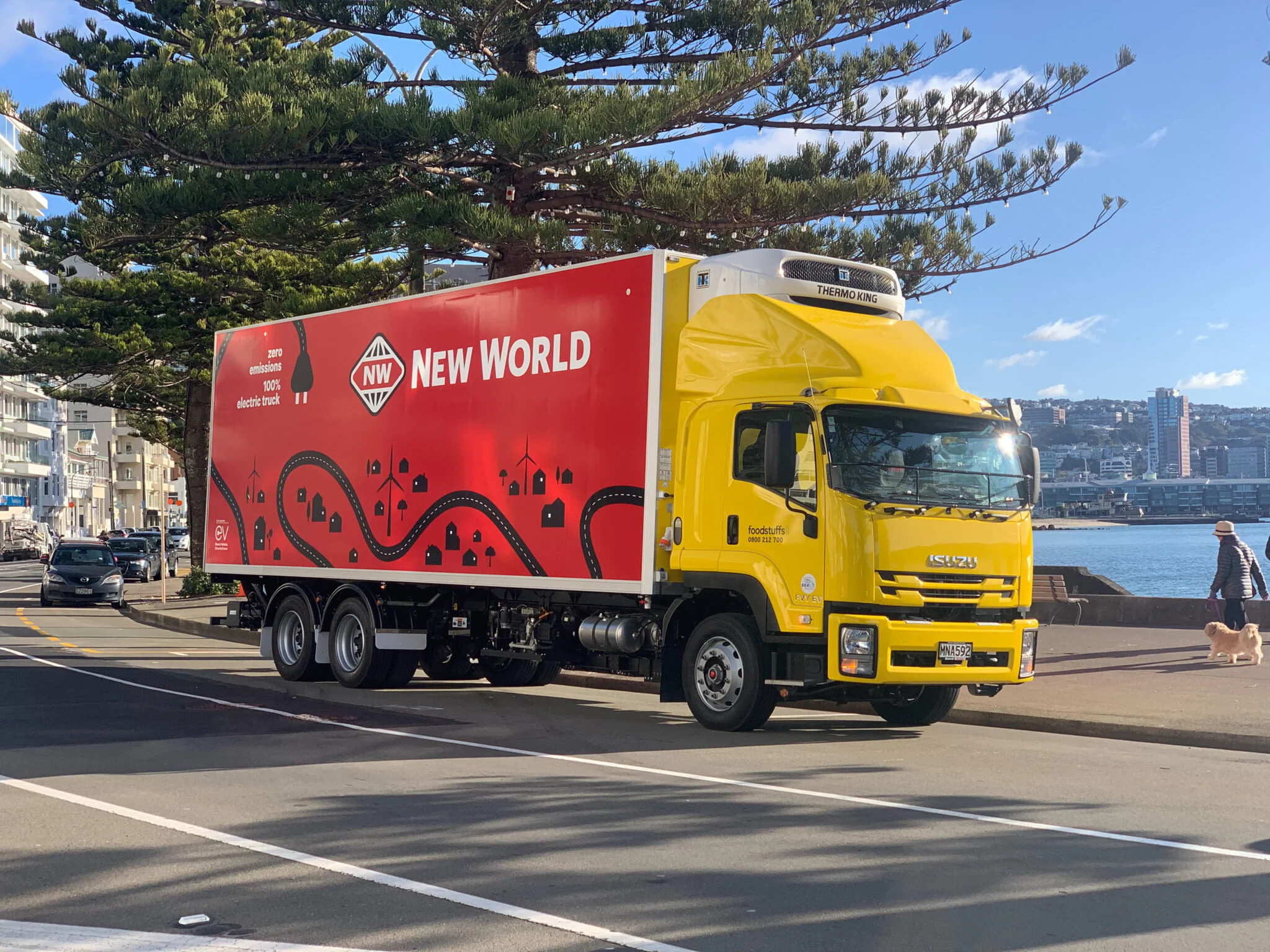
An Isuzu truck with SEA-Drive technology. Image: SEA Electric
SEA-Drive 70 – contains 88 kilowatt hours (kWh)
SEA-Drive 100 – contains 101 kilowatt hours (kWh)
SEA-Drive 120 – contains 138 kilowatt hours (kWh)
Wu Peng, Vice President of Sales and Marketing for Soundon commented that “this is a significant milestone in our partnership with SEA Electric. Receiving this 1,000-unit order not only facilitates SEA Electric’s substantial global growth, it also positions Soundon as a leader in the export market for commercial electric vehicles. It’s a winning proposition for all.”
With global headquarters and key leadership in Los Angeles, SEA Electric currently has operations in five countries and more than one million miles of independent Original Equipment Manufacturer (OEM) testing and in-service operation in all markets.
SEA Electric is an Australian success story, and currently partners with commercial vehicle OEMs, dealers, operators and upfitters to deliver zero-emissions trucks around the world. The company is expected to deliver more than 1,000 electric commercial vehicles this year. The company forecast is to have more than 15,000 vehicles on the road by the end of 2023.

Soundon New Energy Technology’s manufacturing centre in China. Image: SEA Ealectric
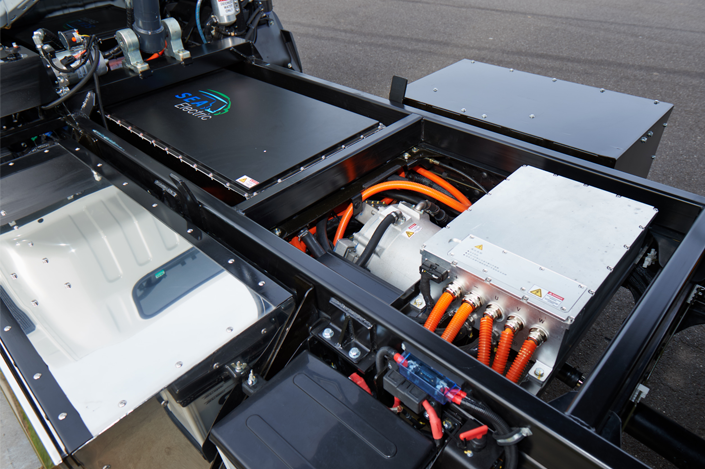
An example of SEA Electric’s SEA-Drive unit for OEMs. Image: SEA Electric

Mercedes-Benz EQA electric crossover confirmed for Australian arrival in June 2021
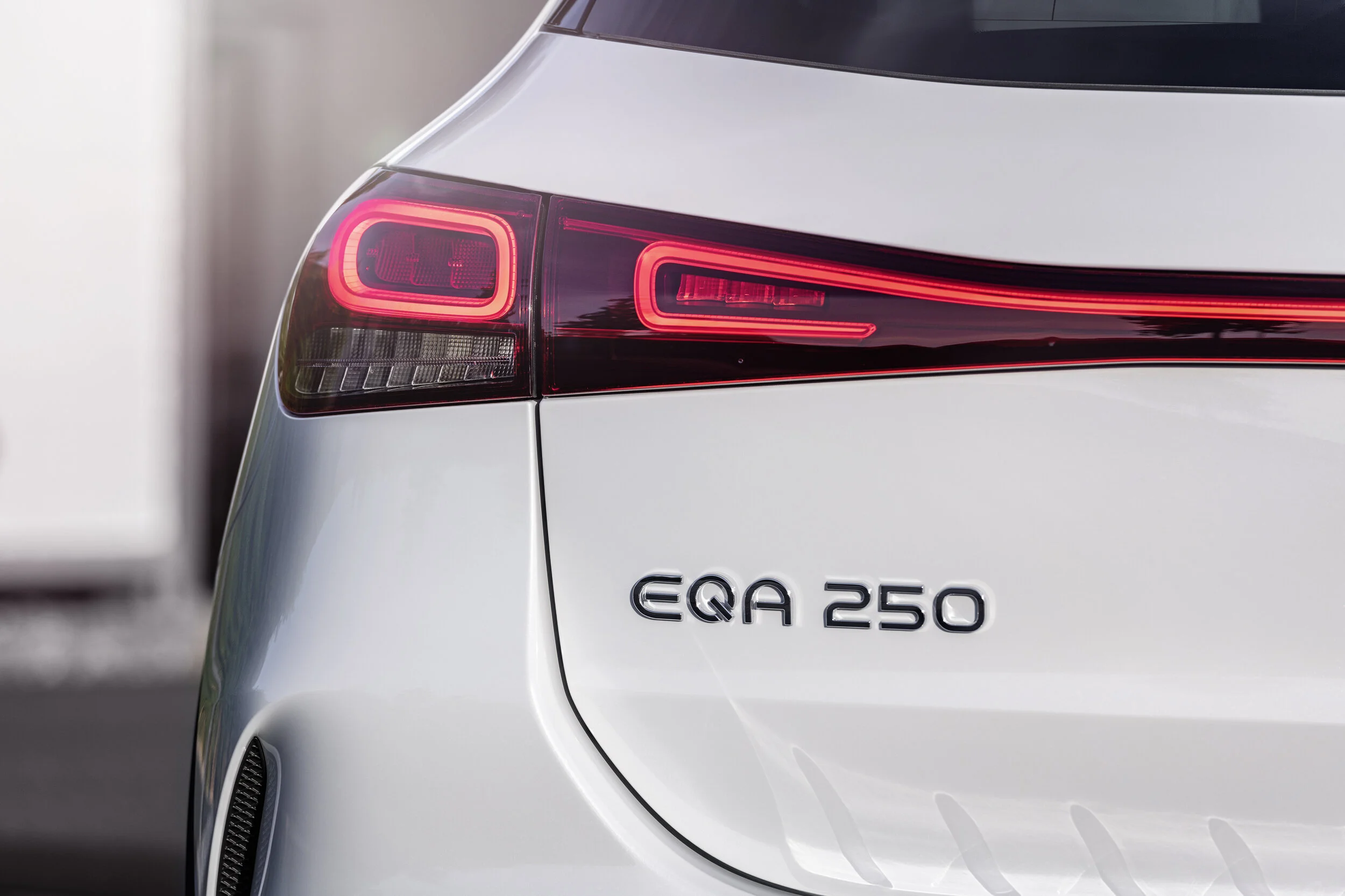
Mercedes-Benz is set to get a head start in Australia, beating Hyundai’s IONIQ 5, Tesla’s Model Y and BMW’s iX3 to market in 2021. The manufacturer has confirmed that the EQA 250 will open for orders from Australian customers next month, with deliveries to commence in June.

Mercedes-Benz expands EQ range in Australia - EQA 250 available from June
Mercedes-Benz is set to get a head start over its rivals in Australia, beating Hyundai’s IONIQ 5, Tesla’s Model Y and BMW’s iX3 to market this year. The manufacturer has confirmed that the EQA 250 will open for orders from Australian customers next month, with deliveries to commence in June.
Priced from $76,800 AUD for the EQA 250 and $84,100 for the EQA 250 Edition 1 (excluding on-road costs), both models feature an asynchronous electric motor at the front axle, with 140 kW (190 PS) or power and 375 Nm (276 lb ft) of torque.
Regarding the battery, Mercedes-Benz has a 420 volt lithium ion battery with five modules and 200 cells in a double decker design. It offers a net energy content of 66.5 kWh, with an energy consumption rating of 16.2kWh/100km. The EQA 250 offers 480 kilometres ADR range (426km/265miles WLTP), so expect around 400km in real world Australian conditions.
Mercedes-Benz Australia is offering a comprehensive standard equipment list on the EQA. The EQA 250 receives adjustable damping with DYNAMIC SELECT driving modes, 19-inch AMG 5-twin spoke AMG alloy wheels, the twin-10.25-inch MBUX infotainment system/instrument cluster, Apple Carplay/Android Auto, wireless phone charging, DAB+ digital radio, DISTRONIC active distance assist cruise control, and active assists including blind-spot monitoring, Traffic Sign Assist, lane keeping and automatic emergency braking.
The Edition 1 package is a limited volume option, and includes the above features plus 20-inch AMG multi-spoke alloy wheels in matte copper, AMG exterior trim, Neva grey leather, backlit design trim elements in the interior, silver chrome metallic finishes, AMG pedals, illuminated door sill panels, a unique vehicle key, sports multifunction steering wheel, and most importantly, “Edition 1” floormats.
We can’t wait to see the EQA 250 land in Australia. While the EQA range is still based on Daimler’s MFA2 platform architecture—we’ll have to wait for the EQS to debut the modular MEA platform—it’s size, performance, equipment, looks and price should see it compete admirably in the popular premium compact crossover market in Australia. We covered the global launch of the EQA range extensively; for more information and pictures, read our article here




Westport CT's Tesla Model 3 police cruiser - one year and 13,000 miles later
Westport Police purchased the first EV in Connecticut for active police duty in 2019, and while the COVID-19 pandemic has seen the car travel less than the department had been expecting, the Tesla Model 3 Long Range dual motor variant has now covered 13,000 miles (21,000 kilometres).
Westport Police purchased the first EV in Connecticut for active police duty in 2019, and while the COVID-19 pandemic has seen the car travel less than the department had been expecting, the Tesla Model 3 Long Range dual motor variant has now covered 13,000 miles (21,000 kilometres).
Police Chief Foti Koskinas happily gave a tour of the vehicle and update regarding its service at last weekend’s EV Freedom event in Westport. Chief Koskinas stated in the video that the Model 3 police cruiser has used about US$600 worth of electricity over 13,000 miles, and that they’re already way past break even with this car on the fleet.
While the Model 3 police cruiser is only used for traffic duties—excluding prisoner transport at this stage—Chief Koskinas stated that the car is capable of performing two 8-hour back to back shifts without requiring a charge.
The rear compartment is perfectly sized to hold emergency equipment, handguns and larger firearms, while the front trunk or “frunk” is a very convenient storage option for emergency medical equipment.

The rear of the Model 3 is spacious enough for police equipment and firearms. Screenshot: Paul Braren on YouTube
There are a number of benefits in choosing Tesla for police duties; namely the built in cameras can be adapted for police use, rather than having to retrofit thousands of dollars worth of external cameras. Antennas and radio equipment can be easily incorporated into the vehicle’s frame and glass roof, giving the Tesla Model 3 police cruiser a very clean look.
The only drawback according to Chief Koskinas is that the headlights will switch off after 45 seconds upon stopping the vehicle, which is unsuitable for police duties. He stated that Tesla is working with the department to recode this however.

The frunk of the Tesla Model 3 stores medical equipment. Screenshot: Paul Braren on YouTube
Electric vehicles have huge benefits to police departments in terms of running costs, but there are also benefits to officer health, ease of operation, flexibility in customisation, reducing emissions and of course on-road performance. While municipal and state governments across the world have been a little hesitant at adopting battery electric vehicles, mainly due to issues around range performance, we’re certainly seeing the tide changing; Thai police have a number of Tesla Model 3’s on their fleet, Freemont, CA has run a successful trial with a Tesla Model S, and, Closer to home, Victoria, Australia has a Tesla Model X for highway patrol duties while the New South Wales Police has recently taken delivery of a Hyundai Kona Electric.
Source: Paul Braren on YouTube

Tesla looks to officially commence Singapore operations; Model 3 available to order
Tesla looks to be gearing up for a launch of operations in Singapore this year, with multiple roles in retail, service, parts and customer service advertised on the company’s website as at 25 January 2021. Also visible on the website’s charging location search page is a marker over Singapore showing that a Supercharger site is planned, but that the “Target opening date [is] to be confirmed”, and that “Timing and location subject to change”.
Tesla looks to be gearing up for a launch of operations in Singapore this year, with multiple roles in retail, service, parts and customer service advertised on the company’s website. Also visible on the website’s charging location search page is a marker over Singapore showing that a Supercharger site is planned, but that the “Target opening date [is] to be confirmed”, and that “Timing and location subject to change”.
Note that many reputable news sources are reporting Singapore’s first Supercharger is likely to be located exactly on the pin; that is at the Singapore Island Country Club. Our take is that this is a general location marker, and Tesla would be unlikely to place the company’s first rapid charging site within the grounds of a private club, off limits to the public.

Tesla’s website shows that Singapore is a planned future Supercharging location.
The Tesla model 3 can also now be ordered in Singapore, in Standard Range Plus and Performance specifications. Tesla’s website quotes a date of “mid 2021” for deliveries of either model, and is available from SG$S112,845 (SR+) and SG$154,845 (Performance), excluding Certificate of Entitlement (COE) which can cost between SG$40-50,000 at today’s rates. The COE gives vehicle owners the right to own and operate a vehicle for ten years, and is purchased through an open bidding system, though if you purchase a new vehicle, the dealership generally handles the acquisition of the COE.

Tesla’s Model 3 is eligible for significant government concessions in Singapore.
Interestingly, Tesla’s website shows that the Model 3 is eligible for two sizeable discounts on the country’s Additional Registration Fee (ARF). There’s a SG$20,000 EV early adopter incentive, and a SG$20,000 Vehicle Emissions Scheme (VES) rebate. These discounts make the Model 3 incredibly competitive with other sports sedans in the market.
At this stage, The revised Model S and Model X remain off limits for Singaporeans to order.
Although Tesla’s CEO Elon Musk has, in the past been rather uncomplimentary of the Singaporean Government’s attitude towards not only electric vehicles generally but his company, Singapore now has a mandate to eradicate internal combustion engined vehicles on its roads by 2040. This government support means that Singaporeans will soon have not only policy certainty around zero emissions vehicles, but an increased rollout in charging infrastructure, as well as potential rebates on the cost of vehicle registration.

Tesla’s Model 3 will be available to Singaporeans by mid-2021.
Reducing vehicle emissions will be crucial in achieving the island-state’s overall goal of peak emissions of 33 million tonnes by 2050, given the heavy reliance on gas, coal and oil for energy. There are about 600,000 privately owned cars on the road in Singapore, with EVs numbering about 1,100 (that’s only 0.18%).
With the zero emissions mandate, recently raised petrol duties, no minimum registration fee and the 10 year validity of the mandatory Certificate of Entitlement, some analysts are predicting that Singapore has the potential to produce a market for a minimum of 50,000 electric vehicle sales per annum.

Vietnam's VinFast discussing potential EV battery and components deal with Apple supplier Foxconn
Vietnam's largest conglomerate Vingroup confirmed on Friday that its automotive subsidiary VinFast was in early stage talks with the Foxconn Technology Group about working together and that any partnership formed would focus on developing batteries and electric car parts.
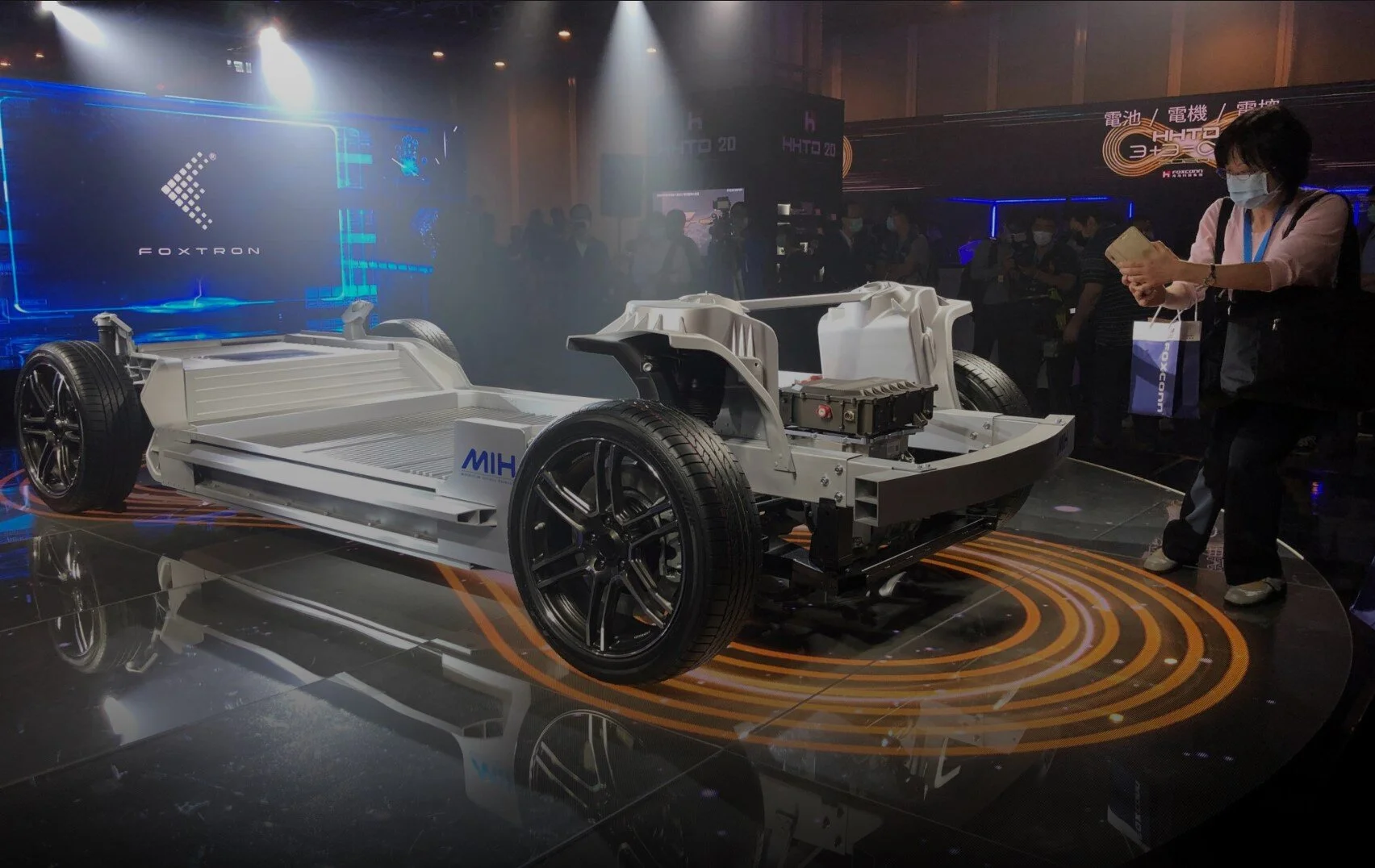
Foxconn’s EV platform at a company event in 2020. Image: Reuters/Yimou Lee
Vietnam's largest conglomerate Vingroup confirmed on Friday that its automotive subsidiary VinFast was in early stage talks with the Foxconn Technology Group about working together and that any partnership formed would focus on developing batteries and electric car parts.
"Vingroup has received proposals from Foxconn but nothing is concrete yet. The partnership, if any, will focus on developing the batteries and electric car parts," a spokesman for Vingroup said. "No decision on working together to produce EVs has been made yet."

The flagship EV VinFast VF33 concept.
According to Reuters, Foxconn has put forward a proposal to VinFast to acquire their EV production lines, However VinFast would prefer a partnership as it remains keen to keep and grow its EV business.
Foxconn naturally declined to comment, however chairman Liu Young-Way also stated that the company may consider producing electric vehicles at its Wisconsin, USA plant, or look to setting up production facilities in Mexico. Liu described Foxconn as the "new kid in town" for vehicle manufacturing, and said the company needs to quickly build up its capacity to earn trust from clients.
Foxconn has been the world’s largest contract manufacturer for OEM’s for a few years now, and has openly stated that it has ambitions to shake up the automotive industry, but offering startup and established players alike a shortcut to competing in the electric vehicles market.
There’s no reason to expect that this can’t happen; Foxconn has moved quickly to establish deals with companies like Fisker and Byton. Recently Foxconn successfully established a deal with Zhejiang Geely Holding Group to provide contract manufacturing.

The VinFast LUX SA2.0 designed by Pininfarina. Image: VinFast

The VinFast LUX SA2.0 Interior.
Vinfast is the automotive arm of Vingroup, Vietnam’s largest conglomerate consisting of 48 subsidiary companies across real estate development, retail services, education, network security, healthcare and of course automotive manufacturing. The group has a combined estimated 50,000 employees, and a turnover in 2019 of 100 trillion VND - approximately $4.3 billion USD. Vinfast recently set up a research and devlopment arm in Australia, based in Melbourne.
The company sold around 30,000 vehicles in 2020, and plans to increase that by 50% in 2021. VinFast’s electric vehicle offerings are expected to begin hitting the domestic Vietnamese market by December 2021.
Source: Automotive News



Polestar and Deepal expand Australian operations as they seek growth in the local market