

Kia to expand Australian model range with the launch of Niro EV electric SUV
Kia Australia has finally announced that the Niro EV (known as the e-Niro in overseas markets) will be available in Oz, priced from $62,590 for the entry-level EV S specification, and $65,990 for the better-equipped EV Sport specification.
Niro EV to feature 64 kWh battery with 77 kW DC charging
WLTP Energy consumption figures of 455km 158 Wh/km
0-100km/h figure of 7.8 seconds, 167 km/h top speed (overseas figures)
EV S priced from $62,590, EV Sport priced from $65,990
Hybrid and Plug-in Hybrid models also available
Kia Australia has finally announced that the Niro EV (known as the e-Niro in overseas markets) will be available in Oz, priced from $62,590 for the entry-level EV S specification, and $65,990 for the better-equipped EV Sport specification.
This places the pricing of the Niro EV very close to sister-brand Hyundai’s Kona Electric sibling, with which the Niro EV shares a battery and electric motor. The Kona Electric range is priced from $62,000 for the Elite and $65,990 for the Highlander specification. Both models have a power output of 150 kW, and produce 395 Nm of torque.
Offering a 64 kWh Li-ion Polymer battery and a front-mounted permanent magnet synchronous motor, the Niro EV can cover 455 kilometres on a single charge according to the WLTP combined testing cycle, and can reach 100 km/h in 7.8 seconds.

Inclusions
The EV S model features an 8-inch touchscreen with wireless Android Auto and Apple Carplay, Digital radio, 7-inch digital driver’s instrument panel, eight-way power-adjustable front seats, 17” aerodynamic alloy wheels, automatic climate control, and a cloth/leather black upholstery.
In addition, the Sport model adds a 10.25-inch touchscreen with built-in navigation, full LED headlights, a premium 8-speaker JBL audio system, aluminium sports pedals, and Kia’s Blind Spot Detection and Rear Cross-Traffic Alert.
Both models will feature brake regeneration control via paddle-shifters, a virtual engine sound system, rear-view camera, seven airbags, Autonomous Emergency Braking (car/pedestrian/cyclist), Lane Keep Assist, Lane Follow Assist, Smart Cruise Control, and Driver Attention Alert. We think it’s disappointing that Kia Australia chose to differentiate the entry-level EV S by excluding Blind Spot Detection and Rear Cross-Traffic Alert; we always believe all available safety technology should be standard.

Charging
Like Hyundai’s Kona Electric, the Niro EV features 7.2 kW Type-2 AC charging, and 100 kW CCS2 DC fast charging. Kia claims nine hours and 35 minutes are required to charge the Niro EV to 80% via an AC connection, and 54 minutes when plugged into a 100 kW DC fast charger.
Fastned’s graph below shows the Niro EV charging at a maximum of 77 kW from 0 to 40 percent on a DC network, dropping to 55 kW at a 55 percent state of charge (SOC), before tailing down to just 25 kW at an 80 percent SOC. Fastned achieved a maximum power figure of 77 kW, and an average of 64 kW, and beat Kia’s time of 44 minutes for a 10-80 percent charge.

Fastned’s charging curve for the Kia Niro EV (tested on European model)
Sport variants include three levels of regenerative braking, selectable through the steering wheel paddles; the left paddle increases regenerative braking and deceleration while the right paddle decreases it.
One Pedal Braking is also included, which is activated by holding the left paddle in for more than half a second while coasting. Continuing to hold the paddle will bring the car to a halt.


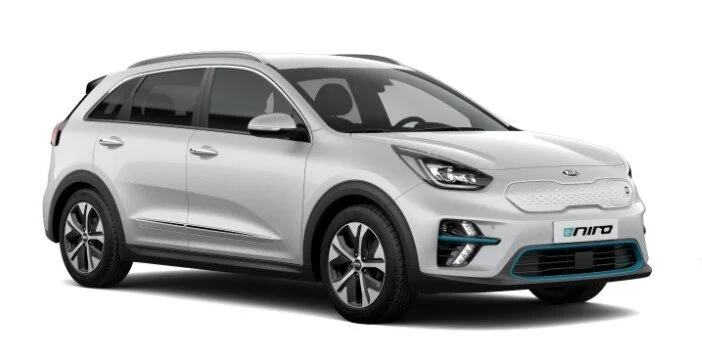

Six colours will be available at launch; Clear White, Snow White Pearl, Aurora Black Pearl, Silky Silver, Runway Red and Yacht Blue. All but Clear White will attract a premium paint surcharge of $520.
Kia will also offer a hybrid and plug-in hybrid (PHEV) version of the Niro, starting from $39,990 and $46,590 respectively. The PHEV variant includes an 8.9 kWh battery, and achieves a combined-cycle fuel efficiency figure of 1/3 l/100km.
We’ll keep you updated on the Niro EV’s availability and delivery timings when we findout more.


BMW iX electric SUV and i4 Gran Coupe to make North American public debut on June 4
BMW’s all-electric iX Sports Activity Vehicle i4 Gran Coupé Will debut to the media at [SPACE] by BMW, a new brand experience at The Grove in Los Angeles on Tuesday, June 1 in a media event. On June 4, [SPACE] by BMW will open to the public until November 30.

BMW’s iX ‘Sports Activity Vehicle’ at its recent Chinese Debut. Images: BMW
BMW’s all-electric iX Sports Activity Vehicle i4 Gran Coupé will debut to the media at [SPACE] by BMW — a new brand experience at The Grove in Los Angeles — on Tuesday June 1. On June 4, [SPACE] by BMW will open to the public until November 30.
The iX and i4 Gran Coupe will also be available to order from 3:01 p.m. PST / 6:01 p.m. EST on June 1, with deliveries estimated to commence in early 2022.
We’ve covered both global launches previously on EV Brief; The iX SAV in xDrive50 specification produces 370kW (503 PS) and offers a 600km (373 mi) WLTP range, while the iX xDrive40 produces 240kW (326 PS) and offers a 500km (310 mi) range. The performance-oriented i4 Gran Coupe will make 390 kW (530PS) in the top-level guise, with a range up to 590km (366mi) according to BMW.
[SPACE] by BMW is the brand’s chic take on redefining the customer experience, engaging local artist Spencer Mar Guilbert to collaborate on “the interior design, drawing inspiration from both the natural world and the iconography of street art” according to BMW. The two-story space will feature vehicle displays from BMW, BMW M, BMW i, MINI and BMW Motorrad.
“The debuts of the BMW iX and i4 are only the beginning,” said Uwe Dreher, vice president of marketing, BMW of North America. “We wanted to do something special to introduce these new vehicles, which is why we’ve created a brand platform in one of the most important electric vehicle markets in the world.” Dreher continued: “But [SPACE] by BMW will go beyond just vehicle debuts and displays. We will have a full schedule of programming and events which will create opportunities to engage and connect with consumers.”

The BMW i4 Gran Coupe.

Hyundai Motor Group plans $7.4 billion investment in US manufacturing by 2025
Hyundai Motor Group (HMG), which includes Hyundai Motor Company and Kia Corporation, announced its plan to invest $7.4 billion in the U.S. by 2025 to produce future EVs and enhance its production facilities.
Hyundai’s new petrol-engined Tucson SUV on the production line in the Alabama factory. Image: Hyundai
Hyundai Motor Group (HMG), which includes Hyundai Motor Company and Kia Corporation, announced its plan to invest $7.4 billion in the U.S. by 2025 to produce future EVs and enhance its production facilities.
José Muñoz, Hyundai Motor Company’s Global Chief Operating Officer and President and CEO of Hyundai Motor North America said, “I am excited to make this announcement on behalf of the Hyundai Motor Group. This investment demonstrates our deep commitment to the U.S. market, our dealers and customers. Hyundai will lead the future of mobility in the United States and around the world. Our efforts are proof positive that Hyundai will continue to pursue excellence in our current and future product line-up.”
HMG plans to bring a range of American-made electric vehicles to U.S. consumers from 2022, starting with the Hyundai Ioniq 5 and Kia EV6.
HMG is also working with the U.S. government and other business partners to expand the U.S. hydrogen energy ecosystem. HMG signed an MOU with the U.S. Department of Energy in February 2020 to cooperate in hydrogen fuel cell technology innovation and global expansion. This included the installation of a hydrogen refueling station and providing NEXO SUVs.
HMG will also launch a subsidiary in Washington, D.C. to spearhead the Group’s Urban Air Mobility (UAM) businesses. The subsidiary will focus on creating an UAM technology ecosystem, and follows the group’s purchase of robotics company Boston Dynamics in 2020.
This vote of confidence in the U.S. by HMG comes after President Biden announced the acceleration of government spending to increase EV uptake, including $174 billion in incentives, tax credits, and rapid chargers.

Hyundai’s Montgomery Alabama factory. Image: Hyundai

Volta Trucks amps up its electrification strategy with new electric trucks and market expansion
UK electric truck startup Volta Trucks has outlined a Road-to-Zero Emissions strategy, crucial to following through with its promise to decarbonise the logistics industry. With many European cities implementing low or zero-emission zones, Volta Trucks intends to be ahead of the curve by rolling out four fully electric commercial vehicles by 2025.

The Volta Zero is targeting London as an initial launch market. Images: Volta Trucks
Four battery-electric Volta Zero vehicles to be offered from 7.5 to 19 tonnes.
Volta Trucks projects volumes to exceed 27,000 units per year by 2025.
Market expansion via Europe-first city-specific strategy, with launch markets, expanded from London and Paris to include wider European cities.
Vehicle manufacturing strategy to locate facilities close to core markets.
Volta Trucks lays out its Road-to-Zero Emissions strategy with a road map to 2025.
UK electric truck startup Volta Trucks has outlined a Road-to-Zero Emissions strategy, crucial to following through with its promise to decarbonise the logistics industry. With many European cities implementing low or zero-emission zones, Volta Trucks intends to be ahead of the curve by rolling out four fully electric commercial vehicles by 2025.
Announcing the company’s Road-to-Zero Emissions strategy, Chief Executive Officer of Volta Trucks, Essa Al-Saleh, said:
"We have seen huge success since launching the 16-tonne Volta Zero in September 2020. We have significant tail winds with zero emission large commercial vehicles, thanks to forthcoming legislation changes that are driving demand, as well as many customers with uncompromising sustainability agendas wanting to purchase the most environmentally focused vehicles for their fleets. This has created a very strong order book that encourages us to rapidly accelerate our plans.
Volta Trucks will introduce its brand with the 16-tonne Volta Zero, expected to commence production late in 2021, followed by 19-tonne and 12-tonne variants in 2023. According to Volta, the most affordable of the range, a 7.5-tonne model, is currently in the early design development phase and will enter production in late-2024.

Volta Trucks plans to revolutionise logistics fleets with the Zero.
Volta Trucks will adopt a network manufacturing strategy, planning a number of assembly facilities distributed across its key markets with a view to minimising unnecessary transportation and cost. Volta Trucks is currently engaged in the ‘expressions of interest’ phase of the repurposing of Nissan’s former factory in Barcelona. Ultimately, Volta Trucks is considering a number of additional manufacturing locations across Europe, North America and Asia, to be able to achieve a significant volume ramp up from launch.
Volta Trucks announced last year a large purchase of 1,000 full-electric large commercial vehicles by Petit Forestier, Europe’s largest refrigerated commercial rental fleet. The company holds over $260 million USD in orders as of January 2021.
The company also plans to revolutionise commercial logistics fleets, by offering a Truck as a Service ("TaaS") option for fleet managers to accelerate the electrification of their fleets, while paying a single, monthly fee for a vehicle inclusive of servicing, insurance and maintenance.
![Australia's Nexport enters deal with Splend to supply 3000 BYD electric vehicles from 2022 [updated]](https://images.squarespace-cdn.com/content/v1/5237a580e4b09510ca448d5e/1621028323693-Z1IV5T7BJ8ZAS5HOYK7M/2021-BYD-Han-25.jpg)
Australia's Nexport enters deal with Splend to supply 3000 BYD electric vehicles from 2022 [updated]
Following the signing of an historic distribution agreement to allow Nexport to sell right-hand-drive BYD vehicles globally, Nexport has announced its own historic deal to provide 3000 BYD electric vehicles to ride-share leasing business Splend
The BYD Han will form part of Nexport’s Australian line-up in 2022. Images: BYD
[updated] Speaking with Luke Todd, CEO of Nexport and TrueGreen this afternoon, he confirmed to EV Brief that of the 3,000 BYD units in the MOU, 2,000 would be making their way to Australia. This is a significant figure, given around 5,000 battery electric vehicles were sold in Australia in 2020. He also confirmed on-demand drivers would be trained and educated in the BYD model range to provide demonstration drives to potential customers.
We're hoping to speak with Todd this week on the podcast, covering all things BYD.
Following the signing of a historic distribution agreement to allow Nexport to sell right-hand-drive BYD vehicles globally, Nexport has announced its own historic deal — a Memorandum of Understanding (MOU) with Splend — to purchase 3,000 BYD electric vehicles.
We hadn’t heard of Splend until this media release hit our inbox, but the Australian and United Kingdom-based company provides flexible vehicle subscription and ownership plans specifically for rideshare and delivery drivers on platforms such as Uber, DiDi and AmazonFlex. Splend provides rental or rent-to-own plans for drivers, inclusive of servicing and maintenence, roadside assistance and driver training.
The MOU between Nexport and Splend will see the 3,000 BYD vehicles delivered across the UK and Australia from early 2022; in addition, it also includes a deal that will see Splend provide demonstrator vehicles for new BYD buyers, as part of Nexports direct to consumer sales model through EV Direct.
As commuters are slow to return to public transport in COVID-19 affected areas, demand for rideshare services across the globe is increasing, and the electrification of these trips is key to reducing emissions in our cities. reducing costs and improving profits and reliability for drivers.
Splend is already advertising that they will be offering electric vehicle options soon for drivers, and Uber will be reducing their commission by 50% for every EV ride until 30 June 2022.
At the time of publishing, we don’t have a figure on the proportion of units allocated to Australia and the UK, but will update this article with a comment from Nexport when we can.
Source: Nexport

Mercedes-Benz EQS sedan enters series production ahead of summer 2021 launch
The Mercedes-Benz EQS has entered series production at the company’s Factory 56 in Sindelfingen, Germany, alongside Mercedes-Benz S-Class and Mercedes-Maybach models.
Mercedes-Benz board members and executives celebrating the start of EQS series production. Image: Daimler
The Mercedes-Benz EQS has entered series production at the company’s Factory 56 in Sindelfingen, Germany, alongside Mercedes-Benz S-Class and Mercedes-Maybach models. The production facility is the result of over 730 million Euros invested, as Mercedes-Benz looks to rolling out its electrification strategy, and reducing its environmental footprint.
Factory 56 will be completely CO₂-neutral, thanks in part to a rooftop photovoltaic system and energy storage system based on reused vehicle batteries. Mercedes-Benz plans to use Factory 56 as an environmentally friendly manufacturing blueprint to transfer to its other vehicle plants worldwide.
Mercedes-Benz claims to have reached new levels of efficiency in the assembly process, due to high levels of digitisation and an MO360 digital ecosystem that focuses on providing the best possible support to its 1,500+ workers at Factory 56.
According to Michael Bauer, Site Manager and Head of Production of Mercedes-Benz Sindelfingen Plant, "With the EQS in our portfolio, we are once again proving the future viability of the Sindelfingen site: Here tradition is combined with a new understanding of innovation and sustainability. Thanks to our highly competent team, we have successfully completed the start of production of the EQS at the Mercedes-Benz Sindelfingen plant."
The EQS is set for a summer 2021 launch in Europe and North America, with other markets to follow late in 2021-22. Read more on the EQS in our launch preview.

Factory 56 at the Mercedes-Benz Sindelfingen plant. Image: Daimler.

Hyundai confirms mid- to long-term EV strategy, highlights future model line-up
Hyundai Motor Company recently outlined their Mid-to long-term EV Strategy alongside announcing the company’s first-quarter business results, in a presentation to investors and analysts.
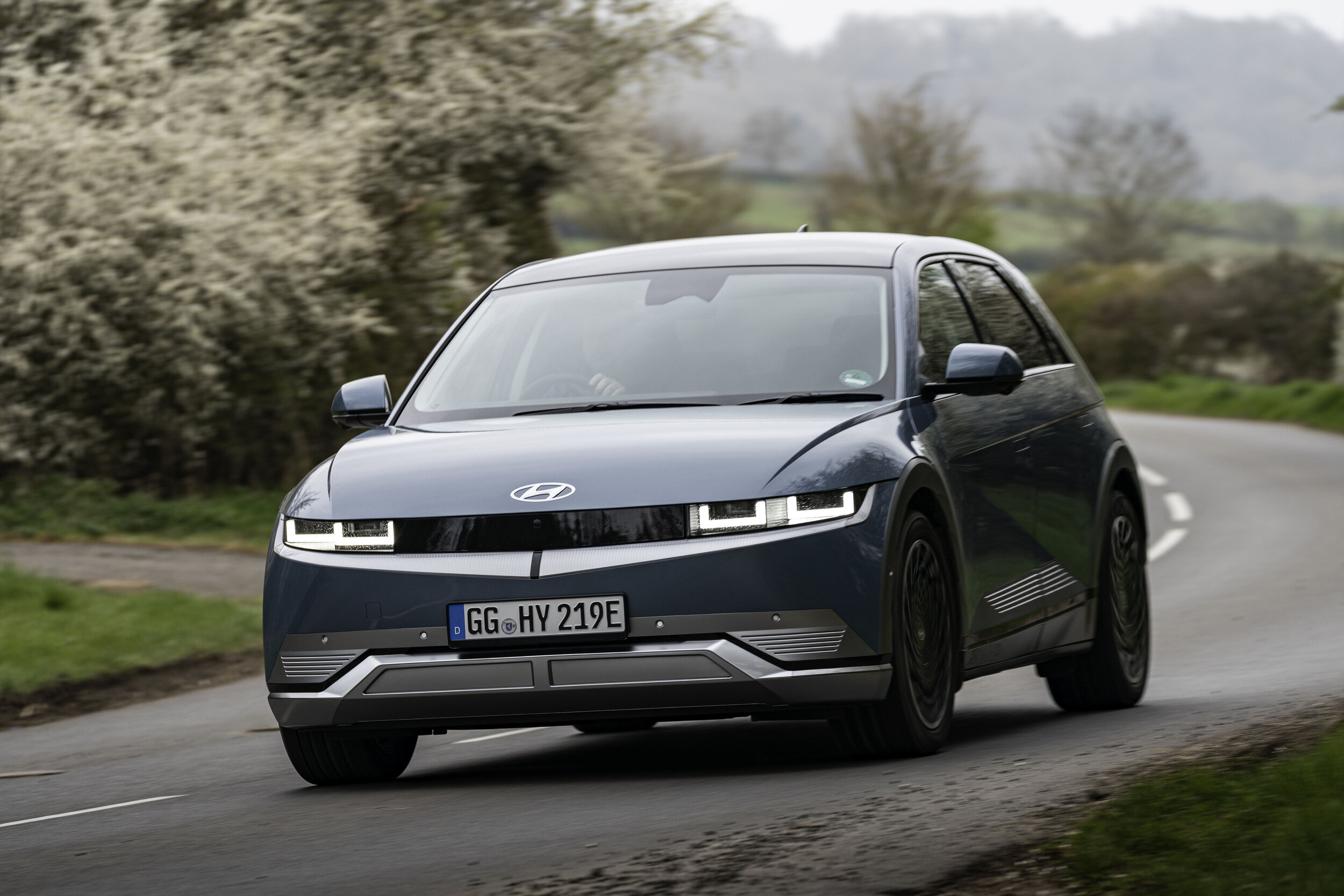
The IONIQ 5 is Hyundai’s first dedicated EV. Image: Hyundai UK
12+ models based on E-GMP platform across Genesis and Hyundai brands by 2025;
160,000 sales units by 2021, 560,000 sales units by 2025;
IONIQ 6 to launch in 2022 along with Genesis’s first dedicated EV
Plans to strengthen Hyundai’s core EV competitiveness through driving range improvements, V2X, fast-charging;
Enhanced product value through optimising cost and performance of batteries and motors;
Plans to secure market leadership in emerging markets such as Indonesia
Hyundai Motor Company recently outlined their Mid-to long-term EV Strategy alongside announcing the company’s first-quarter business results in a presentation to investors and analysts. We break down some of the key points:
Global EV Demand Outlook
Hyundai looks at General Motors and Volkswagen as key competitors in the global EV market, and sees analysts’ demand outlooks ranging from 6.1 to 16 million sales units by 2025. 2020 saw 3.24 million sales globally, up 43 percent on 2019 sales, so the real 2025 figure is likely to fall somewhere in the middle of this range.
Global OEMs are targeting 5 to 8 million EV sales units by 2022, and 10.25 to 18 million sales units by 2025. General Motors plans 30 electrified models by 2025, as it rolls out new models utilising its Ultium pouch-style battery — a joint venture project with LG Chem — underpinned by its modular electric architecture.
Volkswagen is looking to Europe and China for EV growth, targeting 70 percent of its model mix to be electrified by 2030 in both markets.

Hyundai’s take on global EV demand. Images: Hyundai Motor Company
2. Hyundai’s Electrification Strategy
From a base of 100,000 sales units in 2020 spread across four models, Hyundai is looking to achieve 5x growth by 2025 to 560,000 sales units across 12 models. These will likely be a combination of fully electric and plug-in hybrid.
Hyundai’s new model offensive starts with the upcoming IONIQ 5, and the company is aiming to capture an early majority of buyers through the key brand concepts of advanced technology, and a new user experience.
The IONIQ range will expand in 2022, with the release of the IONIQ 6 sedan which will take design inspiration from the Prophecy Concept.
The Genesis luxury brand will play a key role in achieving Hyundai Motor Company’s EV sales ambitions. Genesis has worked hard over the last 2 years to build brand awareness and emphasise its focus on design and advanced technology through its petrol and diesel-based vehicles, but the brand is getting ready to present its Electrified G80 later in 2021, followed by its first dedicated EV in either late 2021 or early 2022 according to the below timeline.

Hyundai plans to grow its EV lineup to 12 models by 2025.
3. Building on USP’s to strengthen core EV competitiveness
Hyundai understands that while the EV market is set to grow considerably this decade, competition from other OEMs will also increase. Chinese EV manufacturers are eyeing the profitable luxury EV market and can compete with Hyundai or Tesla on software and technology. Hyundai will seek to strengthen its core competitiveness from what it sees as its three core USPs; Driving range, Charging time, and vehicle-to-everything (V2X) technology.
Hyundai flags 2023 as the date for its fourth generation of battery systems to emerge, and it sees 2027 as the time to prepare for the mass production of solid-state battery technology. The company also looks to lead in high-speed ultra-rapid charging, rolling out its E-Pit charging stations across South Korea.
Hyundai has led in V2X technology, and the IONIQ 5 is the first production car that can power domestic appliances via the charging port, or that can be optioned with a household power socket in the vehicle’s interior. The IONIQ 5 also offers Vehicle to Home and Vehicle to Vehicle power, allowing customers to charge another EV, or power items in a home should a blackout occur.

Range, Charging Time and flexible power are hallmarks of Hyundai’s core USPs.
4. EV Competency Enhancement Strategy
Hyundai understands that to prepare for the predicted uptick in BEV sales units, it has to secure the competitiveness of key components, and enhance the value of its products.
Firstly, the company is looking to maximize the benefits of commonization across models; it has done this with the E-GMP electric architecture and plans to standardise cell/module design, taking into account a future expanded model line-up. Hyundai also recognises the importance of reliable charging for consumers, in standardising EV charging quality and providing reliable high-speed charging options when customers are away from home.

Hyundai’s IONIQ 5. Image: Hyundai UK
All this investment needs some serious pay-offs, and Hyundai — like most auto manufacturers — spends a lot of time formulating go-to-market strategies that can respond to changing trends in demand growth and shifting government policy. Europe and China have been strong markets for EV manufacturers since announcing strict emissions regulations and net-zero targets, however, these markets are crowded, and in the case of China, full of domestic players.
As the slide below outlines, Hyundai is looking to nations without rapid charging networks or even reliable electricity grids as an opportunity to secure market leadership in electric vehicle sales. India and Indonesia both have huge populations and a rapidly growing middle class with aspirations for vehicle ownership.
Electric vehicle sales account for only 0.2 percent of the market in India, and in Indonesia, a key Association of South East Asian Nations (ASEAN) region for automotive sales volume, just 29 (!) electric passenger cars were sold in 2019. Both countries see that the electrification of passenger vehicles, trucks, and bikes has real benefits in terms of reducing pollution and emissions, and are beginning to draft policy frameworks to set up charging networks, and provision incentives for consumers looking to purchase an EV. Hyundai is looking to position itself early on as an aspirational, ‘clean’ brand to consumers in these countries, and optimise the development, component supply chain and local partnerships to capture market share.

Hyundai looks to emerging markets in South East Asia for growth.

Subaru announces the all electric Solterra SUV, on sale from 2022 in the Northern Hemisphere
Subaru’s planned fully-electric SUV now has a name — Solterra — and it is based on a platform co-developed with Toyota. Subaru names the architecture the e-Subaru Global Platform, whereas over in Toyota City, it’s known as the e-TNGA platform and underpins the BZ4X Concept.
Subaru’s Solterra will be available in the Northern Hemisphere in 2022. Images: Subaru USA

Subaru’s all-electric SUV will be named Solterra.
Subaru’s planned fully-electric SUV now has a name — Solterra — and it is based on a platform co-developed with Toyota. Subaru names the architecture the e-Subaru Global Platform, whereas over in Toyota City, it’s known as the e-TNGA platform and underpins the BZ4X Concept.
We know little of the technical specifications at this stage (much like the BZ4X), however Subaru and Toyota have confirmed both vehicles will be fitted with all wheel drive as standard.
The name Solterra was born from the latin words for “Sun” and “Earth” to represent Subaru’s commitment to “delivering traditional SUV capabilities in an environmentally responsible package”. The company has yet to comment on whether this means that the manufacturing process is carbon neutral, or that the car contains recycled/planet-friendly components.
Subaru promises to increase electrified model range
This is the first in a series of battery-electric models from the automaker, as Subaru targets an electric-ish future with plans for the early 2030s to “apply electrification technologies to all Subaru vehicles sold worldwide”. According to the fine print accompanying this statement, Subaru is referring to fully electric as well as petrol hybrid technologies.
Let’s hope the Solterra also represents a new design direction for the company; the last few years have — in our opinion — shown a decline in Subaru’s design direction, with a number of derivative, unremarkable vehicles coming out of their design studio. Hyundai has certainly laid out a challenge with the bold Ioniq 5, and Audi’s Q4 brings a sharp, contemporary style to the traditional SUV silhouette.
The Solterra is scheduled to go on sale in Northern Hemisphere markets initially, reaching Canada, the US, China, Japan and Europe sometime in 2022. The Driven has confirmed that Subaru Australia has no plans to release the Solterra in the short term.
Source: Subaru USA

Ford to reveal all electric F-150 pickup truck on May 19 - updated with Livestream link
You know time are a-changin’ when the best-selling vehicle in the United States ditches its internal combustion engine.
The F-150 Lightning will be revealed May 19 at Ford World Headquarters in Dearborn and live-streamed for millions to watch, and will also be presented at 18 key locations for the brand including Times Square in New York City and Las Vegas Boulevard, otherwise known as ‘Las Vegas Strip’.

Whatever it is, the way you tell your story online can make all the difference.
You know time are a-changin’ when the best-selling vehicle in the United States ditches its internal combustion engine.
The F-150 Lightning will be revealed on May 19 at Ford World Headquarters in Dearborn Michigan via live-stream on YouTube, and will also be presented at 18 key locations for the brand including Times Square in New York City and Las Vegas Boulevard, otherwise known as ‘Las Vegas Strip’.
Ford President and CEO Jim Farley said “Every so often, a new vehicle comes along that disrupts the status quo and changes the game … Model T, Mustang, Prius, Model 3. Now comes the F-150 Lightning. America’s favorite vehicle for nearly half a century is going digital and fully electric. F-150 Lightning can power your home during an outage; it’s even quicker than the original F-150 Lightning performance truck, and it will constantly improve through over-the-air updates.”
Americans love their pickup trucks, and Ford clearly doesn’t want to be left behind the competition, with General Motors planning an electric Chevrolet Silverado, Rivian moving swiftly on the development of their R1T, and Tesla hoping to start production of its Cybertruck this year.
The F-150 Electric will be manufactured at the new Rouge Electric Vehicle Center in Dearborn, Michigan.
Source: Ford Media
Chinese Automaker NIO plans to sell electric vehicles in Europe from 2022: First stop Norway
Chinese premium electric vehicle manufacturer NIO has announced that it is rolling out the brand to European customers, starting with Norway. From 2022, Norwegian customers will have access to NIO’s high-speed Supercharger network, the NIO Power Swap technology and NIO House incorporating the brand experience with servicing facilities.

NIO announces expansion into Norway with ES8 SUV
In a smooth Silicon Valley-esque online launch, Chinese premium electric vehicle manufacturer NIO has announced that it is rolling out the brand to European customers, starting with Norway. From 2022, Norwegian customers will have access to NIO’s high-speed Supercharger network, the NIO Power Swap technology and NIO House incorporating the brand experience with servicing facilities.
The flagship ES8 SUV will be the first vehicle available to Norwegian customers, with deliveries commencing in September this year. Offering a WLTP range of 500km from its 100 kWh battery, the full-size SUV sports dual motors, with 405 kW (540 PS) and 725 Nm (535 lb ft). Orders open for the ES8 in July 2021.

A concept rendering of NIO’s planned European service centers. Image: NIO
NIO’s ET7 sedan. Image: NIO
NIO House and Battery Charging
NIO has commenced construction on its ‘NIO House’, dubbed the meeting place for NIO users. NIO has already hired its core team of local experts, and the 2000 square metre NIO House in the centre of Oslo is designed as a brand showcase and service centre. NIO plans four additional facilities in 2022, in Bergen, Stavanger, Trondheim and Kristansand.
In addition, NIO intends to bring its Power Swap technology to Europe, which enables vehicle batteries to be exchanged at automated facilities within three minutes. The company claims four battery swap stations will be operational before the close of 2021. It’s unclear if NIO will introduce its Battery as a Service plan to European customers; currently, owners in China are able to pay a reduced upfront cost for their vehicle, but leasing the battery as a separate package.
NIO will also be rolling out its own Supercharger network at busy sites along popular routes, and will bring an AC home charging solution to market for European customers in 2022.
2022 will bring the NIO to five additional European markets, and will also see the launch of the ET7 sedan later in the year.
Watch the replay of the press conference below.

Mazda MX-30 Electric now available for pre-order in Australia for $65,490
If you’re after a fully electric vehicle with less space, less range, and fewer kilowatts than a Tesla Model 3 SR+ that costs more Money, the Mazda MX-30 Electric might be the vehicle for you. Mazda has opted for a small 35.5 kWh battery pack for the MX-30, with a 200 kilometre (125 mile) WLTP range. Mazda claims the impetus behind this decision was to provide a balance between driving range, which gives customers peace of mind, and CO2 emissions from an LCA (Life-Cycle Assessment) perspective.
Mazda’s MX-30 Electric is an urban BEV. Images: Mazda Australia
If you’re after a fully electric vehicle with less space, less range, and fewer kilowatts than a Tesla Model 3 SR+ that costs more Money, the Mazda MX-30 Electric might be the vehicle for you.
Ok, that’s a bit harsh (though true), so let’s back up a bit. Mazda has long resisted electrification while other mass-market automakers from South East Asia like Hyundai, Mitsubishi, and Toyota have embraced zero-emissions drivetrains (to varying degrees).
Mazda has opted for a small 35.5 kWh battery pack for the MX-30, with a 200 kilometre (125 mile) WLTP range. Mazda claims the impetus behind this decision was to provide a balance between driving range, which gives customers peace of mind, and CO2 emissions from an LCA (Life-Cycle Assessment) perspective.
A smaller battery is obviously better for the environment while keeping a vehicle’s weight down and theoretically minimising cost. We certainly believe that there will be a place for affordable, low-range EVs that are designed and used exclusively for urban commuting, but we can’t help but feel Mazda will have some stiff competition for the MX-30 Electric.

Rear doors are hidden by the low roofline and handle-less body panels.
So what does $65,490 get you? There’s an AC synchronous electric motor with 107 kW (145 PS) and 271 Nm (200 lb-ft), 50 kW DC charging with a 20-80 percent charge taking a claimed 36 minutes, and a 355 volt electrical architecture. 0-100 km/h (0-62 mph) takes 9.7 seconds. The MX-30 is lighter than some other small BEV crossovers but weighs in at 1,720 kg (3,790 pounds). Hyundai’s larger Kona electric is 1,685 kg (3,714 lb)
The interior contains many recycled materials, such as breathable fabrics from recycled plastic bottles, and cork fascia. Mazda’s usual refined, minimalistic design language is present in the interior, and the rear-hinged rear door is a nice touch, but the back seats appear to be a cramped place for anyone but small children.
The MX-30 will feature a solid standard equipment list in Australia, including:
Adaptive LED Headlights (ALH)
8.8-inch widescreen colour display (Mazda Connect)
Apple® CarPlay and Android™ Auto
Driver’s seat with 10-way power adjustment (including lumbar adjustment) and 2-position memory
Heated front seats
Advanced keyless entry
Advanced keyless push-button start
7-inch TFT LCD multi-information meter display
Glass sunroof with power tilt and slide
Blind Spot Monitoring (BSM)
Forward Obstruction Warning (FOW)
Front Cross Traffic Alert (FCTA)
Hill Launch Assist (HLA)
Lane Departure Warning (LDW)
Lane-keep Assist System (LAS)
Traffic Sign Recognition (TSR)

Mazda has used recycled plastics and cork in the minimalist cockpit.
Mazda’s approach of a small battery in a small crossover may be environmentally sound, but will it succeed in the Australian market? Tesla’s Model 3 SR+ starts at $62,900 in Australia, Hyundai’s Kona electric is available from $62,000, and Mini’s Electric — the only vehicle in Australia with a comparable range figure to the Mazda’s — starts from $54,800.
We’re looking forward to driving the MX-30 Electric to see if it does indeed make sense as an urban EV. The MX-30 Electric is available to pre-order from Mazda Australia now, with customer deliveries to commence in August 2021.

Chinese automaker NIO plans NeoPark, an EV Industry Park in Hefei with $7.7 billion US initial investment
NIO’s founder, chairman and CEO William Li announced plans this week for a new smart electric vehicle industry park in conjunction with the Hefei municipal government at Xinquao, Hefei, Anhui province, about 5 hours west of Shanghai.

A concept rendering of NeoPark in Hefei, Anhui. Image: NIO
Hefei lies about 5 hours drive from Shanghai. Image: Google Maps
NIO’s founder, chairman and CEO William Li announced plans this week for a new smart electric vehicle industry park in conjunction with the Hefei municipal government at Xinquao, Hefei, Anhui province, about 5 hours west of Shanghai.
In a ceremony with Chinese government officials, NIO announced that it will be the first major manufacturer to be based within this world-class EV industry cluster, designed as a mega campus to house everything the EV manufacturing industry needs. The automaker has also committed 50 billion RMB ($7.7 billion US) to the initial stages of planning and construction.
NeoPark will be a hub for research and development, design, autonomy as well as parts and components manufacturing, and the concept allows for hundreds of key supporting enterprises to be able to function as an industry cluster within the park.
At 16,950 acres (over 11 square kilometers), the campus of NeoPark will contain manufacturing areas, research and development areas, living space, and an eco-park. It’s estimated that over 50,000 workers will be able to live/stay on campus at any one time, and Hefei plans to support the industry by providing policy support and funding, which, in turn, should attract more EV chain businesses and talent.
A NIO showroom within NeoPark rendered for the presentation.
NeoPark is launch before Chinese media.
Hefei will increase its support for the smart electric vehicle industry through funding, favourable policy and construction. NIO will be heavily involved in the long-term development planning of the park, and will introduce more EV chain businesses through establishing an R&D, corporate and manufacturing presence there.
NeoPark claims green credentials too, though the media event didn’t highlight any specifics at this stage.
NeoPark has the potential to realise an annual production capacity of 1 million vehicles and 100 GWh of battery storage according to NIO, and the campus gross yearly output could reach RMB 500 billion ($77.23 billion US).

Nio executives at the launch of NeoPark.

Electrify America Opens its 600th EV Charging Station in the United States
It’s only taken three years for Electrify America to roll out 600 EV ultra-fast charging sites across the continental United States. That’s nearly 2,600 individual DC fast chargers, with Hawaii, South Dakota, Wyoming and Vermont to receive ultra-fast charging sites by early 2022. This follows the completion of two cross-continental routes completed late in 2020, from Jacksonville, FL to San Diego, CA via I-10 and I-8, and from Washington DC to Los Angeles, CA.

Electrify America charging site with solar canopy in Baker, California.
It’s only taken three years for Electrify America to roll out 600 EV ultra-fast charging sites across the continental United States. That’s nearly 2,600 individual DC fast chargers, with Hawaii, South Dakota, Wyoming and Vermont to receive ultra-fast charging sites by early 2022. This follows the completion of two cross-continental routes completed late in 2020, from Jacksonville, FL to San Diego, CA via I-10 and I-8, and from Washington DC to Los Angeles, CA.

Electrify America’s cross-continental routes. Image: Electrify America
“With our rapid station deployment, we are on track to have 800 charging stations with about 3,500 chargers open or under development by the end of this year - delivering on our commitment to make EV driving easier and more accessible,” said Giovanni Palazzo, president and chief executive officer, Electrify America. “We’re proud to be on the forefront of expanding the nation’s EV charging infrastructure and are excited to see our continued growth, as we help meet EV demand and climate priorities set by the Administration.”
Electrify America is also continuing its rollout in states with a smaller population of EV drivers — and greater distances between metropolitan areas — such as Minnesota, Montana, and New Hampshire.
It’s network consists of 150kW DC chargers, which can add about 7.5 miles (12 kilometres) of battery range per minute for capable vehicles, while highway locations feature 150kW and 350kW chargers, which can add an estimated 23 miles (37 kilometres) of battery range per minute for capable vehicles.
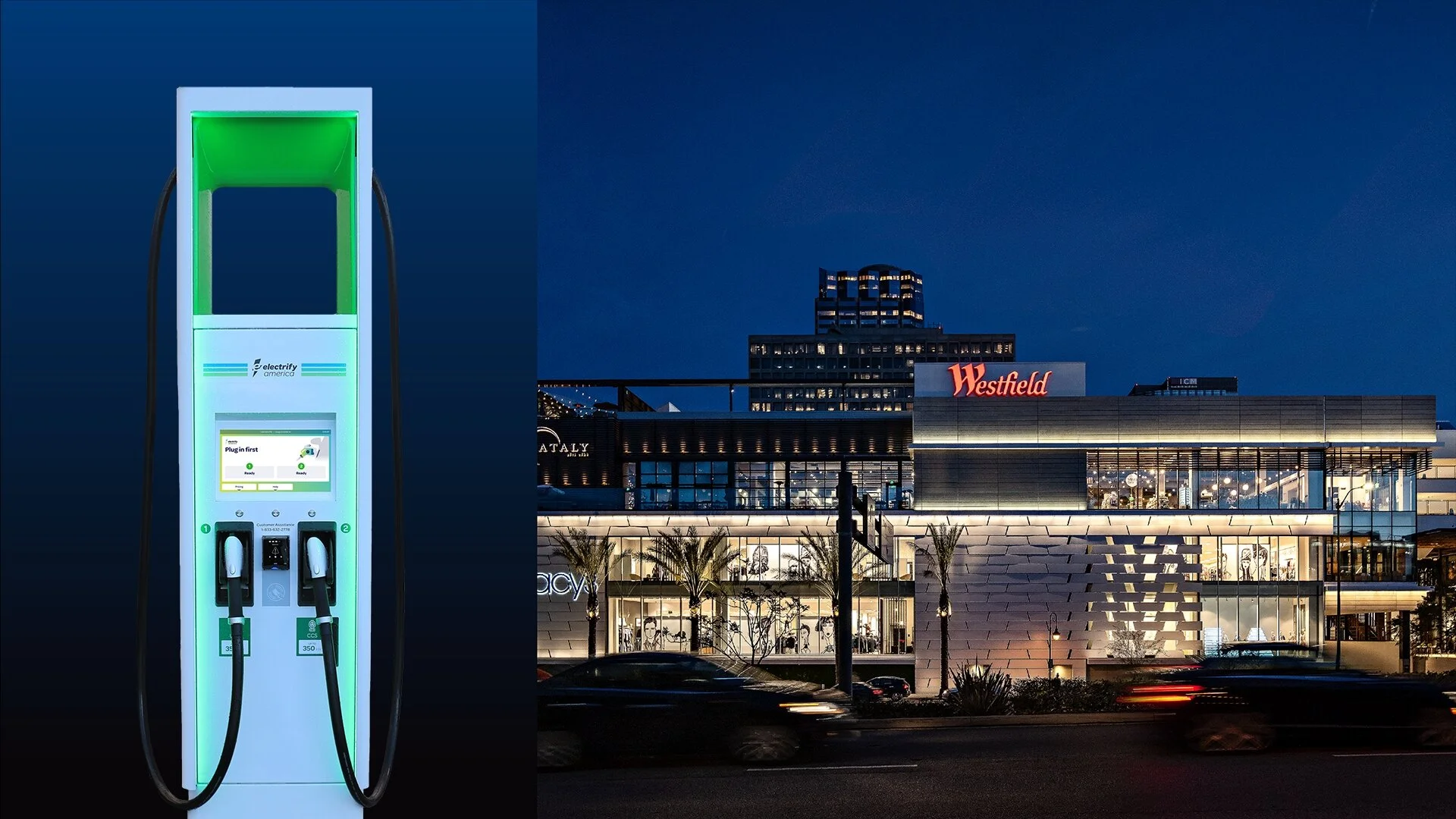
The network isn’t perfect however, with a number of YouTubers and EV drivers experiencing multiple issues with charging on the network, from software to hardware, on vehicles such as Ford’s Mustang Mach-E, and Volkswagen’s ID.4. This is particularly ironic given Volkswagen’s involvement with the rollout of the Electrify America network. Charging station reliability is even more important than charging station ubiquity and and speed in our opinion, and is crucial to increasing the uptake of battery electric vehicles, and providing peace of mind to all current and prospective EV drivers.

Nissan Leaf e+ arrives in Australia with 62 kWh battery, 160kW and 340Nm from $60,490
Nissan’s Leaf has been on sale since 2010, and has sold over 500,000 vehicles across two generations. Nissan Australia has finally welcomed the Leaf e+ to our shores, and it offers a respectable 62 kWh battery size with 385 kilometres (239 miles) WLTP range, up from the regular Leaf’s 40 kWh battery.

Nissan’s Leaf e+. Images: Nissan Australia
Nissan’s Leaf has been on sale since 2010, and has sold over 500,000 vehicles across two generations. Nissan Australia has finally welcomed the Leaf e+ to our shores, and it offers a respectable 62 kWh battery size with 385 kilometres (239 miles) WLTP range, up from the regular Leaf’s 40 kWh battery.
Such is the popularity of the Leaf, some Australians couldn’t wait for Nissan to officially offer the Leaf e+ variant and chose to import their own from Japan.
Nissan states that the Leaf e+ produces a “thrilling” 160kW and 340Nm, achieving a 0-100km/h (0-62 mph) time of 6.9 seconds. According to Nissan Australia Managing Director, Stephen Lester, “The Nissan LEAF is one the world’s most popular electric vehicle, the new Nissan LEAF e+ will only further that appeal by delivering more of what our customers love about their EV,”
“With more power, more range and more performance, as well as full bi-directional charging capability, the e+ is simply more LEAF, and helps ensure there really is an EV to suit every need in Australia.
“From zero-emissions commuting in the city to weekends away and everything in-between, the Nissan LEAF and LEAF e+ have you covered”.
The Leaf’s biggest disadvantage when compared to other EVs has been its range, and the addition of 22 kWh over the standard Leaf is decent. Nissan’s engineers have cleverly increased the battery capacity by improving the cell density with a marginal increase in module size.
Unfortunately, Nissan has stuck with passive cooling for the Leaf’s battery, which is a considerable disadvantage against most of this vehicle’s competition which offer liquid-cooled thermal management systems. Passively cooled batteries are less complex, however they are much more sensitive to ambient temperature, and have a higher annual battery degradation rate against battery EVs with active thermal management.
The Leaf e+ offers 100 kW peak DC charging at 350 volts, providing a 20%-80% charge in 45 minutes. Nissan was also one of the first automakers to offer Vehicle-to-Grid technology, and the Leaf range is capable of bi-directional charging. The automaker is presently engaged in Australian trials to demonstrate the effectiveness of this technology.
Priced from $60,490, $10,500 more than the regular Leaf, the Leaf e+ is priced dangerously close to Tesla’s Model 3 Standard Range Plus at $62,490, and Hyundai’s Kona Electric at $62,000. Both these vehicles offer more range, performance and practicality than the Leaf.

![Volkswagen reveals dual motor all wheel drive ID.4 GTX; more performance EV models to come [Updated]](https://images.squarespace-cdn.com/content/v1/5237a580e4b09510ca448d5e/1619628303699-FOM0QBY4VOX10CRNTQ3K/DB2021AU00216_medium.jpg)
Volkswagen reveals dual motor all wheel drive ID.4 GTX; more performance EV models to come [Updated]
Volkswagen debuts the ID.4 GTX, with the new naming structure to follow the nomenclature GTI, GTD and GTE. The ID.4 GTX offers sportier styling with revised front and rear bumpers, new LED headlights and tail lights, and a sportier interior.

Volkswagen has debuted the new GTX sub-brand, and headline vehicle the ID.4 GTX. Currently livestreaming, we will update this page with more information.
[Updated] GTX will be a sub brand to follow the nomenclature GTI, GTD and GTE. The ID.4 GTX offers sportier styling with revised front and rear bumpers, and new LED headlights and tail lights. 21 inch wheels give the car character, but likely reduce available range.
The ID.4 GTX offers a 77 kWh battery (same as ID.4) and sports two electric motors with up to 220 kW. Volkswagen claims a 0-100 km/h (0-62 mph) time of 6.2 seconds, and a WLTP range of 480 km (290 miles).
There’s a 125 kW DC charging speed, and Volkswagen claims 300km (186 mile) range can be charged in 30 minutes. It’s worth noting that Hyundai’s new Ioniq 5 with 400 and 800 volt architecture offers 10-80 percent charge in 18 minutes, with 100km range restored in 5 minutes.


Volkswagen also previewed a camouflaged ID.5 coupe-SUV and announced that it too would receive the GTX treatment:

![Auto Shanghai 2021: The coolest new models, concepts and more! All the EV news from the show [updated]](https://images.squarespace-cdn.com/content/v1/5237a580e4b09510ca448d5e/1618898830716-MKCC229418Y1MCB6ZUSE/XS21Outdoor52635.jpg)
Auto Shanghai 2021: The coolest new models, concepts and more! All the EV news from the show [updated]
After years of declining patronage at international auto shows, it’s nice to see Auto Shanghai 2021 bustling with concept cars, consumers and of course electric vehicles. We’re putting together a full run down of all new and concept electric vehicles that Auto Shanghai 2021 has to offer; check back here as this page is updated!
After years of declining patronage at international auto shows, it’s nice to see Auto Shanghai 2021 bustling with concept cars, consumers and of course electric vehicles. We’re putting together a full run down of all new and concept electric vehicles that Auto Shanghai 2021 has to offer; check back here as this page is updated!
Audi A6 e-tron concept
Chinese buyers love large, luxurious sedans, so what better venue for Audi to unveil its A6 e-tron concept? With similar dimensions to the current A6/A7 models, the e-tron concept is based on the Premium Platform Electric (PPE) modular architecture that also underpins Porsche’s Taycan and the e-tron GT. Set for a 2023 release, the A6 e-tron concept signals a new design direction for Ingolstadt, with complex, angular surfaces out, and an aerodynamic shape with seamless concave and convex surfaces in. It features a drag coefficient of 0.22cd, and Audi claims up to 100 kWh of battery cells, up to 700 km (434 miles) range and 270 kW peak charging speed thanks to its 800V system architecture.
Audi Q4 e-tron, Audi Q4 Sportback e-tron
The new Audi Q4 range is incredibly important for the brand from Ingolstadt in the Chinese context; sales in China were up 5.4 percent in 2020 to 727,358 units (up from 690,083 in 2019), and globally, SUVs account for 66 percent of the brand’s sales. With two body styles, two battery sizes — 52 kWh and 77 kWh — and DC fast charging up to 125 kW, the Q4 is Volkswagen Group’s premium offering on the MEB platform, sitting alongside the cheaper VW ID.4. The Q4 range will be the first Audi model to roll out of SAIC-VW’s joint venture (JV) manufacturing facility in Shanghai, and pricing is expected to start around RMB 420,000 ($64,640 USD).
Baojun KiWi EV
Based on the Baojun E300 from the SAIC-GM-Wuling joint venture, this microcar is the product of a further corporate tie-up with DJI. The drone company appears to be keen to utilise its expertise to develop hardware, sensors and autonomous software for electric vehicles, following years of development. It’s just a concept for now, but we fully expect SAIC-GM-Wuling to leverage DJI’s technology for future BEVs.
BMW i4 M-Sport
Though we still don’t have the full specifications for BMW’s upcoming i4 sport sedan, the company is teasing us with this M-Sport variant that wears tougher looking front and rear bumpers complete with carbon fibre trim. We’re not sold on this look — especially next to some of the fantastic design coming out of Ingolstadt Germany and Namyang South Korea — but we are sold on the 0-62 mph (0-100km/h) time of 4 seconds, 80 kWh battery with 300 miles (482 kilometres) range and the fact this is a sport sedan rather than a hulking SUV. The i4 range is expected to go on sale worldwide in the second half of 2021.
See more of our BMW i4 coverage and full image gallery here
BMW iX
Speaking of hulking SUVs, here’s BMW’s iX. We understand the importance of this car given the success of BMW’s X5 and X7 models, so it’s great to see BMW emphasising the importance of zero emissions drivetrains. The iX will come in xDrive50 and xDrive40 variants, with 370 kW (503 PS) and 240 kW (326 PS) respectively. The iX range will offer up to 249 miles (400 kilometres) of range, and debut BMW’s new technology toolkit, with enhanced connectivity, digital services, and a new generation i-Drive system. Chinese consumers will find Tencent applications built into the BMW iX, as well as a native WeChat functionality. Read more of our iX coverage here.

BYD’s EA1 Hatchback
BYD EA1
BYD’s newest small car debuted at Auto Shanghai, and signals the future direction of the brand’s compact-class city models. Designed by BYD’s Global Design Director Wolfgang Egger, It features some pleasing design details that mimic VW’s ID.3, while retaining a unique Chinese personality. Based upon the company’s e-Platform 3.0, the EA1 won’t be short of cutting-edge technology, with BYD’s signature blade battery and 800 volt architecture available across the model range. BYD plans a ‘hot’ variant, and in exciting news for Australia, BYD and Australian importer Nexport plan to bring the EA1 down under in late 2021.
Cadillac Lyriq (General Motors)
GM has gone all in on battery electric vehicles, and the luxury brand Cadillac has debuted its full-size electric SUV based on the new Ultium platform. This modular design allows for efficient packaging of electronics, batteries and thermal management, and includes new technologies like a wireless battery management system. There are familiar Cadillac styling cues, with the vertical, slim-line headlights and angular design. The Lyric features a full-length glass roof, 23 inch wheels, and a 33 inch (yes, 33) in car LED display. Cadillac will also debut an in-car active noise cancelling system, aiming to reduce wind noise and tyre hum for passengers. Cadillac has stated that Chinese buyers will be able to order the Lyric in late 2021, for deliveries commencing early next year.
Image: Ford China
Ford Evos
Ford has debuted the EVOS at Auto Shanghai, the first model from the blue oval under a new China 2.0 plan and “Progressive Energy in Strength” design philosophy. According to Ford, the company is focused on “electrification and intelligence, customer-centered products and services and upgraded customer experience”. The EVOS features a 1.1m-wide horizontal screen, a virtual personal assistant (similar to NIO’s Nomi) and is based on the all-new Fully Networked Vehicle E/E architecture, which supports dynamic over-the-air software updates. The Ford EVOS will be built by Changan Ford, sold and serviced through the Ford NDSD distribution network across China.
Image: Ford China
Ford Mustang Mach-E
Ford is bringing the Mustang Mach-E to China, and the first domestically built variant — the Mustang Mach-E GT First Edition — is now available to pre-order. Prices will range from RMB 265,000-379,900 ($40,820-$58,520 USD). Ford says owners will have access to over 160,000 fast chargers in more than 340 cities across the country through an exclusive app, as well as access to NIO’s nationwide fast charging network. The Mustang Mach-E GT first edition will be powered by two electric motors making 358 kW (486 PS) and 860 Nm (634 pound-feet) torque. A less expensive entry model will eventually be introduced, but all Mustang Mach-E’s in China will receive the GT front fascia.
The Genesis Electrified G80. Image: Genesis
Genesis Electrified G80
Genesis’s design language has evolved into something quite striking; it’s not pretty but it is elegant, and has loads of presence. Sort of like a futuristic tech-heavy Bentley to our mind. Utilising Hyundai Motor Corporation’s BEV experience and expertise, the Electrified G80 comes with dual motor all-wheel-drive as standard, and 350 kW rapid charging with 427 kilometres WLTP range. Like the Hyundai Ioniq 5 and Kia EV6, 400 - 800 volt electricals are standard, and vehicle-to-load (V2L) is available for customers. Genesis quotes a 0-100 km/h time of 4.9 seconds for the luxe sedan. Expect more details and a North American launch later in 2021.

Hyundai’s Giugiaro inspired Ioniq 5
Hyundai Ioniq 5
We love the look of this car. It’s 8-bit retro-futurism personified, with the Giorgetto Giugiaro inspired headlights and roofline, to the ‘parametric pixel’ design language. Available with 52 kWh and 72 kWh batteries in rear and all wheel drive, Chinese buyers looking for something different should appreciate the road presence of the Ioniq 5 (it’s bigger than a Tesla Model 3) as well as the interior comfort. Thanks to the company’s new E-GMP platform, the Ioniq 5 is able to push the wheels to the corners of the car, and stretch the wheelbase to 3 metres. We were hands on with the Ioniq 5 last week, and can tell you that that wheelbase provides for an incredibly spacious and relaxing interior.

The Mercedes Benz EQB. Image: Mercedes Benz
Mercedes Benz EQB
The Mercedes Benz battery electric vehicle onslaught is here, with the EQB following the recent EQS and EQA launches. Mercedes would like to you think this EQB is based on its all-new Electric Vehicle Architecture (EVA), it’s actually based on the combustion engined GLB, and it shows. Thankfully, it’s dorky looks should mean plenty of interior space, with seven seats available. Battery capacity is up to 66.5 kWh with 100 kW rapid charging, and there are front and all wheel drive options available in Europe and China. Expect the US and Australia to get all wheel drive only variants.
NIO’s ET7 sedan. Image: NIO
NIO ET7
We really hope NIO brings the ET7 to markets outside China. This rather good looking sports sedan will offer battery sizes of 70, 100 and 150 kWh, dual motor all wheel drive, and a system output of 480 kW (652 PS) and 850 Nm (626 lb ft). NIO has commenced body-in-white production this month, and hopes to have customer ready ET7s landing in Q1 2022. As the first sedan in NIO’s line up, the ET7 is an important car, and is expected to compete with Tesla’s refreshed Model S, as well as offerings from BYD, Mercedes-Benz and Audi. the ET7s party piece is its Aquila Super Sensing system with over 33 high-performance sensing units including one ultralong-range high-resolution LiDAR.
Image: Great Wall Motors
ORA Lightning Cat (Great Wall Motors)
ORA is Great Wall Motors’ all-electric brand, and the Lightning Cat is a kooky-but-fun visual mashup of a VW beetle, Porsche 911 and Panamera and Tesla Model 3. With dual motors and all wheel drive, the Lightning Cat can reach 62 mph (100 km/h) in 3.5 seconds according to Great Wall Motors. Oval headlights, two-tone paint and a glasshouse that resemble the Porsche Panamera’s somehow work, and the interior at least looks quite upscale, with a sporty three spoke steering wheel, retro instruments, a suspended centre control area with additional touchscreen, and orange sports seats.

The Seres SF5. Image: Huawei
Seres SF5
Seres’s entry into the BEV market comes in the form of a jointly-developed SUV with tech giant Huawei. The SF5 dual motor variant features 405kW and 820Nm, as well as a 1.5 litre four cylinder engine which acts as a range extender. According to Chinese market information, the SF5 has an electric-only range of 150 kilometres, but the small battery helps keep the cost of the vehicle down; RMB 216,800 in China ($33,370 USD). As you would expect, seamless integration with Huawei’s smart phones is available through the in car entertainment system, and the SF5 features adaptive cruise control and active steering assistance technology as part of its Level 2 autonomous driving system.

Image: Toyota Motor Corporation
Toyota BZ4X
Toyota has finally been dragged into the BEV sphere, announcing the BZ4X SUV as part of a full-scale electrified model roll-out by 2025. The BZ4X is based on the e-TNGA platform co-developed with Subaru, and features Subaru’s all-wheel drive system. Not a huge amount is known about the drivetrain under this model as it is still officially a concept, but the BZ4X is expected to be built in Japan for western markets, and at the Tianjin FAW Toyota Motor Co factory for the Chinese domestic market. Expect a launch date sometime in 2022.
Volkswagen’s China-only ID.6 X and ID.6 Crozz. Image: Volkswagen
Volkswagen ID.6 X, ID.6 Crozz
The ID.6 range is the first all-electric model designed for a specific market, with popular Chinese apps and the ability to check local air quality levels in the infotainment system. Based on the EV-only MEB platform architecture, this 4,876mm long (192 inches) SUV is longer and wider than the US-only Atlas model. 58 and 77 kWh versions will be available, with 430 km (270 miles) and 580 km (365 miles) NEDC range. Rear and all-wheel-drive versions will be available, but pricing isn’t expected to be finalised until later this year. VW’s rivals in this segment include the NIO ES8, Li Xiang One, and Geely’s Xingyue L.


Xpeng’s new P5 sedan. Image: Xpeng
Wuling Hong Guang Mini EV Convertible (SAIC-GM-Wuling)
Errr… What is this? I hear you ask. Bear with us; this is the coolest little convertible going into production at Auto Shanghai. Based on the Hong Guang Mini EV, The Convertible is a chic city car with 120 km (75 miles) of range from a 9.3 kWh battery, or 170 km (106 miles) of range from a 13.9 kWh battery. Top speed is low — as you would expect — peaking at 100 km/h (62 mph). However it seats four, and is guaranteed to be easy to park at 2,917 mm long. The Convertible should be a good seller for Wuling; the hardtop version sold over 40,000 units in March, to be China’s best selling EV. Keep an eye out for it later in the year.
Xpeng P5
We’ve previously covered the Xpeng P5 launch extensively, and as the Chinese NEV luxury sedan market heats up, the P5 will prove to be an important car for the new automaker. Xpeng will likely beat NIO to market with the first production vehicle to feature a LiDAR-based autonomous driving system, and according to the company, the system works in challenging scenarios such as night and low-light conditions, backlighting, and alternating light and dark illumination in tunnels. The P5 should have a range of around 600km (373 miles) on the Chinese NEDC cycle, and full technical details are expected in the coming months, ahead of a late-2021 launch.

Image: Zhijiang Geely Holding Group
Zeekr 001
In a sea of electric SUVs, it’s hard not to get giddy at the sight of something a bit different. Geely’s new Zeekr brand debuts the production version of the Lynk & Co Zero Concept we saw last year. It’s a big, bold shooting-brake-meets-Panamera wagon based on Geely’s Sustainable Experience Architecture (SEA), and we love it. With 400 kW (543 PS) and 700 Nm (516 lb ft), the Zeekr 001 should hit 100 km/h (62 mph) in 3.8 seconds. It’s set for release later in 2021, and let’s hope it makes it outside China.

Tesla posts record net income, revenue up 73%, record net profit of $438 million
Tesla has had a stellar first quarter of 2021, beating earnings expectations from Wall Street analysts. The automaker posted US$10.389 billion in revenue, up 73 percent YoY from $5.985 billion in Q1 2020, and just behind the figure of $10.744 billion for Q4 2020 as well as non-GAAP earnings per share of $0.93.

Tesla’s Model X and Model S are set for a refresh in 2021. Image: Tesla Motors
Tesla has had a stellar first quarter of 2021, beating earnings expectations from Wall Street analysts. The automaker posted US$10.389 billion in revenue, up 73 percent YoY from $5.985 billion in Q1 2020, and just behind the figure of $10.744 billion for Q4 2020, and the company also announced non-GAAP earnings per share of $0.93.
GAAP earnings are used to standardise financial reporting of large, publicly-traded companies, and non-GAAP earnings constitute items like large asset write-downs, one-time transactions or company restructuring costs.
Tesla reported record net profit of $438 million for the seasonally slow quarter (GAAP), as well as sales of regulatory credits to the tune of $518 million. Operating income came in at $594 million, resulting in a 5.7% net operating profit.
According to the company, quarter-end cash and cash equivalents decreased to $17.1B—still a huge pile of cash—in Q1, “driven mainly by a net cash outflow of $1.2B in cryptocurrency (Bitcoin) purchases, net debt and finance lease repayments of $1.2B, partially offset by free cash flow of $293M.”
Tesla has been growing its vehicle sales to the tune of 100% YoY, and according to Elon Musk, the Model Y SUV is likely to become the best selling vehicle on the planet within the next few years. Tesla investor David Lee has some interesting figures should the automaker manage to achieve 500,000 deliveries a quarter, demonstrating that this could potentially net Tesla $22.5 billion in revenue, and $5.6 billion in gross profit.
Tesla will obviously have a lot of expenses over the next few years; the completion of Gigafactories in Berlin and Texas, scaling up production of its new 4680 cells to deal with the incredible demand for batteries and rolling out more Supercharging sites, service and sales centers and mobile technicians to name a few. We have full confidence in Tesla; partly due to its year over year profit and increasing sales volume, but also due to the untapped potential of its energy business.
Tesla has the ability to make Tesla Energy almost as big as its automotive business in our view. The company deployed 92 MW of solar in Q1, up 163% from 35 MW in Q1 2020. It also deployed 445 mWh of energy storage, up 71% from 260 mWh in Q1 2020.

Tesla’s financial summary for Q1 2021. Source: Tesla

Tesla’s operational summary for Q1 2021.
Source: Tesla Motors

Volkswagen's ID.4 electric crossover named 2021 World Car of the Year
Volkswagen has taken home the largest prize from the annual World Car Awards overnight, with the ID.4 crossover named 2021 World Car of the Year. 93 international journalists from 28 countries make up the World Car Awards jury panel, and the votes were tabulated by KPMG.
Volkswagen has taken home the largest prize from the annual World Car Awards overnight, with the Volkswagen ID.4 crossover named 2021 World Car of the Year. 93 international journalists from 28 countries make up the World Car Awards jury panel, and the votes were tabulated by KPMG.

VW’s ID.4 1st Edition in Honey Yellow
Ralf Brandstätter, CEO Volkswagen Cars stated “We are particularly pleased about our ID.4 being named “World Car of the Year”. Not only because it is one of the most important car awards in the world - but because the jury also honored a great idea and a great team. The first ID. Model for the key markets of Europe, China and the U.S. carries our electric offensive around the world. A convincing car, a great idea - and the “World Car of the Year” award? That goes well together for us!”
This year’s winner was chosen from an initial entry list of 24 vehicles from all over the world, then a short list of three finalists as announced on March 30, 2021. The Top Three in the World finalists for 2021 also included another EV, the Honda e, and the Toyota Yaris.
To be eligible for the World Car of the Year award, vehicles must be produced in volumes of at least 10,000 units/year, must be priced below the luxury-car level in their primary markets, and must be “on-sale” in at least two major markets, on at least two separate continents, between May 1, 2020 and May 1, 2021.
This win should help Volkswagen justify the billions spent on its shift to electro-mobility and assist the company in forgetting the ‘Dieselgate’ era. We’re certainly excited to see more competition in the marketplace, especially in the form of EVs from one of the world’s largest automakers, but Volkswagen still has some issues to iron out if it is to truly achieve mass-market adoption of its zero emissions vehicles.
EV teardown expert Sandy Munro stated that Tesla need not worry about competition from the ID.4 after comprehensively examining VW’s newest EV, and Engineering Explained showed that there are issues with charging the ID.4, even on the DC fast charging network established by Volkswagen, Electrify America.

Toyota reveals first battery EV concept at Auto Shanghai, the BZ4X Concept Crossover
Many in the motoring media thought this day wouldn’t come, but Toyota has finally unveiled its BZ4X Concept crossover, and the Japanese automaker says that it “hopes to begin worldwide sales of the model by the middle of 2022”.

Toyota BZ4X marks start of 15 model BEV rollout by 2025
Many in the motoring media thought this day wouldn’t come, but Toyota has finally unveiled its BZ4X Concept crossover at Auto Shanghai 2021, and the Japanese automaker says that it “hopes to begin worldwide sales of the model by the middle of 2022”.
Taking its ‘BZ’ moniker from the concept of ‘Beyond Zero’ emissions, The BZ4X carries familiar toyota design elements, wrapped in a shape that mimics Kia’s EV6 in its cab-backward squared-off look. Based on the e-TNGA platform co-developed with Subaru, all wheel drive (AWD) variants of the BZ4X will utilise Subaru’s proven AWD technology.
Of course while many people were quick to herald the arrival of the BZ4X Concept as a Hyundai and Kia challenger, Toyota has released very limited information on the car, preferring to wax lyrical about the company’s planned EV rollout over the next decade.
Speaking of, Toyota plans to expand to its model lineup to around 70 electrified vehicles globally by 2025, however this includes non-plug-in hybrids powered by combustion engines. Toyota has labeled its/Lexus’s hybrids as ‘self-charging’ in a jab at BEV owners having to stop to charge; a dishonest description of the technology. Norway has even banned this advertising language, calling it “misleading consumer practice”.

Toyota’s BZ4X Concept looks production ready.

Toyota’s BZ4X Concept
The company plans 15 dedicated BEVs, including seven carrying the bZ (Beyond Zero) brand moniker. In addition, Toyota intends to bring electrification to its pickup truck lineup in the near future, including hybrid and BEV powertrains.
Toyota continues to hedge its bets on vehicle technology, committing to internal combustion, hydrogen fuel cell and battery electric vehicle development.. Toyota Australia vice-president of sales and marketing Sean Hanley stated: “Our approach reiterates Toyota Australia's absolute commitment to reducing its CO2 footprint and the adoption of new technologies across our extensive range of vehicles, whilst recognising the different practical needs of Australian customers and geographies”
We’d have to question Toyota’s approach; with most major global auto manufacturers facing declining sales revenue, increasing operating costs and capital expenditure, and strict emissions controls across China, North America and Europe over the coming decade, many manufacturers such as General Motors, Volkswagen and Volvo are settling on Battery Electric Vehicle technology. It’s unlikely that any one company —even one as big as Toyota — can afford to back three different propulsion technologies in the medium-to-long term.
Toyota BZ4X Gallery:


Mercedes Benz EQS exterior revealed - meet Stuttgart's first EV luxury sedan
The Mercedes Benz EQS is an important vehicle for the Stuttgart automaker. 120 years after the trademark ‘Mercedes’ was registered by Daimler-Motoren-Gesellschaft in 1901, we now have an all-electric sedan that is designed to ensure not only that the company remains the king of luxury motoring, but also the relevance and profitability in a world of strict emissions legislation, and dwindling resources.
2021 Mercedes Benz EQS debuts ‘sensual purity’ design language, 770 km range from 107.8 kwh battery
Mercedes Benz EQS 450+
single permanent magnet synchronous motor, rear wheel drive
245 kW (333 PS) / 568 Nm (418 lb ft), WLTP combined energy consumption 20.4-15.7kWh/100 km, range not stated
90 kWh nickel, manganese cobalt (NMC) modular battery, pouch cell design with 400V architecture, 200 kW DC fast charging
Mercedes Benz EQS 580 4MATIC
front and rear permanent magnet synchronous motors, all wheel drive
385 kW (523 PS) / 855 Nm (630 lb ft), WLTP combined energy consumption 21.8-17.4 kWh/100 km, range up to 770 km (478 miles)
107.8 kWh NMC modular battery, hard case cell design with 400V architecture, 200 kW DC fast charging
The Mercedes Benz EQS is an important vehicle for the Stuttgart automaker. 120 years after the trademark ‘Mercedes’ was registered by Daimler-Motoren-Gesellschaft in 1901, we now have an all-electric sedan that is designed to ensure not only that the company remains the king of luxury motoring, but also the relevance and profitability in a world of strict emissions legislation, and dwindling resources.
We’ve already covered the technical details, interior and Hyperscreen quite recently, so let’s look at what Mercedes-Benz has revealed today.

Exterior Design
It’s nice to finally be able to put a face to the EQS name. Designing such a flagship vehicle must be rather difficult, and on the whole, Gorden Wagener and his team must be congratulated. The EQS is a balance of progressive style and refined, familiar luxury. It’s a vehicle that has to outline the brand’s future direction, while still appealing to the S-Class buyer.
There are some odd angles however; soft, sloping front and rear are a result of function over form no doubt. With a drag coefficient of 0.2 cd, Mercedes Benz claims the EQS is the slipperiest sedan in the world.
Mercedes Benz states that the design philosophy behind the EQS can be defined as ‘Sensual Purity’ and that this is realised through clear, uncomplicated surfaces, curves and surface-emphasising modelling. It’s certainly not a fussy design, but will it appeal to buyers looking for a certain level of aggression and sportiness? Perhaps we’ll have to wait for an AMG version to find out.
The short front end and cab-forward look is almost the antithesis of the long-hooded luxo-barge look we’ve come to expect from this segment over the last few decades. The front end is handsome, if considerably more restrained than the EQS concept car. The black ‘grille’ on the front of the EQS is available with a Mercedes star pattern, if customers choose the AMG Line Exterior or Electric Art Exterior.
Frameless, coupé-like doors and a high, arched beltline draw the eye down the body to the rear of the EQS. Flush doorhandles aid aerodynamics, and provide a clean side profile view. The glasshouse is accentuated with chrome, and a two tone paint scheme is available.
Broad, generous surfaces, reduced join in body panels create an almost seamless transition between glass and bodywork at the rear. The rear tail light assembly is a broad, futuristic swoop of red, accentuating the width and hinting of the power within the EQS. 19-22 inch wheels are available, and the three exterior package inclusions are listed below:


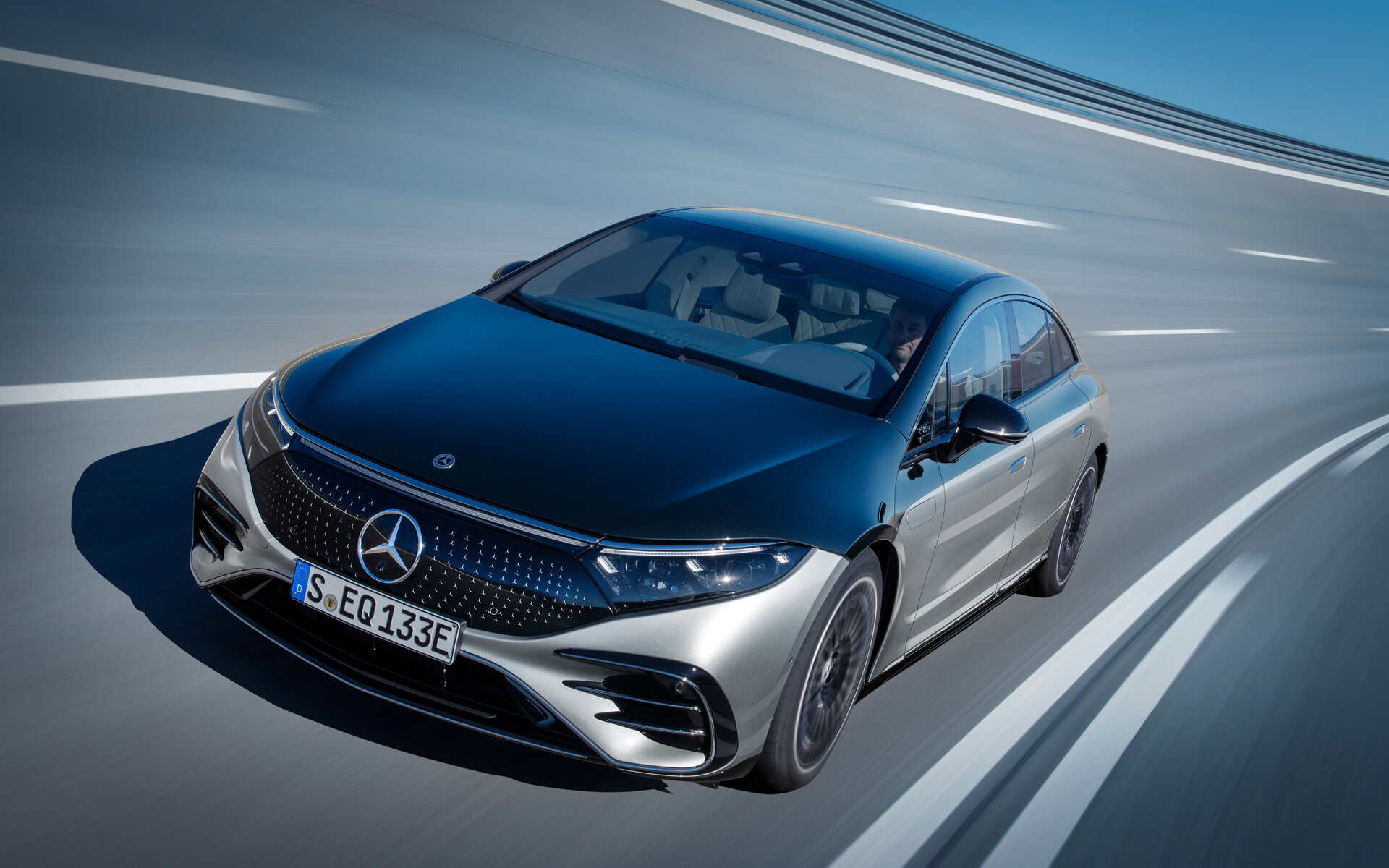
Our favourite view of the EQS sedan
In our eyes, the most attractive angle of the EQS is a slightly raised and offset front three quarter view. The body is made of aluminium to keep weight down, and the front hood (bonnet) is of a clamshell design. Frunk fans will be disappointed to learn there’s no front storage compartment, but there’s ample space in the passenger compartment and rear trunk, with 610 litres of cargo capacity.
At 5.2 metres long with a 3.2 metre wheelbase — 106mm longer than the W223 S-Class — the EQS is a big car. The EQS 450 weighs in at 2480 kg (5467 lb), while the EQS 580 is 2585 kg (5,698 lb).
Mercedes Benz is expected to release an AMG performance variant of the EQS in the future, as well as a cheaper version with a smaller battery capacity. Europe, the UK and North America should see the EQS launch in the second half of 2021, while it’s expected that Mercedes-Benz Australia will bring the EQS down under in December 2021/January 2022.
You can read more of our coverage on the technical aspects of the EQS here, and view more galleries below:
2021 Mercedes Benz EQS exterior gallery




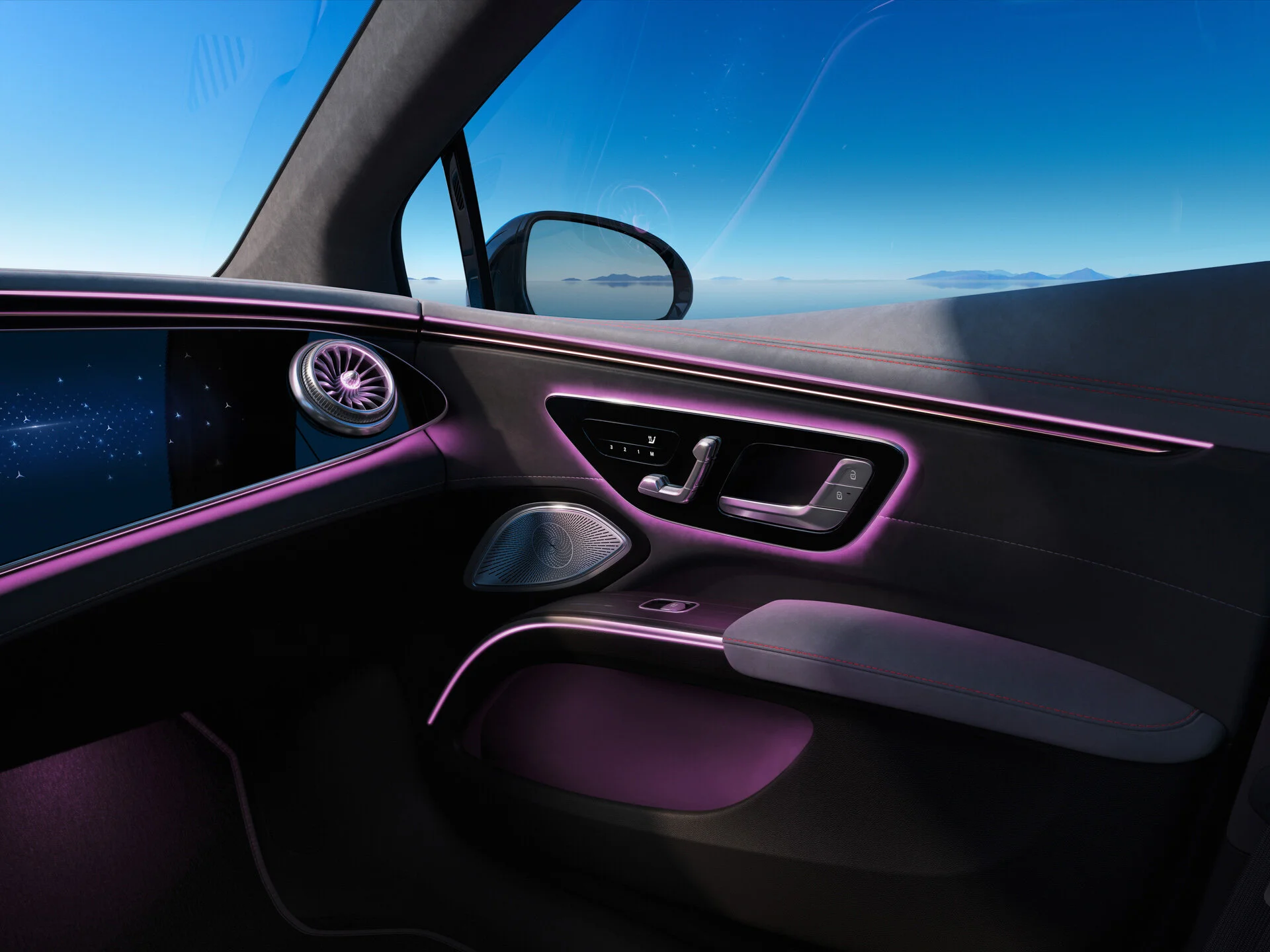
2021 Mercedes Benz EQS interior gallery







Polestar and Deepal expand Australian operations as they seek growth in the local market